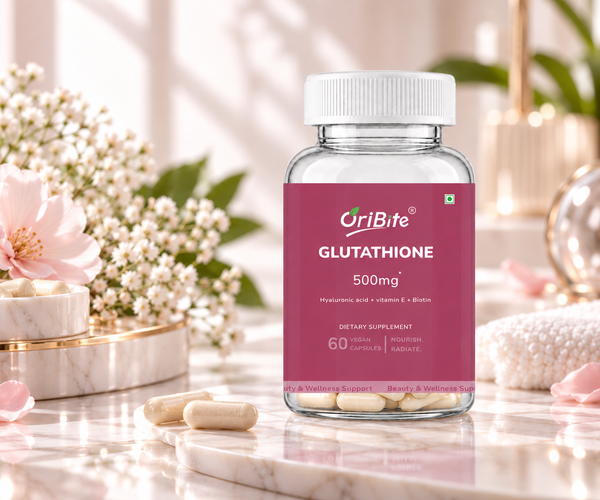
What Is Glutathione? L-Glutathione, GSH & the Skin Science

What Is Glutathione? L-Glutathione, GSH, and the Skin Science Explained
If you've shopped for a glutathione supplement, you've probably run into a confusing mix of terms on the label — glutathione, L-glutathione, GSH, reduced glutathione, oxidized glutathione. They're not all marketing spin; some of these terms describe genuinely different things that affect how the supplement works. This article breaks down what glutathione actually is, what those label terms mean, and how the compound connects to the skin-related science it's most often marketed for.
What Is Glutathione?
Glutathione is a small molecule made from three amino acids — cysteine, glutamine (or glutamic acid), and glycine — produced naturally by nearly every cell in the human body. It's frequently called the body's "master antioxidant" because of its central, coordinating role in neutralizing free radicals and supporting the broader antioxidant network, including helping regenerate other antioxidants like vitamins C and E after they've been used up.
Unlike plant-derived supplement ingredients, glutathione is endogenous — your body already manufactures it continuously as part of normal cellular function. Supplementation is based on the premise of boosting levels beyond what the body produces on its own, or offsetting depletion linked to oxidative stress, certain health conditions, or aging.
What Does "L-Glutathione" Mean?
The "L-" prefix refers to the molecule's specific structural orientation — a chemistry term (L- versus D- isomer) that indicates which form of the molecule is present. L-glutathione is the naturally occurring form found in the human body and in food sources, and it's the form used in essentially all legitimate glutathione supplements. In practice, when you see "L-glutathione" on a label, it's simply specifying the natural, biologically active form of the compound rather than indicating a fundamentally different product from "glutathione" alone — most reputable supplements are using this form regardless of whether the "L-" is explicitly stated.
What Does "GSH" Mean?
GSH is the standard scientific abbreviation for glutathione in its reduced, active form — the form capable of performing its antioxidant function by donating electrons to neutralize free radicals. When glutathione performs this antioxidant reaction, it converts into an oxidized form called GSSG, which the body then recycles back into active GSH using specific enzymes and other nutrients, in an ongoing cycle.
When you see "GSH" referenced in research or on a product label, it's specifically pointing to the active, reduced form — the form that matters most for antioxidant activity. Some supplement marketing emphasizes "GSH" specifically to signal that the product contains the active form rather than an inactive precursor.
Reduced vs. Oxidized Glutathione: Why the Difference Matters
This is one of the more genuinely important distinctions for anyone evaluating a glutathione supplement. Reduced glutathione (GSH) is the biologically active form responsible for antioxidant activity. Oxidized glutathione (GSSG) is the "used up" form, which the body needs to recycle back into GSH before it's active again.
Supplements are generally formulated to deliver reduced glutathione (GSH), since that's the directly active form. This is part of why formulation and stability matter — glutathione can oxidize over time or during digestion, which is a central concern behind the bioavailability questions surrounding standard oral glutathione supplements, and part of why newer delivery forms like liposomal glutathione have been developed specifically to better protect and deliver the reduced, active form.
What About Glutathione Precursors (NAC, Glycine, Glutamine)?
Some products don't contain glutathione directly, but instead contain its building-block amino acids — most commonly N-acetylcysteine (NAC), which supplies cysteine, the amino acid generally considered the rate-limiting ingredient in the body's own glutathione production. The logic behind precursor supplementation is that supplying the raw materials may support the body's natural glutathione synthesis, rather than delivering pre-formed glutathione directly.
This is a meaningfully different approach from direct glutathione supplementation, with its own separate body of research, and it's worth knowing whether a product you're considering contains glutathione itself or a precursor like NAC, since the two aren't interchangeable in terms of studied dosing or expected mechanism.
How Does This Connect to Skin Science?
Glutathione's skin-related research centers on two overlapping ideas. First, as a central antioxidant, it's proposed to help support skin cells against oxidative stress — the kind of cellular damage linked to premature aging, dullness, and uneven tone, caused by UV exposure and other environmental stressors. Second, and more specifically tied to its brightening reputation, some research suggests glutathione may inhibit tyrosinase, an enzyme involved in melanin production, offering a plausible mechanism for its effect on skin pigmentation.
Both of these proposed mechanisms depend on the active, reduced form of glutathione (GSH) actually reaching and being available to skin cells — which loops back to why formulation, absorption, and the reduced-vs-oxidized distinction aren't just chemistry trivia, but genuinely relevant to whether a given product is likely to work as intended.
How to Read a Glutathione Label With This Knowledge
- "L-glutathione" or "glutathione" — generally refers to the same natural, biologically relevant form; not a meaningful difference on its own.
- "Reduced glutathione" or "GSH" — indicates the active form is what's being delivered, which is what you want for antioxidant activity.
- "Liposomal glutathione" — indicates a delivery format designed to improve absorption and protect the compound from breaking down before it's absorbed.
- NAC, glycine, or glutamine listed instead of "glutathione" — indicates a precursor-based product working through a different mechanism (supporting your body's own production) rather than direct glutathione supplementation.
Frequently Asked Questions
Is L-glutathione different from regular glutathione?
Not meaningfully. "L-" refers to the molecule's natural structural form, which is the form used in essentially all legitimate glutathione supplements, whether or not the label explicitly states "L-glutathione."
What does GSH mean on a supplement label?
GSH is the scientific abbreviation for reduced glutathione — the active, antioxidant form of the molecule, as opposed to GSSG, its "used up" oxidized form.
Is NAC the same as glutathione?
No. NAC (N-acetylcysteine) is a precursor that supplies cysteine, an amino acid the body uses to produce its own glutathione. It's a different approach from taking glutathione directly, with its own separate research base.
Why does the reduced vs. oxidized form matter for skin benefits?
Glutathione's proposed skin benefits — antioxidant support and potential tyrosinase inhibition — depend on the active, reduced (GSH) form reaching your system. This is part of why absorption and formulation quality genuinely affect whether a product is likely to work as intended.
The Bottom Line
Glutathione, L-glutathione, and GSH generally refer to the same natural, active compound — the terminology differences are mostly about precision (natural form, active/reduced state) rather than fundamentally different ingredients. The more meaningful label distinctions to watch for are reduced vs. oxidized glutathione, direct glutathione vs. precursor compounds like NAC, and standard vs. enhanced-absorption formulations like liposomal glutathione — all of which genuinely affect whether a product is positioned to deliver the skin-related benefits it's marketed for.
For general information only. Talk to your doctor before starting any supplement.