How Glutathione Affects Skin at the Cellular Level: Tyrosinase, Melanosomes & the Eumelanin-Pheomelanin Shift
How Glutathione Affects Skin at the Cellular Level: Tyrosinase, Melanosomes & the Eumelanin-Pheomelanin Shift
Glutathione's reputation as a skin-brightening ingredient is now widespread, but the popular explanation — "it's an antioxidant, so it lightens skin" — skips over most of what's actually going on. The real mechanism, as far as current research understands it, involves a specific interaction with the enzyme that drives pigment production, a documented shift in which type of melanin the skin actually makes, and a cellular pathway that's considerably more specific than "general antioxidant support." This article takes a closer look at that mechanism — what's reasonably well established, what's still hypothesis, and where the research gaps are.
A Quick Primer: How Skin Makes Pigment
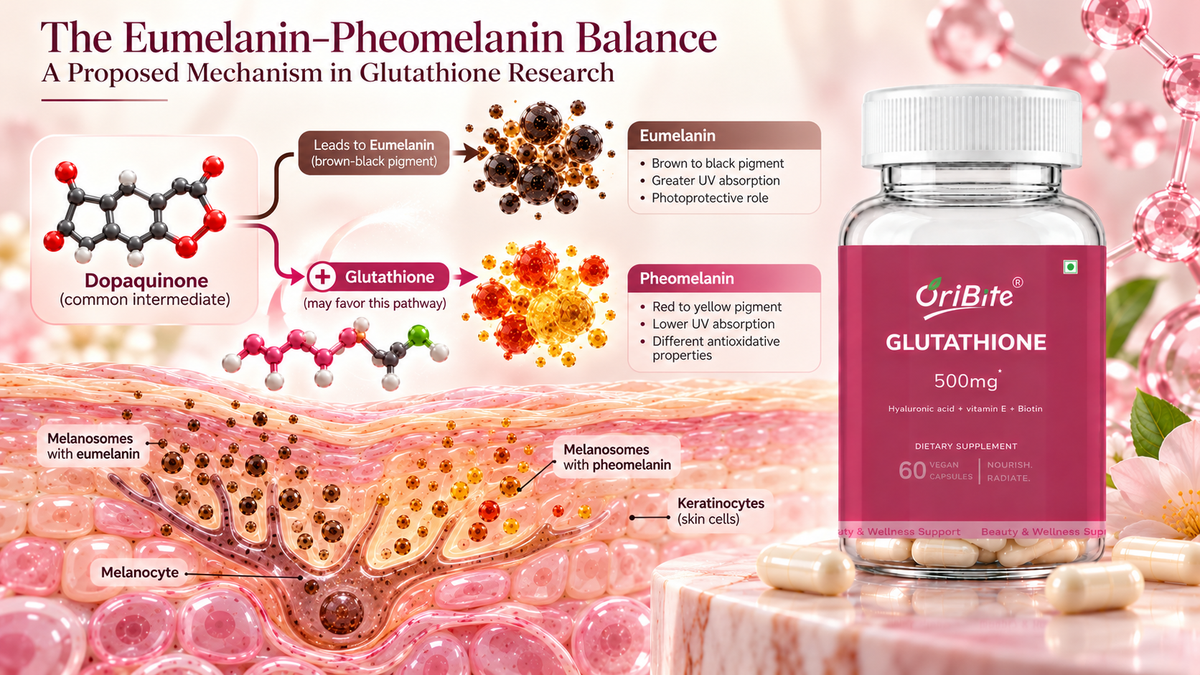
Skin color is determined primarily by melanin, a pigment produced by specialized cells called melanocytes, located in the basal layer of the epidermis. Inside melanocytes, melanin is synthesized within organelles called melanosomes, then transferred to surrounding skin cells (keratinocytes), where it accumulates and becomes visible as skin tone.
The process of making melanin — called melanogenesis — is driven by a copper-containing enzyme called tyrosinase. Tyrosinase is the rate-limiting enzyme in this pathway, meaning it's the step that controls how fast (and how much) melanin gets produced. Tyrosinase converts the amino acid tyrosine into a compound called DOPA, and then into dopaquinone — the branch point where the pathway splits into one of two directions, producing one of two different types of melanin.
Two Types of Melanin: Eumelanin vs. Pheomelanin
This branch point is central to understanding glutathione's proposed mechanism. From dopaquinone, melanogenesis can proceed down one of two paths:
- Eumelanin: A brown-black pigment. Higher relative eumelanin production is associated with darker, more UV-protective pigmentation.
- Pheomelanin: A red-yellow pigment. Higher relative pheomelanin production is associated with lighter pigmentation and is the dominant melanin type in fair, red-toned skin.
Everyone produces both types, and the ratio between them — not just the total amount of melanin — is a major factor in determining visible skin tone. This ratio is genetically influenced, but research suggests it can also be modulated biochemically, which is where glutathione's proposed mechanism comes in.
Mechanism 1: Direct Tyrosinase Inhibition
Glutathione contains a reactive sulfhydryl (thiol) group, and research has proposed that this group can interact with the copper ions at tyrosinase's active site — the part of the enzyme responsible for its catalytic activity. By interacting with this copper-dependent active site, glutathione is thought to reduce tyrosinase's enzymatic activity, effectively slowing the first, rate-limiting step of melanin production.
This mechanism has the strongest support in laboratory (in vitro) research using isolated tyrosinase and melanocyte cell cultures, where glutathione and glutathione-related compounds have shown measurable inhibitory effects on tyrosinase activity. Whether this translates proportionally to visible skin lightening in a living person — where absorption, delivery to melanocytes, and cellular concentration all come into play — is a separate and less settled question.
Mechanism 2: The Eumelanin-to-Pheomelanin Switch
This is the mechanism most specific to glutathione, and arguably the more interesting one. At the dopaquinone branch point described above, glutathione (or its component amino acid, cysteine) is proposed to react directly with dopaquinone, forming a conjugate that gets funneled down the pheomelanin production pathway instead of the eumelanin pathway.
In practical terms, this means glutathione's proposed effect isn't limited to simply making less melanin overall — it's theorized to shift the type of melanin the skin produces, favoring the lighter-toned pheomelanin pathway over the darker eumelanin pathway. This "eumelanin-to-pheomelanin switch" is a well-documented biochemical concept in pigmentation research more broadly (it's part of how red hair color is understood, for example, since red hair is associated with genetic variants that favor pheomelanin production). Applying that same switching mechanism to glutathione supplementation is a more specific and more recent area of research, and one of the more compelling explanations for why glutathione's effects on skin tone are sometimes described as producing a warmer, more even brightness rather than a uniform loss of pigment.
Mechanism 3: Antioxidant Activity and Oxidative Stress
Glutathione is one of the body's primary intracellular antioxidants, neutralizing reactive oxygen species (ROS) generated during normal cellular metabolism and in response to stressors like UV exposure. Oxidative stress is known to upregulate melanogenesis as part of the skin's protective response to UV damage — melanin itself functions partly as a defense against UV-induced DNA damage.
By reducing oxidative stress at the cellular level, glutathione may indirectly reduce the signals that would otherwise ramp up tyrosinase activity and melanin production. This mechanism is less specific than the direct tyrosinase interaction or the eumelanin-pheomelanin switch, but it's mechanistically plausible and consistent with glutathione's broader, well-established role as an antioxidant.
Mechanism 4: Melanosome Transfer
A less-studied but proposed fourth pathway involves melanosome transfer — the process by which pigment-containing melanosomes move from melanocytes into surrounding keratinocytes, where they become visible in the skin. Some research has explored whether glutathione or related antioxidant compounds might influence this transfer process, independent of how much melanin is actually produced. This mechanism has considerably less research behind it than the tyrosinase and eumelanin-pheomelanin pathways, and should be treated as a more speculative, early-stage area of the science.
Why Delivery Method Matters for These Mechanisms
All four mechanisms above describe what glutathione does once it reaches melanocytes at a sufficient concentration — but getting there is a separate challenge, and it's one of the biggest gaps between the cellular-level research and real-world results.
- Oral glutathione must survive digestion, which can break down the tripeptide before much of it is absorbed intact. This is part of why formulation matters (see below) and why oral glutathione's real-world effect on skin tone is generally considered more modest and slower-building than injectable forms.
- Topical glutathione faces the challenge of penetrating the skin barrier to reach melanocytes in the basal layer, which limits how much of an applied product actually reaches its target.
- Injectable (IV) glutathione bypasses digestion and delivers glutathione directly into the bloodstream, which is part of why it's associated with more pronounced effects in some settings — but it also carries its own distinct safety considerations and is not something to pursue without direct medical supervision.
This is a meaningful caveat for interpreting the mechanism research: a study showing tyrosinase inhibition in a petri dish doesn't automatically tell you how much visible change to expect from a daily capsule, since the amount of glutathione that actually reaches melanocyte cells in the skin depends heavily on absorption and delivery — which is exactly why formulation (reduced vs. S-acetyl vs. liposomal) is such a significant factor in whether an oral glutathione product is likely to be effective at all.
What the Research Doesn't Yet Establish
A few honest limitations are worth keeping in mind when evaluating this research:
- Much of the mechanistic evidence comes from cell culture and laboratory studies, not from directly observing these pathways in living human skin. This is standard for early-stage mechanism research, but it means the story is more established at the "how it could work" level than at the "how much it actually changes skin tone in a person" level.
- Human clinical trials on glutathione and skin tone are fewer in number and generally smaller in scale than the mechanism research would suggest, and results vary depending on dose, form, and duration of use.
- Individual variation is significant. Baseline pigmentation, genetics affecting the eumelanin/pheomelanin ratio, and individual differences in glutathione absorption and metabolism likely all affect how much visible change any one person experiences.
- Effects, where documented, tend to build gradually over weeks to months of consistent use, rather than appearing quickly — consistent with the idea that glutathione is shifting an ongoing biological process rather than instantly bleaching existing pigment.
Putting the Mechanism Together
The current research picture suggests glutathione's effect on skin tone isn't a single mechanism but a layered one: direct inhibition of the tyrosinase enzyme that drives melanin production, a proposed biochemical switch that favors lighter pheomelanin over darker eumelanin at the dopaquinone branch point, a supporting role in reducing the oxidative stress that can upregulate melanogenesis, and a less-established possible role in melanosome transfer. Each piece is more supported at the laboratory level than at the whole-person clinical level, and the amount of glutathione that actually reaches melanocyte cells — which depends heavily on formulation and delivery method — likely explains much of the variation in real-world results between products and between individuals.
The Bottom Line
Glutathione's role in skin tone isn't just "it's an antioxidant, so it helps" — the research points to a specific, multi-part mechanism centered on tyrosinase inhibition and a documented shift in melanin production toward the lighter pheomelanin pathway. That said, most of this mechanism is best supported at the cellular and laboratory level, with human clinical evidence still catching up in scale and consistency. Understanding the mechanism is useful less as a guarantee of results and more as a way to set realistic expectations: gradual change, built on a specific and biologically grounded pathway, rather than an instant or uniform effect.
Related Articles
- Glutathione for Skin Brightening: The Complete Guide
- Glutathione Purity and Quality Testing: What to Look For
- Reduced vs. S-Acetyl vs. Liposomal Glutathione: What's the Difference?
- Does Oral Glutathione Actually Work? What the Research Says
- Glutathione Capsules Price Guide: India and USA (What You Should Actually Pay)
For general information only. Talk to your doctor before starting any supplement.