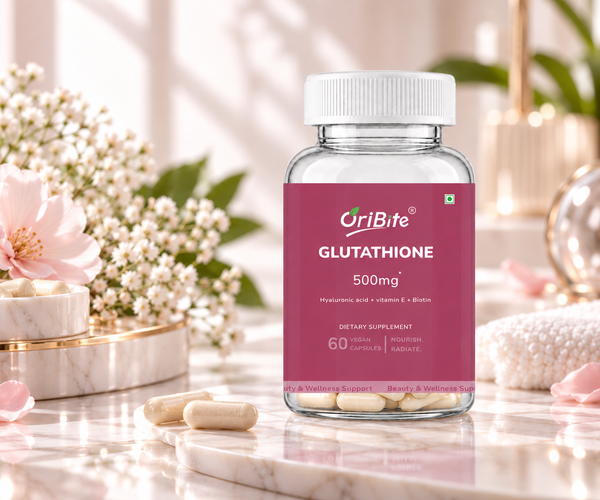
Glutathione for Skin Brightening FAQ: Answers to the Most Common Questions

Glutathione for Skin Brightening FAQ: Answers to the Most Common Questions
Glutathione comes with more questions than most supplements — partly because it's genuinely more complex (three different delivery methods, a specific cellular mechanism, real safety distinctions between forms), and partly because the marketing around it has outpaced the research more than usual. This guide brings together straightforward answers to the questions we hear most often, organized by topic, and grounded in what the current evidence and regulatory guidance actually say.
The Basics
What is glutathione, and how does it relate to skin tone?
Glutathione is a tripeptide — made of the amino acids glutamine, glycine, and cysteine — and one of the body's primary intracellular antioxidants. Its connection to skin tone comes from a specific mechanism: it's thought to inhibit tyrosinase, the enzyme that drives melanin production, and to shift the balance of melanin the skin produces toward a lighter type. It isn't primarily a skin ingredient by original function; skin brightening is one specific, studied application of a broader antioxidant molecule.
How does glutathione actually lighten skin at a cellular level?
Two main mechanisms are proposed. First, glutathione's active thiol group is thought to interact with the copper-dependent active site of tyrosinase, reducing its activity and slowing melanin production. Second, glutathione (or its component cysteine) is thought to react with an intermediate compound in the melanin pathway, redirecting production toward pheomelanin (a lighter, red-yellow pigment) instead of eumelanin (a darker, brown-black pigment). A supporting antioxidant effect, reducing the oxidative stress that can trigger melanin production, is also proposed as a secondary mechanism.
Does glutathione permanently change your skin color?
No. The mechanism involves modulating an ongoing, active biological process, not permanently altering pigment already present. Effects documented in research are tied to continued use, and skin tone would be expected to gradually shift back toward baseline patterns if supplementation stops, particularly with continued sun exposure.
Dosage & Delivery Method
What dose of glutathione has actually been studied?
Clinical trials on oral glutathione for skin lightening have generally used doses in the 250mg to 500mg per day range, taken over periods of roughly 8 to 12 weeks or longer. Topical formulations have typically used around 2% glutathione concentration in trials.
Which is better: oral, topical, or IV glutathione?
Oral and topical glutathione have the more favorable overall profile: a moderate, if mixed, body of clinical evidence with a manageable safety record. IV (injectable) glutathione is different — it carries meaningfully higher documented risks (including liver, kidney, and severe hypersensitivity reactions) and is not an approved use for cosmetic skin lightening in several major markets, including the Philippines, where regulators have explicitly warned against it. Systematic reviews have also found no clear evidence that IV delivery is actually more effective than oral or topical routes for this purpose.
How long does it take to see results?
Where clinical trials have shown an effect, it has generally built gradually over 8 to 12 weeks of consistent daily use, not days. Effects have also been reported more consistently on sun-exposed skin than on sun-protected areas, which is why daily sun protection matters for anyone using glutathione for this purpose.
Safety
Is glutathione safe to take?
Oral glutathione capsules are generally well tolerated in clinical trials, with mild, infrequent side effects reported. Injectable glutathione for cosmetic skin lightening is a different matter — it's associated with documented serious risks, including toxic effects on the liver, kidneys, and nervous system, and rare but severe reactions like Stevens-Johnson syndrome. It should not be pursued outside proper medical supervision, and in several countries it isn't an approved cosmetic use at all.
Is IV glutathione for skin whitening legal?
This varies by country and is worth checking locally, but in some major markets, regulators have specifically stated that no injectable glutathione product is approved for skin lightening — its only approved use is as an adjunct treatment in certain chemotherapy protocols. Availability at a spa or clinic doesn't necessarily mean the use is approved or being administered safely.
Can I take glutathione while pregnant or on medication?
Anyone who is pregnant, breastfeeding, or managing a medical condition or taking medication should talk with a healthcare provider before starting glutathione supplementation, regardless of the intended use.
Effectiveness & Research
Does glutathione actually work for skin brightening?
The clinical evidence is genuinely mixed. Some randomized, controlled trials have found a statistically significant reduction in melanin index with oral or topical glutathione; others have found no significant difference from placebo. Pooled analysis across multiple studies has shown a more consistent positive signal at commonly studied doses, but individual results vary, and study quality varies as well.
Does it work the same for everyone?
No. At least one clinical trial found effects limited to participants over 40, and effects have generally been more consistent on sun-exposed skin than sun-protected skin. Genetics, baseline skin tone, and individual absorption likely all play a role in how much difference any one person notices.
Purity & Product Quality
Why does the form of glutathione matter?
Reduced glutathione (GSH) is the active form most research is based on, but it's chemically unstable and can oxidize into the far less active GSSG form — whether during manufacturing, storage, or digestion. S-acetyl and liposomal forms are designed to improve stability and absorption. A label that just says "glutathione" without specifying the form is leaving out one of the most important quality details.
How can I tell if a glutathione supplement is high quality?
Look for a clearly stated form (reduced, S-acetyl, or liposomal), a specific milligram dose, third-party testing (ideally including a reduced-vs-oxidized ratio check), published certificates of analysis, and GMP-certified manufacturing. Vague labeling and an absence of any independent testing are the clearest red flags.
How should I store glutathione to keep it potent?
Keep it cool, dry, and out of direct light, with the cap sealed tightly after each use. Heat, humidity, and light all accelerate the breakdown of active glutathione into its oxidized, less effective form. Refrigeration usually isn't necessary unless the label specifically says so.
Cost
How much should glutathione capsules actually cost?
Pricing varies by market and formulation. As a general guide, a reasonably dosed, reasonably tested monthly supply typically runs roughly ₹600–₹1,500 in India, or $20–$45 in the US, with premium fermented or liposomal formulations running higher in both markets. Prices well below these ranges are worth investigating rather than assuming they're simply a good deal, given how much genuine, stable, high-purity glutathione costs to produce.
The Bottom Line
Glutathione has a real, evidence-backed — if inconsistent — role in skin brightening when taken orally or applied topically, working through a specific mechanism involving tyrosinase inhibition and a shift in melanin type. Results tend to build gradually and vary by individual, sun exposure matters more than most people expect, and IV administration for cosmetic use carries documented risks that aren't matched by stronger evidence of benefit. Getting a good outcome comes down to the details: the right form and dose, a quality-tested product, realistic expectations about timing, and steering clear of injectable "shortcuts" that current evidence and regulatory guidance don't support.
Related Articles
- Glutathione Purity and Quality Testing: What to Look For
- How Glutathione Affects Skin at the Cellular Level: Tyrosinase, Melanosomes & the Eumelanin-Pheomelanin Shift
- Glutathione and Skin Brightening: A Review of the Clinical Research
- Common Myths About Glutathione and Skin Whitening, Debunked
- Building Glutathione Into a Daily Skin-Brightening Routine
- Glutathione Capsules Price Guide: India and USA (What You Should Actually Pay)
- Glutathione Lifestyle Guide: Storage, Daily Use & Common Myths
For general information only. Talk to your doctor before starting any supplement.