How Beetroot Works: Mechanisms of Action
How Beetroot Works: Mechanisms of Action in the Body
Beetroot juice is a staple of gyms and blood-pressure advice columns, yet most explanations stop at "it boosts nitric oxide." This guide explains how beetroot works at the level of molecules, cells and organs, and it is honest about which steps are proven in people and which are still hypotheses. If you want to know why a red vegetable might lower blood pressure, change exercise efficiency or calm oxidative stress, the answer runs through a surprising partnership between the plant, your mouth bacteria and your blood vessels.
The sections below move from the active compounds to the biology, then to the evidence and its limits. Sources are listed at the end so you can check each claim.
1. How Beetroot Works: Executive Mechanism Summary
The short version. Beetroot (Beta vulgaris) works mainly through two families of compounds.
- Inorganic nitrate is converted by oral bacteria and body tissues into nitrite and then nitric oxide (NO), a gas that relaxes blood vessels and tunes mitochondrial and muscle function. This is the best-supported mechanism.
- Betalains, the red-violet pigments including betanin, act as antioxidants and may modulate inflammatory signalling. Evidence here is mostly from cells and animals.
Other constituents, such as betaine, potassium, folate and polyphenols, may add smaller effects.
| Mechanism | Main compound | Strength of human evidence |
|---|---|---|
| Nitrate–nitrite–NO pathway and vasodilation | Nitrate | Moderate to good |
| Improved muscle oxygen efficiency | Nitrate | Moderate, varies by person |
| Antioxidant activity | Betalains, polyphenols | Low (mostly preclinical) |
| Anti-inflammatory signalling | Betalains | Low |
| Methyl-group and homocysteine metabolism | Betaine | Low to moderate |
 2. Key Active Compounds in Beetroot
- Inorganic nitrate (NO₃⁻). Beetroot is one of the richest common dietary sources. Content varies widely with variety, soil, fertilizer, season and storage, so figures from roughly 100 to over 400 mg per 100 g fresh weight are reported. Many beetroot juice shots are standardized to supply about 5–8 mmol nitrate (roughly 300–500 mg).
- Betalains. Two groups: red-violet betacyanins (mainly betanin) and yellow betaxanthins (such as vulgaxanthins). They are water-soluble and give beetroot its colour.
- Betaine (trimethylglycine). A methyl donor present in meaningful amounts, roughly in the low hundreds of milligrams per 100 g.
- Phenolics and flavonoids. Including ferulic acid and other phenolic acids.
- Minerals and vitamins. Potassium, magnesium, folate and vitamin C in modest amounts.
- Oxalate. Relevant to safety rather than benefit, and discussed later.
Cooking, juicing, drying and storage change this mix. Boiling in water leaches nitrate and betalains into the cooking liquid, while juicing concentrates nitrate per serving (Clifford et al., 2015).
3. Primary Biological Targets of Beetroot Compounds
The compounds appear to act on a small set of targets:
- Vascular endothelium and smooth muscle, where NO signalling controls vessel tone.
- Skeletal muscle and mitochondria, where nitrate-derived signals influence oxygen use and calcium handling.
- Platelets and the vessel wall, where NO limits adhesion and clotting tendency.
- Redox-sensitive transcription factors such as Nrf2 and NF-κB, which betalains may influence in cell models.
- Oral and gut microbiota, which are essential to activate nitrate in the first place.
4. Pathway 1: The Beetroot Nitric Oxide Pathway (Nitrate → Nitrite → NO)
Why this matters. Your body makes NO from the amino acid L-arginine using NO synthase enzymes. That route needs oxygen and can falter with age, vascular disease and oxidative stress. The nitrate–nitrite–NO route is a backup system that works especially well when oxygen is low (Lundberg et al., 2008).
The steps:
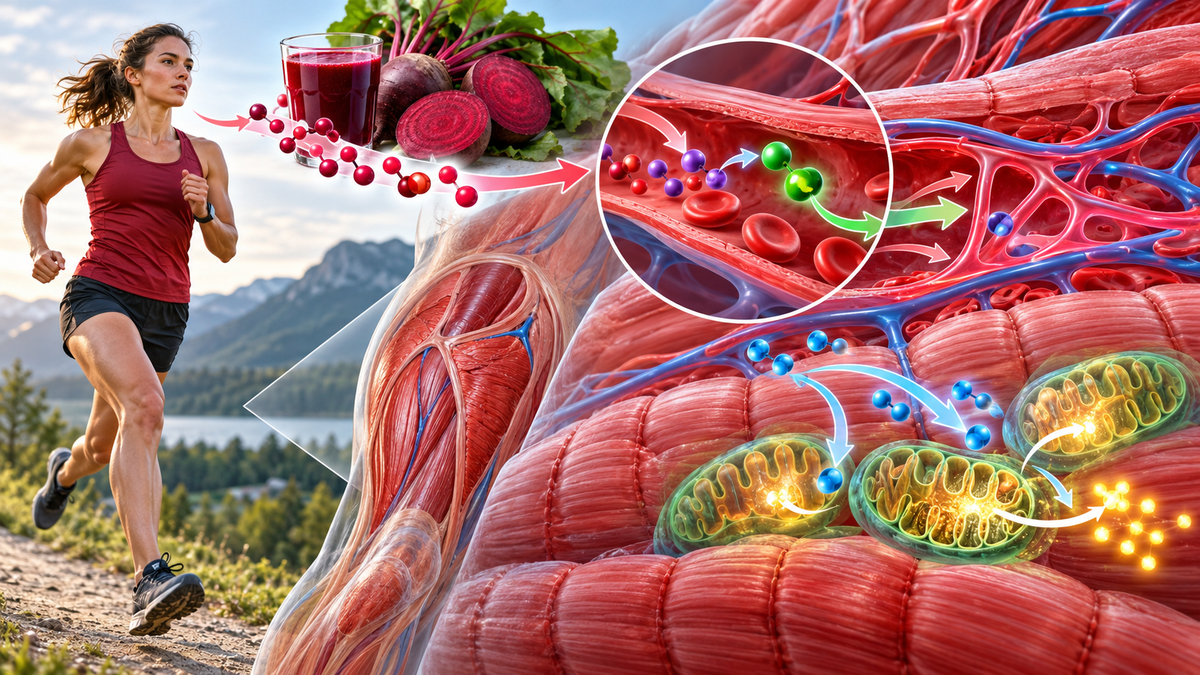
- Ingestion and absorption. Dietary nitrate is absorbed in the upper gut and enters the blood.
- Salivary recycling. The salivary glands actively take up roughly a quarter of circulating nitrate and secrete it in saliva. This loop is called the enterosalivary circulation.
- Bacterial reduction. Bacteria on the back of the tongue carry nitrate reductase enzymes. They convert nitrate to nitrite, something human cells do poorly. Without these bacteria, the pathway weakens.
- Nitrite to NO. Swallowed nitrite is converted to NO in the acidic stomach and, more importantly, in blood and tissues. Deoxygenated haemoglobin, myoglobin, xanthine oxidoreductase and other proteins can reduce nitrite to NO, particularly where oxygen is scarce.
- Signalling. NO activates soluble guanylate cyclase, which raises cyclic GMP (cGMP) and activates protein kinase G. This relaxes vascular smooth muscle and widens vessels.
Evidence that the mouth matters. When volunteers used antibacterial mouthwash, the blood-pressure-lowering effect of nitrate was reduced, and plasma nitrite rose less (Govoni et al., 2008; Kapil et al., 2010). This supports the central role of oral bacteria. It also suggests that frequent antiseptic mouthwash, or some antibiotics, could blunt the benefit, though this has not been tested in long-term trials.
5. Pathway 2: Vascular Tone, Blood Pressure and Platelet Function
The practical result of Pathway 1 is vasodilation. In healthy adults, beetroot juice raised plasma nitrite and lowered blood pressure within hours, with the peak around two to three hours after drinking (Webb et al., 2008). Meta-analyses of trials in adults report average systolic reductions of roughly 4 mmHg, with smaller changes in diastolic pressure (Siervo et al., 2013).
Possible additional vascular effects:
- Reduced arterial stiffness in some studies
- Improved endothelium-dependent dilation, which is the vessel's own ability to relax
- Reduced platelet aggregation in some experiments
Effects tend to be larger in people with higher baseline blood pressure and may be smaller in very fit or younger individuals. Not everyone responds, and response may depend on oral microbiome composition and baseline nitrate status (Lidder and Webb, 2013).
6. Pathway 3: Muscle Oxygen Efficiency and Mitochondria
Some of the most striking findings are in exercise. In controlled studies, nitrate supplementation reduced the oxygen cost of submaximal exercise by roughly 3–5% and in some trials extended time to exhaustion (Larsen et al., 2007; Bailey et al., 2009). That is unexpected, because oxygen cost at a given workload was long assumed to be fixed.
Proposed mechanisms:
- Improved mitochondrial efficiency. Humans given nitrate showed a better oxygen-to-ATP ratio and lower proton leak, possibly via changes in proteins such as the adenine nucleotide translocase (Larsen et al., 2011).
- Better blood flow distribution. More blood may be directed to fast-twitch, oxygen-poor muscle fibres during exercise (Ferguson et al., 2013).
- Calcium handling. Animal work found nitrate increased calcium release in fast-twitch muscle fibres and force production at low frequencies (Hernández et al., 2012).
Reviews conclude that benefits are most reliable for moderate-intensity and short high-intensity efforts in recreational athletes, and less consistent in elite athletes (Jones, 2014). These mechanisms are largely based on small human studies and animal data.
7. Cellular Signalling Beyond Nitric Oxide
At the cell level, beetroot compounds may influence several signalling systems:
- cGMP–PKG signalling, the main route of NO action in vessels and platelets.
- Nrf2 activation. Betalains and phenolics may promote expression of antioxidant and detoxification enzymes in cells.
- NF-κB modulation. Betanin and extracts reduced NF-κB-linked inflammatory mediators in cell and animal work (Clifford et al., 2015).
- Methylation signalling. Betaine donates methyl groups, linking beetroot to one-carbon metabolism.
An important caution: many signalling effects were found with isolated pigments or extracts at concentrations that may exceed what blood reaches after eating beetroot. Betalains are also absorbed poorly, so reaching target tissues is uncertain.
8. Beetroot Betalains and Oxidative Stress Pathways
Betalains are potent radical scavengers in test tubes. Betanin and related pigments can donate electrons and neutralize reactive oxygen species, and they have been described as a distinct class of dietary antioxidants (Kanner et al., 2001). In animal models, beetroot extract lowered markers of lipid oxidation and raised antioxidant enzyme activity.
Oxidative stress also interacts with nitric oxide. Reactive oxygen species can react with NO to form peroxynitrite, reducing NO availability and damaging cells. By lowering oxidative load and by supplying NO through a non-enzymatic route, beetroot may help restore balance in vessels under oxidative stress. This is a plausible, integrated explanation, but human proof that betalains specifically lower oxidative damage in tissues is limited.
9. Inflammatory Pathways
Chronic low-grade inflammation contributes to vascular and metabolic disease. In cells and rodents, betalain-rich extracts reduced inflammatory mediators and enzymes such as COX-2 and cytokines associated with NF-κB signalling (Clifford et al., 2015). Some human trials report small reductions in inflammatory markers such as CRP after beetroot supplementation, while others find no change.
In exercise, beetroot has been studied for muscle soreness and recovery, with mixed and generally modest findings. The anti-inflammatory story is therefore promising but not established.
10. Endocrine, Metabolic and Neurovascular Pathways
- Insulin sensitivity. Nitrate can influence glucose uptake and vascular insulin delivery in muscle. Human results are mixed.
- Lipid metabolism. Animal studies suggest effects on liver fat and lipids through NO signalling. Human evidence is limited.
- Homocysteine and methylation. Betaine helps convert homocysteine to methionine. High intake is associated with lower homocysteine in several studies, though effects on clinical outcomes are unproven.
- Cerebral blood flow. A small number of studies found changes in blood flow to frontal brain regions in older adults after nitrate, and interest in cognition exists. Evidence is early.
- Blood glucose. The sugar content of beetroot juice is not trivial, so people with diabetes should account for it.
11. Mechanism Diagram
DIETARY BEETROOT
   |-- Nitrate (NO3-)                 |-- Betalains (betanin) + phenolics
   v                                  v
Absorbed in gut                       Limited absorption
   v                                  v
Saliva (enterosalivary loop)          Radical scavenging; Nrf2 / NF-kB signalling
   v                                  v
Tongue bacteria: NO3- -> NO2-         Lower oxidative stress and inflammation
   v                                  (mostly preclinical)
Nitrite in blood and tissues
   v   (more efficient when oxygen is low)
Nitric oxide (NO)
   v
sGC -> cGMP -> PKG
   |-- Vessel relaxation -> lower blood pressure
   |-- Less platelet stickiness
   |-- Mitochondrial efficiency and muscle blood flow -> lower O2 cost of exercise
12. Preclinical Evidence
- Nitrate and NO: rodent studies show that dietary nitrate lowers blood pressure, protects against ischaemia–reperfusion injury and improves endothelial function.
- Mitochondria and muscle: mouse and cell work supports effects on calcium handling and force production (Hernández et al., 2012).
- Betalains: cell and animal models show antioxidant, anti-inflammatory and, in some cases, anti-proliferative effects (Lechner and Stoner, 2019).
- Metabolic models: beetroot extracts improved lipid and glucose markers in diet-induced obesity models.
Preclinical findings explain how effects could occur. They do not show that the same effect size appears in people eating normal servings.
13. Human Relevance: What Applies to Real People
- Blood pressure: the most reliable human effect, with an average systolic reduction of about 4 mmHg, which is of public-health relevance if sustained, though long-term trials are fewer (Siervo et al., 2013).
- Exercise: modest improvement in oxygen cost and some time-to-exhaustion measures, strongest in recreational athletes (Jones, 2014).
- Practical amounts: trials commonly used about 5–8 mmol nitrate (roughly 300–500 mg), one to three hours before exercise or measurement. Regular daily use is often studied over days to weeks.
- Who may respond less: people with a disrupted oral microbiome (heavy antiseptic mouthwash use), some antibiotic users and highly trained athletes.
- Safety points: beeturia (pink or red urine) occurs in a minority of people and is harmless. Beetroot is rich in oxalate, so people prone to oxalate kidney stones should be cautious. Those on blood-pressure medicines, nitrates or PDE5 inhibitors should speak with a clinician because of additive vasodilation. Processed meats and nitrite additives raise different issues from vegetable nitrate, and vegetable nitrate comes with antioxidants that shape its effects, but research continues.
14. Mechanistic Uncertainty and Research Gaps
- Betalain bioavailability: how much of the pigment reaches tissues in an active form is unclear.
- Nitrate versus whole food: juice and nitrate-only supplements do not always give identical results, and the contribution of non-nitrate compounds is unresolved.
- Individual variability: oral microbiome, genetics, diet and fitness probably explain who responds.
- Long-term effects: most trials last days to weeks. Long-term cardiovascular outcomes are untested.
- Mouthwash and microbiome questions: the real-world importance of antiseptic mouthwash remains uncertain.
- Industry influence: many trials are small and some are supported by product manufacturers.
- Inflammation and oxidative stress in people: human evidence is thin compared with laboratory work.
15. References
Verify each entry through its DOI before citing it in clinical or commercial material.
- Bailey SJ, Winyard P, Vanhatalo A, et al. Dietary nitrate supplementation reduces the O₂ cost of low-intensity exercise and enhances tolerance to high-intensity exercise in humans. J Appl Physiol. 2009;107(4):1144–1155. doi:10.1152/japplphysiol.00722.2009
- Clifford T, Howatson G, West DJ, Stevenson EJ. The potential benefits of red beetroot supplementation in health and disease. Nutrients. 2015;7(4):2801–2822. doi:10.3390/nu7042801
- Ferguson SK, Hirai DM, Copp SW, et al. Impact of dietary nitrate supplementation via beetroot juice on exercising muscle vascular control in rats. J Physiol. 2013;591(2):547–557. doi:10.1113/jphysiol.2012.243121
- Govoni M, Jansson EÅ, Weitzberg E, Lundberg JO. The increase in plasma nitrite after a dietary nitrate load is markedly attenuated by an antibacterial mouthwash. Nitric Oxide. 2008;19(4):333–337. doi:10.1016/j.niox.2008.08.003
- Hernández A, Schiffer TA, Ivarsson N, et al. Dietary nitrate increases tetanic [Ca²⁺]i and contractile force in mouse fast-twitch muscle. J Physiol. 2012;590(15):3575–3583. doi:10.1113/jphysiol.2012.232777
- Jones AM. Dietary nitrate supplementation and exercise performance. Sports Med. 2014;44(Suppl 1):S35–S45. doi:10.1007/s40279-014-0149-y
- Kanner J, Harel S, Granit R. Betalains: a new class of dietary cationized antioxidants. J Agric Food Chem. 2001;49(11):5178–5185. doi:10.1021/jf010456f
- Kapil V, Milsom AB, Okorie M, et al. Inorganic nitrate supplementation lowers blood pressure in humans: role for nitrite-derived NO. Hypertension. 2010;56(2):274–281. doi:10.1161/HYPERTENSIONAHA.110.153536
- Larsen FJ, Weitzberg E, Lundberg JO, Ekblom B. Effects of dietary nitrate on oxygen cost during exercise. Acta Physiol (Oxf). 2007;191(1):59–66. doi:10.1111/j.1748-1716.2007.01713.x
- Larsen FJ, Schiffer TA, Borniquel S, et al. Dietary inorganic nitrate improves mitochondrial efficiency in humans. Cell Metab. 2011;13(2):149–159. doi:10.1016/j.cmet.2011.01.004
- Lechner JF, Stoner GD. Red beetroot and betalains as cancer chemopreventative agents. Molecules. 2019;24(8):1602. doi:10.3390/molecules24081602
- Lidder S, Webb AJ. Vascular effects of dietary nitrate (as found in green leafy vegetables and beetroot) via the nitrate–nitrite–nitric oxide pathway. Br J Clin Pharmacol. 2013;75(3):677–696. doi:10.1111/j.1365-2125.2012.04420.x
- Lundberg JO, Weitzberg E, Gladwin MT. The nitrate–nitrite–nitric oxide pathway in physiology and therapeutics. Nat Rev Drug Discov. 2008;7(2):156–167. doi:10.1038/nrd2466
- Siervo M, Lara J, Ogbonmwan I, Mathers JC. Inorganic nitrate and beetroot juice supplementation reduces blood pressure in adults: a systematic review and meta-analysis. J Nutr. 2013;143(6):818–826. doi:10.3945/jn.112.170233
- Webb AJ, Patel N, Loukogeorgakis S, et al. Acute blood pressure lowering, vasoprotective, and antiplatelet properties of dietary nitrate via bioconversion to nitrite. Hypertension. 2008;51(3):784–790. doi:10.1161/HYPERTENSIONAHA.107.103523
For general information only. Talk to your doctor before starting any supplement.