
Complete Scientific Guide to Flaxseed Oil
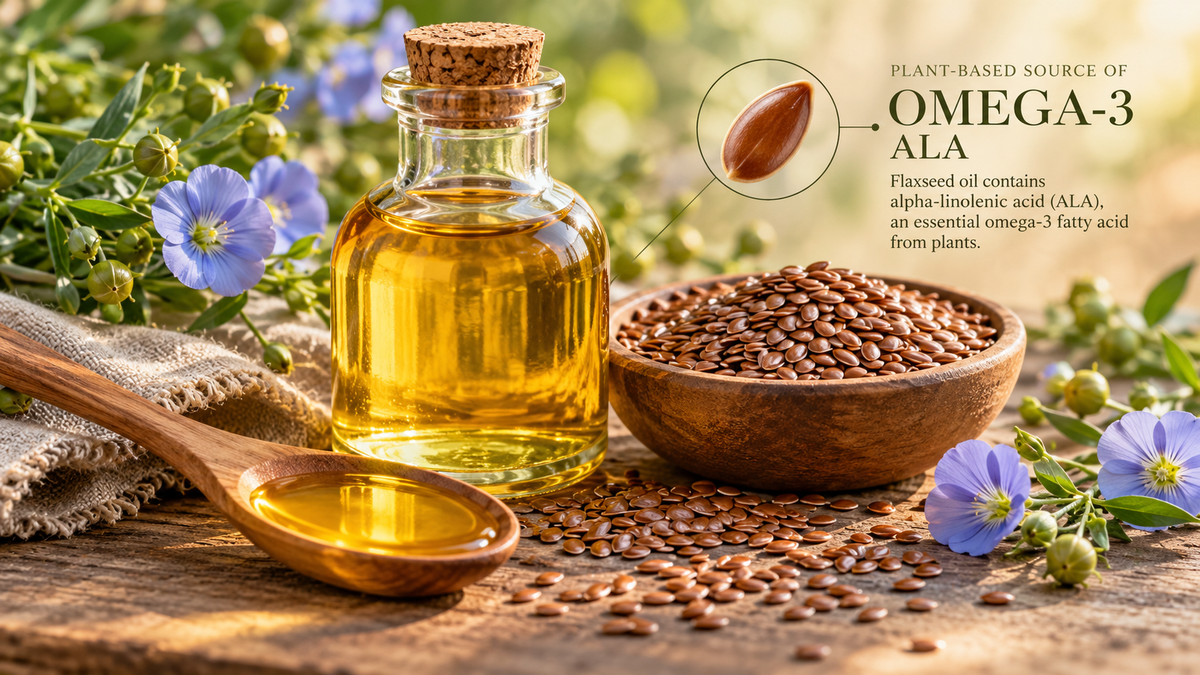
Flaxseed Oil: Complete Scientific Guide to Benefits & Safety
1. Executive Summary and Quick Facts
Flaxseed oil is a pale golden vegetable oil pressed from the seeds of the flax plant. It is one of the richest plant sources of alpha-linolenic acid (ALA), an omega-3 fatty acid that the human body cannot make and must take in from food. People use it as a food oil, as a supplement in liquid or capsule form, and in some traditional and industrial settings.
The science on flaxseed oil is more nuanced than most product pages suggest. ALA is an essential nutrient, and flaxseed oil is a concentrated way to get it. But the body converts only a small share of ALA into the long-chain omega-3s EPA and DHA, and the human trials that exist for flaxseed oil itself are smaller and less consistent than those for whole flaxseed or fish oil. This guide separates what is established, what is promising, and what is still unknown.
Quick facts
- Source: Seeds of Linum usitatissimum (flax / linseed)
- Defining nutrient: ALA, typically around half or more of the fatty acids in the oil
- Not the same as: whole or ground flaxseed (which adds fibre and lignans), or fish oil (which supplies EPA and DHA directly)
- Best-supported use: a source of essential omega-3 intake; nutritional adequacy for ALA
- Evidence on health outcomes: mixed and generally low to moderate certainty (see Section 16)
- Main practical risk: the oil oxidises (goes rancid) easily; quality and storage matter
- Common side effects: mostly digestive (loose stools, bloating) at higher intakes
- Who should speak to a clinician first: people on blood thinners or blood-pressure medicines, those who are pregnant or breastfeeding, and anyone with a bleeding disorder or planned surgery
How to read this guide. Each evidence statement is labelled by the type of research behind it: human randomised trial, human observational study, animal study, laboratory study, or theory. Where a finding comes from whole flaxseed or from ALA in general rather than from flaxseed oil, the text says so.
2. What Is Flaxseed Oil? Definition and Identity
Flaxseed oil is the fixed (non-volatile) oil obtained from the mature seeds of flax. In many countries, and in trade and industrial contexts, the same oil is called linseed oil or flax oil. The names usually refer to the same botanical source, but the grade differs: edible, cold-pressed flaxseed oil is produced under food-safety conditions, while industrial linseed oil (used in paints and varnishes) is not intended for eating and must never be consumed.
Chemically, the oil is a mixture of triglycerides, which are three fatty acids attached to a glycerol backbone. What sets flaxseed oil apart is the proportion of one fatty acid in that mixture: ALA, a polyunsaturated 18-carbon omega-3.
The Codex Alimentarius Commission, the international food-standards body, lists flaxseed (linseed) oil among the named vegetable oils in its standard CXS 210-1999 following a 2019 revision, which gives the oil an internationally recognised identity for trade and labelling.
3. Botanical and Chemical Classification
Botanical classification
|
Rank |
Classification |
|---|---|
|
Kingdom |
Plantae |
|
Family |
Linaceae |
|
Genus and species |
Linum usitatissimum L. |
|
Plant part used |
Seed |
|
Product |
Expressed (pressed) fixed oil |
Two broad flax types are grown: fibre flax (tall, bred for stem fibre used in linen) and oilseed flax (shorter, bred for seed and oil). Most commercial oil comes from oilseed varieties. Some varieties, such as the low-linolenic types sold as "linola", have been bred to contain much less ALA, and these are used more like sunflower oil. This is one reason a label should state ALA content rather than rely on the plant name alone.
Chemical classification
- Lipid class: triacylglycerol-rich vegetable oil
- Dominant fatty acid class: polyunsaturated fatty acids (PUFA), omega-3 series
- Key fatty acid: alpha-linolenic acid (18:3 n-3)
- Essential fatty acids present: ALA (omega-3) and linoleic acid (omega-6). Both are essential because humans cannot synthesise them (NIH Office of Dietary Supplements).
4. Origin, Cultivation and Source
Flax is a cool-climate annual crop. Canada, Russia, Kazakhstan and China are among the main producers of flaxseed globally, and India grows flax mainly for oilseed and some fibre use. Seeds are harvested, cleaned and dried before pressing. Typical oil content by weight is roughly one-third to two-fifths of the seed, depending on variety and growing conditions.
Growing environment influences oil quality. Cooler climates and later seed maturity tend to be associated with higher ALA, while seed variety, soil, and harvest timing alter fatty-acid balance and minor components. Seeds can also take up trace metals such as cadmium from soil, so sourcing and testing of the seed or oil are part of any serious quality programme (Section 23).
Flaxseed oil is not fish-derived and is suitable for vegetarian and vegan diets. It is therefore often positioned as a plant alternative to marine omega-3, although, as explained in Section 12, it does not deliver EPA or DHA in the same way.
5. History and Traditional Use
Flax is among the oldest cultivated crops, grown for fibre and seed across Eurasia for thousands of years. Seeds and oil have been used as food, as a topical emollient, in folk medicine for digestive complaints, and, in processed form, as the drying oil in paints, varnishes and wood finishes.
It is important to separate these uses. Traditional use shows that flax was familiar and widely consumed; it is not evidence that flaxseed oil treats any disease. Historical records of use are best understood as a reason for scientific interest, not as proof of effect.
6. Modern Nutraceutical Use
Today flaxseed oil appears in several forms and contexts:
- As a refrigerated liquid used on salads, in smoothies, or stirred into foods after cooking
- As softgel or capsule supplements, often marketed for general omega-3 intake, heart health, skin, joints or hormonal balance
- As an ingredient in fortified foods and blended oils
- As a vegetarian or vegan omega-3 option
Marketing claims frequently run ahead of the evidence. The sections below describe what the research actually shows for each major outcome, and Section 16 grades it.
7. Chemical Composition
The fatty-acid profile of flaxseed oil varies by variety and growing conditions, so the figures below are typical ranges rather than guarantees. Always check the certificate of analysis for a specific batch.
|
Component |
Approximate share of total fatty acids |
Notes |
|---|---|---|
|
Alpha-linolenic acid (ALA, 18:3 n-3) |
roughly 50–60% |
Defining omega-3; most oxidation-prone |
|
Oleic acid (18:1 n-9) |
roughly 15–25% |
Monounsaturated |
|
Linoleic acid (18:2 n-6) |
roughly 10–18% |
Omega-6 essential fatty acid |
|
Palmitic acid (16:0) |
roughly 4–7% |
Saturated |
|
Stearic acid (18:0) |
roughly 2–5% |
Saturated |
These ranges reflect commonly reported values in food-composition and analytical literature and are provided as an approximate guide. Replace with batch-specific figures when you cite a product.
Minor components include tocopherols (vitamin E forms, mainly gamma-tocopherol), plant sterols, and trace phospholipids. Because of this, a pressed oil is a source of fatty acids more than of vitamins or antioxidants.
What the oil does not contain much of. Whole flaxseed is notable for fibre, mucilage and lignans (such as secoisolariciresinol diglucoside, SDG). These are largely left in the seed meal when oil is pressed, so flaxseed oil generally supplies little fibre and few lignans. Benefits observed with whole or ground flaxseed therefore cannot be assumed for the oil.
8. Key Active Compounds
Alpha-linolenic acid (ALA)
ALA is the main bioactive fatty acid in flaxseed oil. It serves as a structural component of cell membranes, as an energy source, and as the starting material for the body's synthesis of the longer omega-3s eicosapentaenoic acid (EPA) and docosahexaenoic acid (DHA). It is considered essential because humans lack the enzyme needed to make it.
Linoleic acid
A smaller amount of the omega-6 linoleic acid is also present. ALA and linoleic acid compete for the same desaturase and elongase enzymes, so the ratio of the two in the diet can influence how much ALA is converted onward (NIH Office of Dietary Supplements).
Minor constituents
Tocopherols and sterols are present in small amounts. They may help slow oxidation in the fresh oil, but they do not make the oil stable on their own, and refining can remove some of them.
9. Extraction and Processing
How the oil is made affects its flavour, shelf life, and sometimes its contaminant profile.
|
Method |
How it works |
Typical features |
|---|---|---|
|
Cold pressing (expeller, low heat) |
Seeds are mechanically pressed at controlled, lower temperatures without solvents |
Retains natural flavour and minor components; more sensitive to oxidation; usually sold as "virgin" or "cold-pressed" |
|
Hot pressing |
Seeds heated before pressing |
Higher yield; heat can accelerate oxidation and alter flavour |
|
Solvent extraction |
Hexane or similar solvent extracts residual oil, then it is removed |
Used industrially; usually followed by refining |
|
Refining, bleaching, deodorising |
Removes free fatty acids, colour, odour |
Longer shelf stability for some uses; can strip minor components and may form processing by-products |
"Cold-pressed" is not a regulated promise of low temperature in every market, so it is worth asking a supplier for the actual maximum processing temperature and the oxidation data of the batch rather than relying on the term. Because ALA is highly unsaturated, careful handling at every stage (seed storage, pressing, filtering, packaging) is the main determinant of quality. Producers commonly use dark glass, inert-gas flushing and low-oxygen filling to reduce oxidation.
10. Standardization, Potency and Label Interpretation
Unlike many botanical extracts, flaxseed oil is not "standardised" to a marker compound in the pharmaceutical sense. Its identity and strength are described mainly by:
- ALA content (percentage of fatty acids, or milligrams of ALA per serving)
- Oil amount per serving (for example, per capsule or per teaspoon)
- Freshness indicators (peroxide value, anisidine value, free fatty acids)
- Added antioxidants (such as tocopherols or rosemary extract), if any
Two common label pitfalls:
- Oil amount is not ALA amount. A capsule listing 1,000 mg of flaxseed oil does not supply 1,000 mg of ALA. If the oil is about half to three-fifths ALA, the same capsule supplies roughly 500–600 mg of ALA. A label should list ALA separately; if it does not, the figure can be estimated only approximately.
- "Omega-3" on the front panel can hide the source. Check whether the omega-3 listed is ALA, EPA, or DHA. Flaxseed oil provides ALA.
11. Mechanisms of Action
The mechanisms below are proposed explanations. Many come from laboratory or animal studies and are not proven to drive clinical outcomes in people.
- Membrane incorporation. ALA is built into cell-membrane phospholipids, which can alter membrane fluidity and signalling (laboratory and animal evidence; partly supported by human tissue studies).
- Eicosanoid and mediator balance. Omega-3 fatty acids compete with omega-6 fatty acids for the enzymes that make signalling molecules. Increased ALA may shift the balance toward less inflammatory mediators (largely mechanistic; human effects depend on conversion and background diet).
- Conversion to EPA and DHA. A small share of ALA is converted to longer-chain omega-3s that have their own mechanisms. Because conversion is limited, this pathway probably contributes less than the pathway of ALA itself.
- Gene-expression and nuclear-receptor effects. Fatty acids can act on transcription factors such as PPARs in cell and animal models. Direct relevance to human supplementation is unclear.
-
Inflammatory markers. A meta-analysis of randomised trials found lower concentrations of IL-6 and hs-CRP with flaxseed oil in patients with dyslipidaemia-related conditions (see Section 15), which is consistent with an anti-inflammatory effect but does not prove one.

12. Pharmacokinetics and Metabolism
Pharmacokinetics describes how a substance is absorbed, distributed, metabolised and eliminated.
- Digestion and absorption. Triglycerides in the oil are broken down by pancreatic lipase in the small intestine. The fatty acids and monoglycerides are absorbed with bile salts, reassembled and carried in the lymphatic system as chylomicrons before entering the bloodstream.
- Distribution. ALA is incorporated into plasma lipid fractions and cell membranes, and is found in adipose tissue stores.
- Metabolism. A large part of absorbed ALA is oxidised for energy. A review of the topic, citing earlier work, reported that a much larger share of ALA is oxidised (about 15–33%) than is elongated to longer-chain products. Conversion to EPA was about 0.2%, to docosapentaenoic acid about 0.13%, and to DHA about 0.05% in the work summarised there, although figures vary between studies and populations.
- Individual and sex differences. A review of plant omega-3 metabolism notes that conversion to DHA appears to differ by sex, and that overall capacity for conversion is limited in humans.
- Elimination. ALA and its products are largely metabolised to carbon dioxide and water, with the remainder stored or used in lipid synthesis.
Practical meaning. Flaxseed oil raises ALA levels and may modestly raise EPA in blood, but it is a weak way to raise DHA. People who want EPA and DHA specifically are generally better served by food or supplement sources of those fatty acids, as the NIH Office of Dietary Supplements notes.
13. Bioavailability and Factors Affecting Absorption
ALA from oil is well absorbed in healthy adults, and absorption depends mainly on normal fat digestion. Factors that can influence how much ALA ends up where it is needed include:
- Taking the oil with a meal that contains fat, which stimulates bile and lipase release
- Digestive and liver conditions that reduce fat digestion
- Oil freshness, since oxidised oil provides less intact ALA and may bring unwanted by-products
- Competition from dietary linoleic acid, which can reduce conversion of ALA to longer-chain products
- Sex, genetics and background diet, including variation in fatty acid desaturase (FADS) genes
- Form of delivery (liquid, softgel, emulsified product). Direct head-to-head human data comparing forms of flaxseed oil are limited, so claims of superior absorption for a specific format should be treated cautiously.
14. Preclinical Evidence Summary
Animal and laboratory studies are valuable for generating hypotheses but cannot show that the same effect occurs in people. Researchers have examined flaxseed oil or ALA in models of inflammation, lipid metabolism, atherosclerosis, brain function, skin barrier function and some cancers. Findings are often positive in direction, but doses are frequently high relative to human intakes, the animals' fatty-acid metabolism differs from ours, and publication bias may overstate effects.
For this reason, this guide treats preclinical findings as supporting context only. They are not used to support health claims in the human-evidence sections that follow.
For general information only. Talk to your doctor before starting any supplement.


