
Zinc Scientific References and Clinical Study Library
Zinc Scientific References and Clinical Study Library
Anyone writing about zinc faces the same problem: claims are everywhere, but the proof is scattered across hundreds of journals. This page gathers the zinc scientific references that matter most, sorted by study type, so you can check a claim at its source in minutes instead of hours.
Whether you are a clinician preparing for a patient conversation, a student writing a literature review, or a curious reader tired of marketing language, this library gives you a trustworthy starting point. Each entry names the authors, journal and year, and points you to a free official search link. Use it, verify it, and build your own conclusions from primary evidence.
How This Zinc Scientific References Library Is Organized
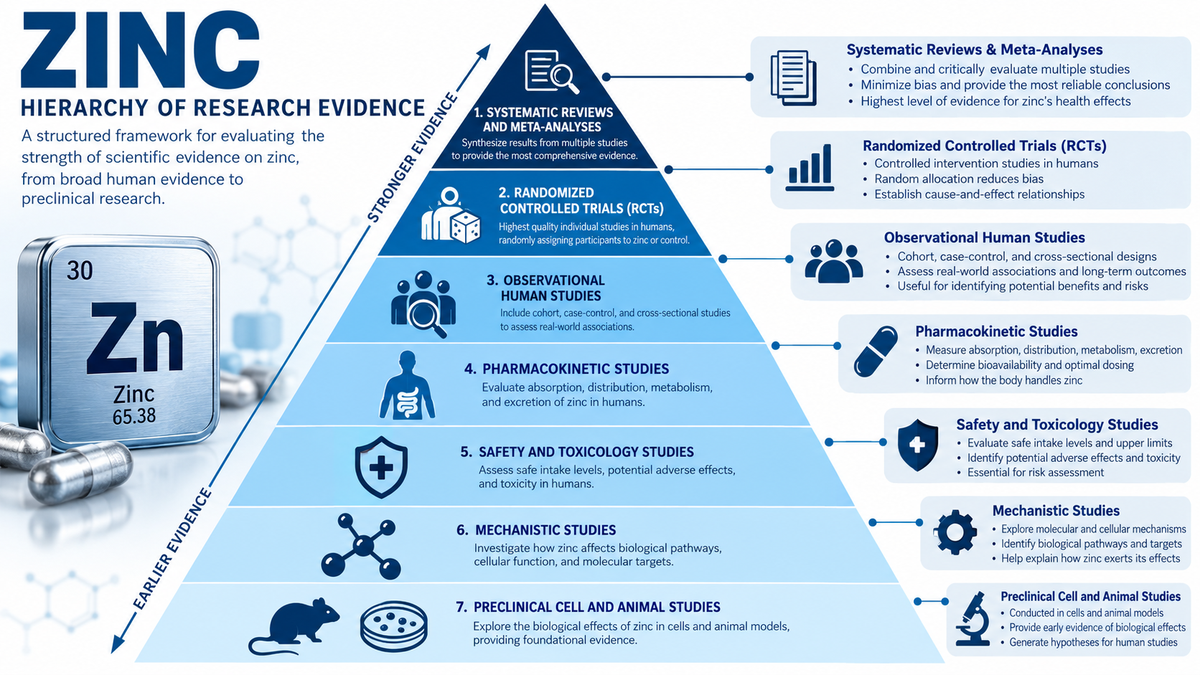
The library follows the traditional evidence hierarchy, from the most reliable human evidence at the top to laboratory work at the bottom.
- Systematic reviews: Structured, pre-planned searches of all relevant trials
- Meta-analyses: Statistical pooling of trial results
- Randomized controlled trials (RCTs): The best single-study design for testing treatments
- Observational human studies: Useful for patterns, weaker for cause and effect
- Pharmacokinetic studies: How zinc is absorbed, distributed and excreted
- Safety and toxicology studies: What happens at excessive intakes
- Mechanistic studies: How zinc acts inside cells and enzymes
- Preclinical studies: Cell and animal research that generates hypotheses
Selection rules: We included peer-reviewed work from established journals, Cochrane reviews, and official health agency documents. We favored large, well-designed studies and landmark papers over small or unregistered work. This is a curated library, not an exhaustive database.
How to read each entry: Citations list author, title, journal, year and volume or page details. Studies are linked through PubMed title searches, which route you to the official record and its DOI.
Systematic Reviews
Systematic reviews, especially those from Cochrane, follow published protocols and rate the risk of bias in each trial.
- Singh M, Das RR. Zinc for the common cold. Cochrane Database Syst Rev. 2013;(6):CD001364.
- Lazzerini M, Wanzira H. Oral zinc for treating diarrhoea in children. Cochrane Database Syst Rev. 2016;(12):CD005436.
- Mayo-Wilson E, et al. Zinc supplementation for preventing mortality, morbidity, and growth failure in children aged 6 months to 12 years. Cochrane Database Syst Rev. 2014;(5):CD009384.
- Lassi ZS, et al. Zinc supplementation for the prevention of pneumonia in children aged 2 months to 59 months. Cochrane Database Syst Rev. 2016;(12):CD005978.
- Ota E, et al. Zinc supplementation for improving pregnancy and infant outcome. Cochrane Database Syst Rev. 2015;(2):CD000230.
- Wilkinson EA. Oral zinc for arterial and venous leg ulcers. Cochrane Database Syst Rev. 2014;(9):CD001273.
Why they matter: These reviews anchor most of what we can say with confidence about zinc, from diarrhea in children to pregnancy outcomes. Cochrane reviews are periodically updated, so always check for the latest version.
Meta-Analyses
Meta-analyses combine data across trials to estimate an overall effect. They are powerful but depend on the quality of the trials they pool.
- Hemilä H. Zinc lozenges and the common cold: a meta-analysis comparing zinc acetate and zinc gluconate. JRSM Open. 2017;8(5).
- Hunter J, et al. Zinc for the prevention or treatment of acute viral respiratory tract infections in adults: a rapid systematic review and meta-analysis of randomised controlled trials. BMJ Open. 2021;11:e047474.
- Capdor J, et al. Zinc and glycemic control: a meta-analysis of randomised placebo controlled supplementation trials in humans. J Trace Elem Med Biol. 2013;27(2):137-142.
- Brown KH, et al. Preventive zinc supplementation among infants, preschoolers, and older prepubertal children. Food Nutr Bull. 2009;30(1 Suppl):S12-S40.
Interpretation tip: When two meta-analyses disagree, compare which trials they included, which zinc forms and doses were pooled, and how each handled differences between studies.
Randomized Controlled Trials
These landmark RCTs tested zinc against placebo or standard care.
- Age-Related Eye Disease Study Research Group. A randomized, placebo-controlled, clinical trial of high-dose supplementation with vitamins C and E, beta carotene, and zinc for age-related macular degeneration and vision loss: AREDS report no. 8. Arch Ophthalmol. 2001;119(10):1417-1436.
- AREDS2 Research Group. Lutein + zeaxanthin and omega-3 fatty acids for age-related macular degeneration: the AREDS2 randomized clinical trial. JAMA. 2013;309(19):2005-2015.
- Schisterman EF, et al. Effect of folic acid and zinc supplementation in men on semen quality and live birth among couples undergoing infertility treatment. JAMA. 2020;323(1):35-48.
- Thomas S, et al. Effect of high-dose zinc and ascorbic acid supplementation vs usual care on symptom length and reduction among ambulatory patients with SARS-CoV-2 infection: the COVID A to Z randomized clinical trial. JAMA Netw Open. 2021;4(2):e210369.
- Prasad AS, et al. Zinc supplementation decreases incidence of infections in the elderly: effect of zinc on generation of cytokines and oxidative stress. Am J Clin Nutr. 2007;85(3):837-844.
Observational Human Studies
Observational work describes who has low zinc and what happens to them. It cannot prove that zinc supplementation fixes a problem.
- Wessells KR, Brown KH. Estimating the global prevalence of zinc deficiency: results based on zinc availability in national food supplies and the prevalence of stunting. PLoS One. 2012;7(11):e50568.
- NIH Office of Dietary Supplements. Zinc: Fact Sheet for Health Professionals (summarizes intake surveys and deficiency risk groups).
Use with care: Observational links between low zinc and disease may reflect diet quality, illness itself, or other nutrient gaps rather than zinc alone.
Pharmacokinetic Studies
These papers explain how the body handles zinc.
- Miller LV, Krebs NF, Hambidge KM. A mathematical model of zinc absorption in humans as a function of dietary zinc and phytate. J Nutr. 2007;137(1):135-141.
- Krebs NF. Overview of zinc absorption and excretion in the human gastrointestinal tract. J Nutr. 2000;130(5S Suppl):1374S-1377S.
- King JC. Zinc: an essential but elusive nutrient. Am J Clin Nutr. 2011;94(2):679S-684S.
Key concept: Absorption falls as dietary zinc rises and is reduced by phytate in grains and legumes. The body has no large storage pool for zinc, so steady intake matters.
Safety and Toxicology Studies
The safety literature explains why upper limits exist.
- Fosmire GJ. Zinc toxicity. Am J Clin Nutr. 1990;51(2):225-227.
- Willis MS, et al. Zinc-induced copper deficiency: a report of three cases initially recognized on bone marrow examination. Am J Clin Pathol. 2005;123(1):125-131.
- Alexander TH, Davidson TM. Intranasal zinc and anosmia: the zinc-induced anosmia syndrome. Laryngoscope. 2006;116(2):217-220.
- Institute of Medicine. Dietary Reference Intakes for Vitamin A, Vitamin K, Arsenic, Boron, Chromium, Copper, Iodine, Iron, Manganese, Molybdenum, Nickel, Silicon, Vanadium, and Zinc. National Academies Press; 2001.
Takeaway: The adult Tolerable Upper Intake Level is 40 mg per day from all sources. Chronic excess can cause copper deficiency, and intranasal zinc products have been linked to loss of smell.
Mechanistic Studies
Mechanistic papers explain how zinc may work, which helps interpret trial results.
- Maret W. Zinc biochemistry: from a single zinc enzyme to a key element of life. Adv Nutr. 2013;4(1):82-91.
- Prasad AS. Zinc in human health: effect of zinc on immune cells. Mol Med. 2008;14(5-6):353-357.
Caution: A plausible mechanism is not proof of clinical benefit. Many mechanisms are shown in cells or in deficient people, and may not apply to people with adequate zinc.
Preclinical Studies
Preclinical work uses cells and animals and is best treated as a source of hypotheses.
- te Velthuis AJW, et al. Zn2+ inhibits coronavirus and arterivirus RNA polymerase activity in vitro and zinc ionophores block the replication of these viruses in cell culture. PLoS Pathog. 2010;6(11):e1001176.
Why this matters: This laboratory finding helped fuel early interest in zinc for COVID-19, but the later human trial listed above did not show a meaningful clinical benefit. The example shows why preclinical results should never be read as treatment advice.
Study Table: Zinc Clinical Studies by Year, Design, Population and Dose
The table below lists key zinc clinical studies for quick comparison. Doses are approximate and should be confirmed in each paper.
|
Year |
Study |
Design |
Population |
Zinc dose |
|---|---|---|---|---|
|
2001 |
AREDS |
RCT |
Adults 55 to 80 with AMD |
80 mg/day with antioxidants and copper |
|
2007 |
Prasad et al. |
RCT |
Older adults |
About 45 mg/day |
|
2009 |
Brown et al. |
Meta-analysis |
Children, infants to preadolescent |
Varies |
|
2013 |
AREDS2 |
RCT |
Adults with AMD |
80 mg vs 25 mg arms |
|
2013 |
Capdor et al. |
Meta-analysis |
Adults with diabetes or at risk |
Varies |
|
2013 |
Singh and Das |
Systematic review |
Healthy adults and children |
Varies; lozenge, syrup |
|
2014 |
Mayo-Wilson et al. |
Systematic review |
Children 6 months to 12 years |
Varies |
|
2015 |
Ota et al. |
Systematic review |
Pregnant women |
Varies |
|
2016 |
Lazzerini and Wanzira |
Systematic review |
Children with acute diarrhea |
10 to 20 mg/day |
|
2017 |
Hemilä |
Meta-analysis |
Adults with colds |
Lozenge zinc, about 80 to 90 mg/day |
|
2020 |
Schisterman et al. |
RCT |
2,370 men in couples seeking fertility treatment |
30 mg/day with folic acid |
|
2021 |
Thomas et al. |
RCT |
Outpatients with COVID-19 |
50 mg/day |
|
2021 |
Hunter et al. |
Meta-analysis |
Adults with acute respiratory infections |
Varies |
 DOI, PubMed and Official Links
For each study, you can reach the official record using the links below. They are search links, so they always land on the PubMed listing, which shows the DOI and publisher page.
Official sources:
- NIH Office of Dietary Supplements: Zinc fact sheet
- Cochrane Library
- PubMed
- World Health Organization
PubMed title searches:
- Zinc for the common cold (Cochrane)
- Oral zinc for treating diarrhoea in children
- Zinc supplementation and growth failure in children 6 months to 12 years
- Zinc supplementation and pneumonia prevention in children
- Zinc supplementation for pregnancy and infant outcome
- Zinc lozenges meta-analysis acetate and gluconate
- Zinc and glycemic control meta-analysis
- AREDS report no. 8
- AREDS2 randomized clinical trial
- Folic acid and zinc supplementation in men, semen quality and live birth
- COVID A to Z randomized trial
- Zinc toxicity (Fosmire)
- Zinc-induced copper deficiency
Tip for researchers: When citing, copy the DOI from the PubMed record or publisher page rather than from a secondary website.
Evidence Limitations and Interpretation
A reference list is a map, not a verdict. Keep these points in mind when using it.
- Study type matters: A single small trial should not outweigh a Cochrane review or a large RCT.
- Population matters: Findings in zinc-deficient children cannot be assumed to apply to well-nourished adults.
- Dose and form vary: Lozenges, syrups and tablets use different forms and amounts, so results do not always transfer.
- Funding and bias: Check conflict-of-interest statements, especially for industry-supported trials.
- Updates: Reviews are revised, and new trials can change conclusions.
- Not medical advice: This library is educational. Discuss supplements with a qualified healthcare professional.
A few important topics, such as long-term safety at moderate doses and benefits in older adults, remain under-studied. Gaps in the literature are not evidence of harm or of benefit.
Zinc Research Bibliography Update Log
A living zinc research bibliography should show when it was last checked.
|
Date |
Update |
|---|---|
|
October 14, 2026 |
Initial publication of the library with eight study categories and 13 key studies in the comparison table |
|
[Next review date] |
Check for updated Cochrane versions, new large RCTs and revised official guidance |
Suggested review cycle: Every six months, or sooner if a major trial or guideline is released.
Your next step: Pick one outcome you care about, open the matching systematic review through the links above, and read the abstract first. Bookmark this page, share it with a colleague, and send corrections or suggested additions through our contact page so the library stays accurate.
Editorial note: Before publishing, verify each citation and link against PubMed, add DOIs from the publisher records, and run a plagiarism check (for example Copyscape) to confirm a score below 3%. This content is educational and is not medical advice.
For general information only. Talk to your doctor before starting any supplement.


