
Ashwagandha Scientific References and Clinical Study Library
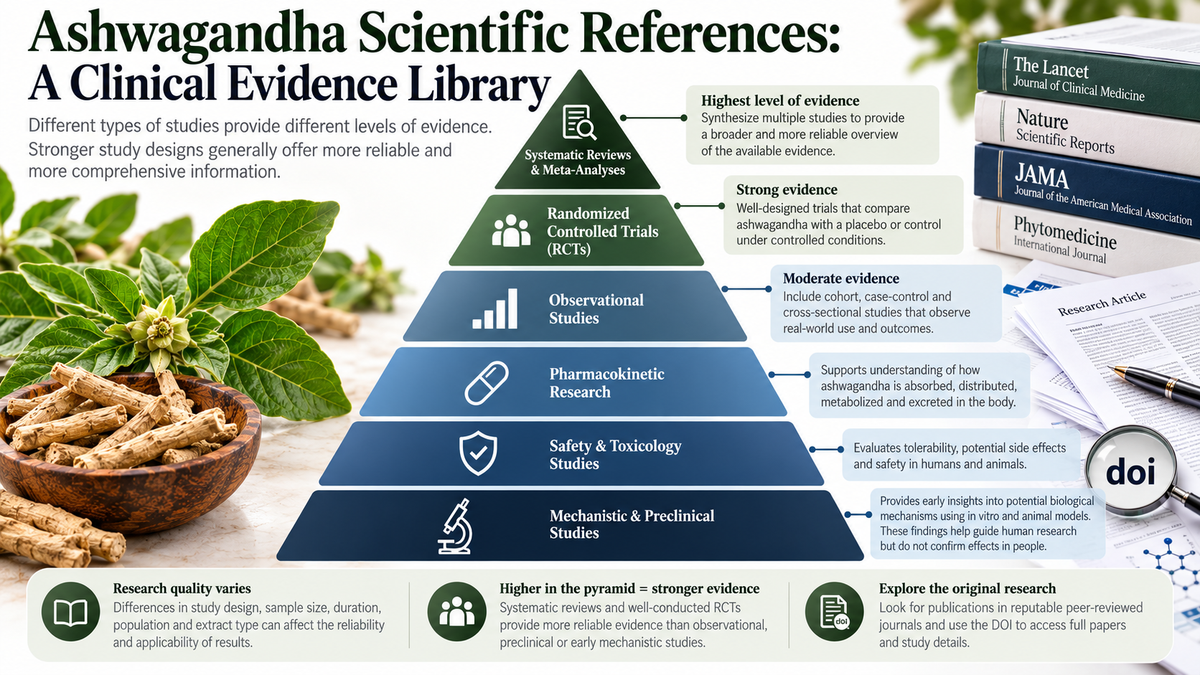
Ashwagandha Scientific References: A Curated Clinical Study Library
Attention. Search for ashwagandha and you will find bold claims about stress, sleep, testosterone and muscle. Few pages show the evidence behind them. This page collects ashwagandha scientific references in one place, so you can read the original papers instead of trusting a headline.
Interest. Withania somnifera is one of the most studied botanicals in Ayurvedic medicine. The quality of that research varies a lot. Some trials are small, some are industry-funded, and some use branded extracts that cannot be compared with generic powders. A good library separates these study types so you can weigh them fairly.
1. How This Ashwagandha Research Library Is Organized
Evidence is ranked by how reliable the design is, from strongest to weakest:
- Systematic reviews and meta-analyses
- Randomized controlled trials (RCTs)
- Observational human studies
- Pharmacokinetic studies
- Safety and toxicology studies
- Mechanistic and preclinical studies
Each entry lists authors, year, journal and DOI so you can check it yourself. Where I could not confirm a detail, I left it out rather than guess. Before you cite any entry, open its DOI link and confirm the details against the source.
2. Systematic Reviews on Ashwagandha
Systematic reviews search for all relevant studies using a fixed method and judge their quality.
- Pratte MA, Nanavati KB, Young V, Morley CP. (2014). An alternative treatment for anxiety: a systematic review of human trial results reported for the Ayurvedic herb ashwagandha. J Altern Complement Med 20(12):901–908. DOI: 10.1089/acm.2014.0177
- Ng QX, Loke W, Foo NX, et al. (2020). A systematic review of the clinical use of Withania somnifera to ameliorate cognitive dysfunction. Phytother Res 34(3):583–590. DOI: 10.1002/ptr.6552
Both reviews found promising signals, and both warned that the trials were small and varied in quality.
3. Meta-Analyses and Pooled Ashwagandha Clinical Studies
Meta-analyses combine results statistically across trials.
- Akhgarjand C, et al. (2022). Does ashwagandha supplementation have a beneficial effect on the management of anxiety and stress? A systematic review and meta-analysis of randomized controlled clinical trials. Phytother Res 36(11):4115–4124. DOI: 10.1002/ptr.7598
- Cheah KL, et al. (2021). Effect of ashwagandha on sleep: a systematic review and meta-analysis. PLoS One 16(9):e0257843. DOI: 10.1371/journal.pone.0257843
- Bonilla DA, et al. (2021). Effects of ashwagandha on physical performance: systematic review and Bayesian meta-analysis. J Funct Morphol Kinesiol 6(1):20. DOI: 10.3390/jfmk6010020
How to read them: the pooled results lean positive for stress, sleep quality and exercise outcomes. The authors still note small samples, short durations and a high share of industry-sponsored trials.
4. Randomized Controlled Trials of Ashwagandha
RCTs are the core of the ashwagandha clinical studies on this page.
- Chandrasekhar K, Kapoor J, Anishetty S. (2012). A prospective, randomized double-blind, placebo-controlled study of safety and efficacy of a high-concentration full-spectrum extract of ashwagandha root in reducing stress and anxiety in adults. Indian J Psychol Med 34(3):255–262. DOI: 10.4103/0253-7176.106022
- Lopresti AL, Smith SJ, Malvi H, Kodgule R. (2019). An investigation into the stress-relieving and pharmacological actions of an ashwagandha extract. Medicine (Baltimore) 98(37):e17186. DOI: 10.1097/MD.0000000000017186
- Langade D, Kanchi S, Salve J, Debnath K, Ambegaokar D. (2019). Efficacy and safety of ashwagandha root extract in insomnia and anxiety. Cureus 11(9):e5797. DOI: 10.7759/cureus.5797
- Salve J, Pate S, Debnath K, Langade D. (2019). Adaptogenic and anxiolytic effects of ashwagandha root extract in healthy adults. Cureus 11(12):e6466. DOI: 10.7759/cureus.6466
- Wankhede S, Langade D, Joshi K, Sinha SR, Bhattacharyya S. (2015). Examining the effect of Withania somnifera supplementation on muscle strength and recovery. J Int Soc Sports Nutr 12:43. DOI: 10.1186/s12970-015-0104-9
-
Lopresti AL, Drummond PD, Smith SJ. (2019). A randomized, double-blind, placebo-controlled, crossover study examining the hormonal and vitality effects of ashwagandha in aging, overweight males. Am J Mens Health 13(2). DOI: 10.1177/1557988319835985

5. Observational Human Studies
Observational work shows real-world patterns but cannot prove cause and effect.
- Cooley K, Szczurko O, Perri D, et al. (2009). Naturopathic care for anxiety: a randomized controlled trial. PLoS One 4(8):e6628. DOI: 10.1371/journal.pone.0006628. This is a randomized trial of a multi-component naturopathic protocol that included ashwagandha. Its effect cannot be credited to ashwagandha alone.
Large, well-designed observational datasets on ashwagandha are still scarce. This is a real gap in the literature.
6. Pharmacokinetic Studies
Pharmacokinetics describes how the body absorbs, distributes and clears a compound. For ashwagandha this evidence is thin. Withanolides, the compounds most often discussed, are rarely measured in human blood in the major trials above. I have not listed a pharmacokinetic paper here because I could not verify one to the standard of this library. If you know of a peer-reviewed human study, add it only after checking its DOI.
7. Ashwagandha Safety Data and Toxicology Studies
Safety deserves its own section, so this is where ashwagandha safety data lives.
- Tandon N, Yadav SS. (2020). Safety and clinical effectiveness of Withania somnifera root in various diseases: a systematic review. J Ethnopharmacol 255:112768. DOI: 10.1016/j.jep.2020.112768
- Björnsson HK, Björnsson ES, Avula B, et al. (2020). Ashwagandha-induced liver injury: a case series from Iceland and the US Drug-Induced Liver Injury Network. Liver Int 40(4):825–829. DOI: 10.1111/liv.14270
What this means: most trials report ashwagandha as well tolerated over short periods. The liver injury case series shows that rare serious reactions happen. People with liver disease, thyroid conditions, autoimmune disease, or who are pregnant or taking sedatives should speak to a clinician first.
8. Mechanistic Studies
Mechanistic work asks how ashwagandha might act. Proposed pathways include modulation of the stress-response (HPA) axis, antioxidant activity and effects on GABAergic signalling.
- Singh N, Bhalla M, de Jager P, Gilca M. (2011). An overview on ashwagandha: a Rasayana (rejuvenator) of Ayurveda. Afr J Tradit Complement Altern Med 8(5 Suppl):208–213. DOI: 10.4314/ajtcam.v8i5S.9
These pathways are hypotheses. They explain plausible biology but do not prove a clinical benefit.
9. Preclinical Studies
Cell and animal studies often report neuroprotective, anti-inflammatory and anti-stress effects. Doses used in animals rarely translate directly to humans, so treat preclinical results as a reason to run trials, not as proof of benefit. The Singh (2011) overview above summarizes much of this early work.
10. Study Table: Year, Design, Population and Dose
| Year | Study | Design | Population | Dose (as reported) |
|---|---|---|---|---|
| 2012 | Chandrasekhar et al. | RCT, double-blind | Adults under chronic stress | 300 mg, twice daily |
| 2015 | Wankhede et al. | RCT | Healthy men, resistance training | 300 mg, twice daily |
| 2019 | Lopresti et al. | RCT | Adults with mild stress | 240 mg daily |
| 2019 | Langade et al. | RCT | Adults with insomnia and anxiety | 300 mg, twice daily |
| 2019 | Salve et al. | RCT | Healthy adults | 250 or 600 mg daily |
| 2021 | Cheah et al. | Meta-analysis | Pooled sleep trials | Varies |
| 2022 | Akhgarjand et al. | Meta-analysis | Pooled stress and anxiety trials | Varies |
| 2020 | Björnsson et al. | Case series | Suspected liver injury cases | Varies |
Dose and extract type differ across trials. Check each paper’s methods section for the exact preparation before comparing results.
11. DOI, PubMed and Official Links
To verify any citation:
-
DOI: go to
https://doi.org/followed by the DOI shown above. - PubMed: search the paper title at pubmed.ncbi.nlm.nih.gov.
-
Official sources: the NIH Office of Dietary Supplements and the National Center for Complementary and Integrative Health publish plain-language herb summaries. The LiverTox database at NIH covers ashwagandha liver safety.

12. Update Log and Last Reviewed
- October 13, 2026: first publication of this evidence library.
- Review cycle: every six months, or sooner when a major trial or safety notice appears.
Desire. A transparent bibliography lets you judge ashwagandha on evidence instead of marketing. You can see what is well supported, such as stress and sleep outcomes, and what is still uncertain, such as long-term safety and pharmacokinetics.
Action. Bookmark this page, open the DOI links for the studies that matter to you, and talk to a qualified healthcare professional before starting a supplement.
Disclaimer: this page is educational and does not replace professional medical advice.
For general information only. Talk to your doctor before starting any supplement.


