
Saffron Scientific References & Clinical Study Library
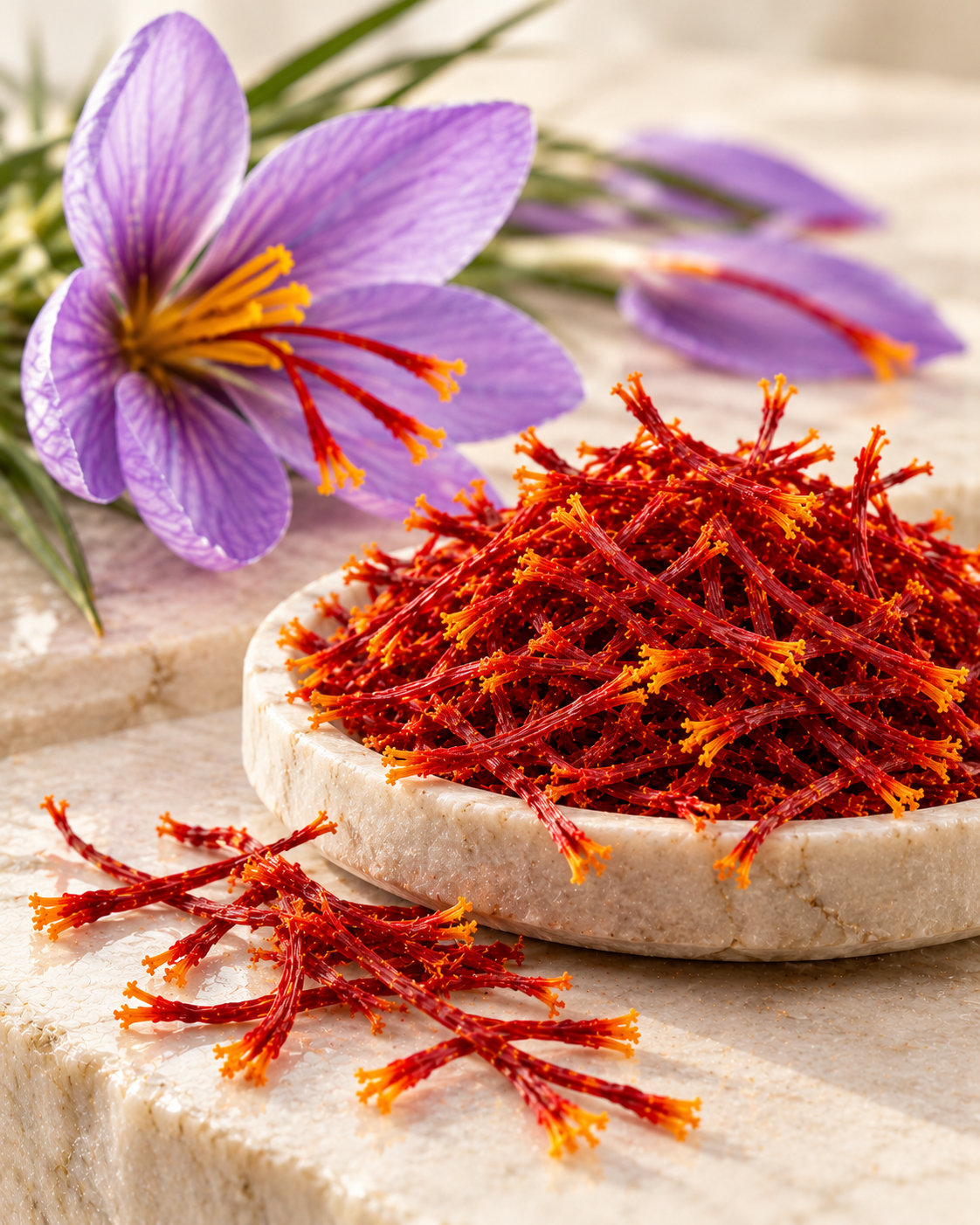
Saffron Scientific References and Clinical Study Library
Saffron (Crocus sativus L.) is one of the most studied culinary botanicals in mental health and eye research, yet its literature is small compared with that of approved drugs. This library gathers the key human and laboratory studies in one place so that readers, clinicians and content editors can trace claims back to their source. Entries are grouped by study type, summarized in a single table, and linked to PubMed, DOI or PubMed Central pages.
This page is a reference tool, not medical advice. Inclusion of a study does not mean its results are strong or have been replicated.
1. How This Library Is Organized
Studies are sorted from the highest level of evidence to the lowest: systematic reviews and meta-analyses first, then randomized controlled trials, observational or open-label human studies, pharmacokinetic and safety studies, and finally mechanistic and preclinical work.
• Every entry lists author or title, journal, year, design, population and dose where known.
• Links point to PubMed, a DOI, or PubMed Central. Where a link is a PubMed search rather than a direct record, it is labeled that way.
• A dagger symbol (†) marks entries whose bibliographic details were not independently re-checked during the last review and should be confirmed before citing.
• Most trials use the stigma extract at about 20 to 30 mg per day, so results should not be generalized to petal extracts, culinary use or very high doses.
• The library is conservative. It lists a smaller number of confirmed sources instead of a long list of unchecked citations.
 2. Systematic Reviews
Systematic reviews describe all relevant trials without necessarily pooling the data. The key review for saffron is by Lopresti and Drummond (2014), published in Human Psychopharmacology. It examined randomized, double-blind studies of saffron for depression, detailing dosages, extract sources, standardization, safety and treatment duration. It also reviewed proposed antidepressant mechanisms, including serotonergic, antioxidant, anti-inflammatory, neuroendocrine and neuroprotective actions. The authors concluded that research provided initial support for mild-to-moderate depression and that more studies were needed.
Reading note: reviews of saffron concentrate on depression, so evidence for other uses such as sleep, appetite, menstrual symptoms or eye health is less often summarized in formal systematic reviews.
3. Meta-Analyses
Meta-analyses pool trial results statistically. Several have been published on saffron and depression, and they broadly agree on direction while differing on size and certainty.
• Hausenblas et al., 2013 (J Integr Med): five randomized trials, two placebo-controlled and three antidepressant-controlled, with high Jadad quality scores. Saffron improved depressive symptoms in adults with major depressive disorder.
• Tóth et al., 2019 (Planta Med): eleven trials in the qualitative analysis and nine pooled, reporting a significant effect on depression severity in mild to moderate depression.
• Neuropsychiatric Disease and Treatment, 2018: seven double-blind trials comparing saffron with placebo or synthetic antidepressants.
• Journal of Nervous and Mental Disease, 2020: twelve studies. Saffron outperformed placebo, was comparable to antidepressants, and showed no significant difference in adverse-effect incidence.
• Umbrella meta-analysis, Pharmacological Research, 2021: seven meta-analyses. Saffron reduced Beck Depression Inventory scores, but the Hamilton scale result was not statistically significant, and the authors concluded that saffron should not be considered a stand-alone treatment.
The umbrella review is a useful reminder that pooled results depend on the scale used and on the trials included. Many included trials overlap across meta-analyses, so the reviews are not fully independent confirmation of each other.
4. Randomized Controlled Trials
Randomized trials provide the best direct evidence of benefit. Saffron trials are mostly small, short and conducted by a limited number of research groups.
Depression
• Noorbala et al., 2005 (J Ethnopharmacol): 40 adults with mild to moderate depression took 30 mg per day of a hydro-alcoholic saffron extract or 20 mg per day of fluoxetine for six weeks. Both groups improved, with no significant difference between them.
• Shahmansouri et al., 2014 (J Affect Disord): 40 patients with depression after percutaneous coronary intervention received saffron 30 mg per day or fluoxetine 40 mg per day for six weeks. Efficacy was similar, and adverse events were systematically recorded.
• Akhondzadeh et al., 2005 (Phytother Res)†: a placebo-controlled trial of saffron in mild to moderate depression, frequently cited as an early positive study.
Eye health
• Falsini et al., 2010 (Invest Ophthalmol Vis Sci): 25 patients with early age-related macular degeneration received saffron 20 mg per day or placebo for three months in a crossover design. Retinal flicker sensitivity improved after saffron but not placebo.
Other randomized trials exist for anxiety, sleep, premenstrual symptoms, metabolic markers and appetite, but they are not itemized here because their bibliographic details were not confirmed in this review. Readers should search PubMed for the latest trials.
5. Observational Human Studies
True observational studies of saffron are scarce. Most human data come from interventional trials. The closest examples are uncontrolled follow-up or open-label studies.
• Piccardi et al., 2012 (Evid Based Complement Alternat Med): 29 patients with early age-related macular degeneration took saffron 20 mg per day for an average of 14 months, with follow-up every three months. Retinal sensitivity improved and the improvement was maintained. There was no placebo group, so the result cannot separate saffron's effect from other factors.
Population-level studies of dietary saffron intake, adverse event registries and long-term cohort data were not found in this review. This is a recognized gap.
6. Pharmacokinetic Studies
Pharmacokinetic studies describe how saffron compounds are absorbed and processed. The main finding is that crocins, the glycosylated pigments, are converted to crocetin in the gut, and crocetin is what appears in plasma.
• Umigai et al., 2011 (Phytomedicine): ten healthy adults received single oral doses of crocetin at 7.5, 15 and 22.5 mg in an open-label escalation study with one week between doses.
• Pharmacokinetics of a commercial saffron extract (PubMed Central record PMC7013346): thirteen healthy volunteers received 56 mg or 84 mg of a standardized extract in a single-dose, randomized, double-blind design. Plasma crocetin peaked about 60 to 90 minutes after dosing, with a dose-dependent response.
These studies are small and short. They do not examine repeated dosing, older adults, people with liver or kidney disease, or interactions with medicines.
7. Safety and Toxicology Studies
• Modaghegh et al., 2008 (Phytomedicine): a randomized, double-blind, placebo-controlled study in 30 healthy adults given 200 to 400 mg per day of saffron tablets for one week, evaluating blood, biochemical and cardiovascular measures.
• Mohamadpour et al., 2013 (Iran J Basic Med Sci): 44 healthy volunteers, 22 per group, received 20 mg per day of crocin tablets or placebo for one month. No major adverse events were reported. Small decreases in amylase, mixed white blood cells and partial thromboplastin time were observed.
• Bostan et al., 2017 (Iran J Basic Med Sci)†: a review of toxicological effects of saffron and its constituents in animals and humans.
For readers interested in side effects, the pooled safety comparison in the 2020 meta-analysis is also relevant. See the companion pages on safety and interactions for interpretation.
8. Mechanistic Studies
Mechanistic work tries to explain why saffron might work. Proposed pathways include effects on serotonin and other monoamines, antioxidant and anti-inflammatory activity, neuroprotection and modulation of the stress axis. The narrative section of the Lopresti and Drummond review summarizes these hypotheses for depression, and the retinal studies cited above relate to proposed antioxidant and cone-protective effects.
A caution applies: mechanistic findings from cells and animals show plausibility, not clinical benefit. Doses used in laboratory studies can exceed what a person could reach by supplementation.
9. Preclinical Studies
Preclinical work includes cell cultures and rodent studies on saffron, crocin, crocetin and safranal across mood, memory, metabolic, cardiovascular, anticancer and toxicity endpoints. The toxicology review by Bostan et al.† is a good entry point for safety-related animal data. Because these studies are numerous and uneven in quality, this library does not itemize them. They should be treated as hypothesis-generating only.
10. Study Table with Year, Design, Population and Dose
|
Study |
Year |
Design |
Population |
Dose / duration |
|
Hausenblas et al. |
2013 |
Meta-analysis |
5 RCTs, adults with major depression |
Varied, stigma/petal |
|
Lopresti & Drummond |
2014 |
Systematic review |
Randomized double-blind depression trials |
Varied |
|
Tóth et al. |
2019 |
Meta-analysis |
11 RCTs (9 pooled), mild to moderate depression |
Pharmacological oral doses |
|
Neuropsychiatr Dis Treat |
2018 |
Meta-analysis |
7 double-blind RCTs, adult depression |
Varied |
|
J Nerv Ment Dis |
2020 |
Meta-analysis |
12 studies, mild to moderate depression |
Varied |
|
Umbrella analysis |
2021 |
Umbrella meta-analysis |
7 meta-analyses, depression |
Varied |
|
Noorbala et al. |
2005 |
RCT vs fluoxetine |
n = 40, mild to moderate depression |
30 mg/day, 6 weeks |
|
Shahmansouri et al. |
2014 |
RCT vs fluoxetine |
n = 40, depression after PCI |
30 mg/day, 6 weeks |
|
Falsini et al. |
2010 |
Crossover RCT |
n = 25, early AMD |
20 mg/day, 3 + 3 months |
|
Piccardi et al. |
2012 |
Open-label follow-up |
n = 29, early AMD |
20 mg/day, about 14 months |
|
Umigai et al. |
2011 |
PK, open-label |
n = 10 healthy adults |
Crocetin 7.5, 15, 22.5 mg single doses |
|
Saffron extract PK (PMC7013346) |
n/a |
PK, randomized double-blind |
n = 13 healthy adults |
56 or 84 mg single dose |
|
Modaghegh et al. |
2008 |
Safety RCT |
n = 30 healthy adults |
200-400 mg/day, 1 week |
|
Mohamadpour et al. |
2013 |
Safety RCT (crocin) |
n = 44 healthy adults |
20 mg/day, 1 month |
Pattern in the table: sample sizes are small, durations are short, and most doses sit between 20 and 30 mg per day. Studies longer than a year are rare.
11. DOI, PubMed and Official Links
Systematic reviews and meta-analyses
• Lopresti and Drummond 2014 (PubMed): https://pubmed.ncbi.nlm.nih.gov/25384672/
• Lopresti and Drummond 2014 (DOI): https://doi.org/10.1002/hup.2434
• Hausenblas 2013 (PubMed): https://pubmed.ncbi.nlm.nih.gov/24299602/
• Hausenblas 2013 (DOI): https://doi.org/10.3736/jintegrmed2013056
• Tóth 2019, Planta Med (PubMed): https://pubmed.ncbi.nlm.nih.gov/30036891/
• Tóth 2019, Planta Med (DOI): https://doi.org/10.1055/a-0660-9565
• Neuropsychiatr Dis Treat 2018 (DOI): https://doi.org/10.2147/NDT.S157550
• J Nerv Ment Dis 2020 (PubMed): https://pubmed.ncbi.nlm.nih.gov/32221179/
• Umbrella meta-analysis 2021 (PubMed): https://pubmed.ncbi.nlm.nih.gov/34757208/
Randomized and open-label trials
• Shahmansouri 2014 (PubMed): https://pubmed.ncbi.nlm.nih.gov/24289892/
• Falsini 2010 (PubMed): https://pubmed.ncbi.nlm.nih.gov/20688744/
• Falsini 2010 (DOI): https://doi.org/10.1167/iovs.09-4995
• Piccardi 2012 (PubMed Central): https://pmc.ncbi.nlm.nih.gov/articles/PMC3407634
• Piccardi 2012 (DOI): https://doi.org/10.1155/2012/429124
• Noorbala 2005 (PubMed search): https://pubmed.ncbi.nlm.nih.gov/?term=Noorbala+hydro-alcoholic+extract+Crocus+sativus+fluoxetine
• Akhondzadeh 2005† (PubMed search): https://pubmed.ncbi.nlm.nih.gov/?term=Akhondzadeh+Crocus+sativus+mild+to+moderate+depression+placebo
Pharmacokinetics and safety
• Umigai 2011 (DOI): https://doi.org/10.1016/j.phymed.2010.10.019
• Saffron extract pharmacokinetics (PubMed Central): https://pmc.ncbi.nlm.nih.gov/articles/PMC7013346
• Modaghegh 2008 (DOI): https://doi.org/10.1016/j.phymed.2008.06.003
• Mohamadpour 2013 (PubMed Central): https://pmc.ncbi.nlm.nih.gov/articles/PMC3637903
• Bostan 2017† (PubMed search): https://pubmed.ncbi.nlm.nih.gov/?term=Bostan+Mehri+Hosseinzadeh+toxicology+saffron+review
Official and regulatory resources
• PubMed (U.S. National Library of Medicine): https://pubmed.ncbi.nlm.nih.gov/
• NCCIH, National Institutes of Health: https://www.nccih.nih.gov/
• ClinicalTrials.gov registry: https://clinicaltrials.gov/
12. Update Log and Last Reviewed
|
Date |
Version |
Notes |
|
12 October 2026 |
1.0 (initial release) |
Library created. Meta-analyses, trials, pharmacokinetic and safety entries checked against PubMed, DOI or PubMed Central records. Items marked † were not re-checked. |
|
Planned |
Quarterly review |
Search PubMed for new saffron trials, add anxiety, sleep and metabolic studies, and replace PubMed search links with direct record links. |
• Last reviewed: 12 October 2026.
• Next review due: January 2027.
• Search terms used: saffron, Crocus sativus, crocin, crocetin, safranal combined with trial, meta-analysis, safety and pharmacokinetics.
• Corrections or additions should cite a PubMed ID or DOI.
Disclaimer: This library is for general information and does not replace professional medical advice. Always verify citations against the original source before using them in clinical, regulatory or commercial content.
For general information only. Talk to your doctor before starting any supplement.


