
CoQ10 Scientific References: Clinical Study Library
Search results for coenzyme Q10 mix rigorous trials with marketing claims. This page collects CoQ10 scientific references in one place, so you can read the original evidence yourself. Every entry is linked to its DOI or PubMed record, and each section says what the research does and does not show.
CoQ10 (ubiquinone, with its reduced form ubiquinol) is a fat-soluble molecule found in mitochondria. It takes part in cellular energy production and acts as a lipid-soluble antioxidant. That biology is well established. Whether supplements improve clinical outcomes is a separate question, and the answer varies by condition.
This page is educational. It is not medical advice and does not recommend treatment.
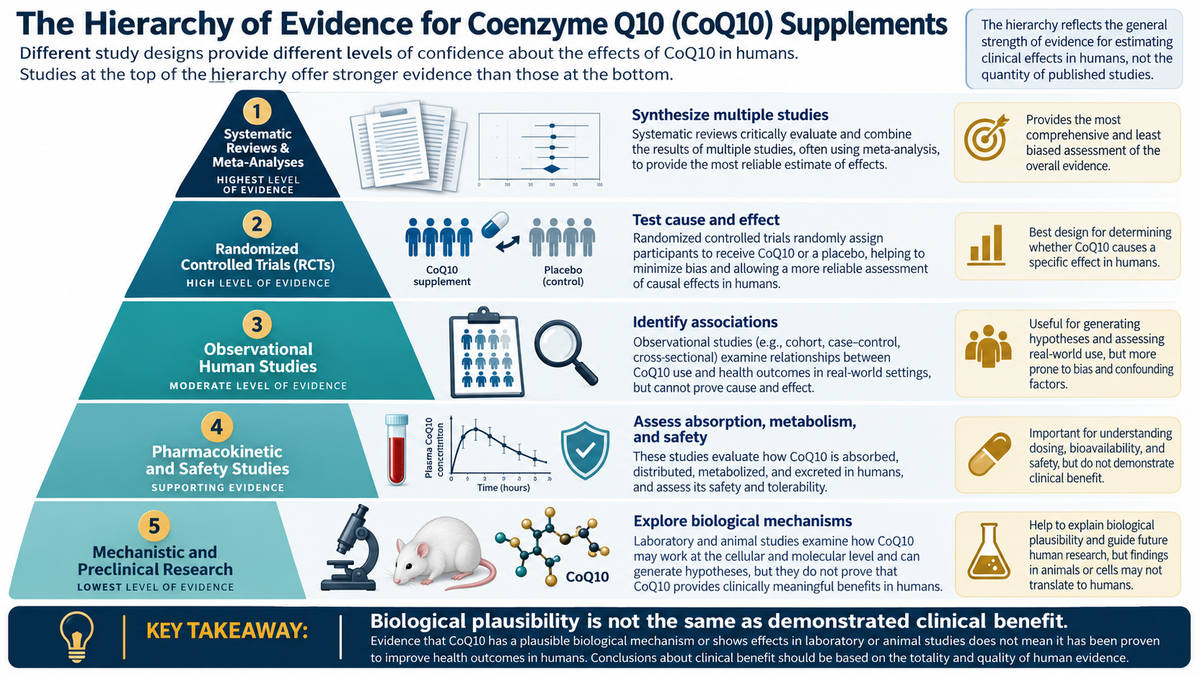
How This Library of CoQ10 Scientific References Is Organized
Studies are grouped by design, from the strongest evidence to the weakest:
- Systematic reviews and meta-analyses, which pool many studies
- Randomized controlled trials (RCTs), the best single-study design for testing cause and effect
- Observational human studies, which can show associations but not proof of cause
- Pharmacokinetic and safety studies, which describe absorption and tolerability
- Mechanistic and preclinical studies, which explain plausible biology but do not prove human benefit
Each section labels findings as established (consistent, replicated), preliminary (promising, limited, or inconsistent), or not supported. A summary table and a full reference list follow. The reference list was assembled from our editorial review of peer-reviewed literature and is not a complete database of all CoQ10 research.
Systematic Reviews on CoQ10 and Health Outcomes
Systematic reviews follow a predefined method to find and appraise all relevant studies. They are generally more reliable than any single trial.
- Cardiovascular prevention. A Cochrane review (Flowers et al., 2014) examined CoQ10 for preventing cardiovascular disease. It found the evidence too limited to draw conclusions about prevention benefits. [1]
- Heart failure. A Cochrane review (Madmani et al., 2014) judged the evidence insufficient to support routine use, citing small trials and inconsistent outcomes. [2]
- Blood pressure. A Cochrane review (Ho et al., 2016) concluded that data were insufficient to establish a reliable blood-pressure-lowering effect. [3]
- Aging and disease. Hernández-Camacho et al. (2018) reviewed CoQ10 in aging and chronic disease. They described a biological rationale and mixed clinical results. [4]
Takeaway: High-level reviews generally call for larger, better-designed trials. They do not confirm that CoQ10 prevents or treats disease.
Meta-Analyses of CoQ10 Randomized Trials
Meta-analyses statistically combine results from multiple trials. Their quality depends on the quality of the trials included.
- Statin-associated muscle symptoms. Banach et al. (2015) pooled randomized trials with roughly 300 participants in total. They reported no significant benefit for muscle pain in their analysis. [5] Trials in this area are small and vary in design, so this remains an unsettled question.
- Heart failure. Lei and Liu (2017) pooled randomized trials in cardiac failure and reported some favorable signals for selected outcomes. The authors noted heterogeneity and called for larger trials. [6]
- Blood pressure. Rosenfeldt et al. (2007) pooled earlier studies and suggested a modest reduction. The included studies were small, which limits confidence. [7]
Evidence status: Preliminary. Results differ between meta-analyses, and publication bias and small samples are recurring concerns.
Randomized Controlled Trials Evaluating CoQ10
RCTs randomly assign people to CoQ10 or placebo, which reduces bias. The most-cited trials are summarized below.
Heart failure (Q-SYMBIO). Mortensen et al. (2014) randomized 420 patients with chronic heart failure to 300 mg/day CoQ10 or placebo for two years, alongside standard care. The short-term primary endpoint did not differ between groups. A secondary analysis found fewer major adverse cardiovascular events with CoQ10. [8] This is a notable signal, but it has not been replicated at scale.
Older adults (KiSel-10). Alehagen et al. (2013) gave elderly Swedish participants 200 mg/day CoQ10 plus selenium yeast for four years. They reported lower cardiovascular mortality than placebo. [9] The intervention combined two supplements, and the participants lived in a selenium-low region, so the findings may not apply elsewhere.
Parkinson’s disease. A phase II trial (Shults et al., 2002) tested 300, 600, and 1,200 mg/day in 80 people with early disease. The highest dose was associated with less functional decline. [10] The larger phase III QE3 trial (Parkinson Study Group, 2014) tested 1,200 and 2,400 mg/day in 600 participants. It was stopped for futility because it showed no benefit over placebo. [11] This is a clear example of promising early results not holding up, so CoQ10 for Parkinson’s disease is not supported by current evidence.
Statin myopathy. Taylor et al. (2015) randomized 41 statin-intolerant patients to 600 mg/day CoQ10 or placebo for 12 weeks. They found no benefit for muscle symptoms. [12]
Observational Human Studies
Observational studies track people without assigning treatments. They can reveal patterns but cannot rule out confounding, such as healthier people choosing to take supplements.
Research in this category includes studies showing that tissue and blood CoQ10 levels decline with age and are lower in some conditions, including heart failure and statin use. [4] Lower levels do not prove that supplementation corrects a problem. Several trials above tested this idea directly, with mixed results.
Evidence status: Hypothesis-generating only.
Pharmacokinetic Studies of CoQ10 Absorption
CoQ10 is lipophilic and large, so absorption is limited and variable. Key points from the literature:
- Absorption is improved when taken with dietary fat. [13]
- Plasma levels rise slowly and may show more than one peak, reflecting intestinal absorption and liver recirculation. [13]
- Formulation matters. Mantle and Dybring (2020) reviewed ubiquinone and ubiquinol products and found that solubilized and ubiquinol formulations often produce higher blood levels than standard powder. [14]
- Higher blood levels have not been proven to produce better clinical results.
Evidence status: Established for general behavior. Product-to-product comparisons are often small and sometimes manufacturer-funded.
CoQ10 Safety and Toxicology Studies
CoQ10 is generally well tolerated in clinical trials. Hathcock and Shao (2006) reviewed human trials and proposed an observed safe level of 1,200 mg/day for healthy adults. [15] Reported side effects are usually mild, such as digestive upset, insomnia, or rash.
Interactions: A 1994 report described reduced warfarin effect in a few patients taking ubidecarenone. [16] Later evidence is mixed, but people on anticoagulants should discuss CoQ10 with their prescriber and have their clotting monitored.
Limits: Most trials last months, not decades. Long-term data in pregnancy, children, and people with kidney or liver disease are limited. Supplement purity and dose vary between products.
Mechanistic Studies Explaining How CoQ10 Works
Mechanistic studies explain how CoQ10 might act. CoQ10 shuttles electrons in the mitochondrial respiratory chain, supporting ATP production, and protects membranes from oxidative damage. [17][18] Hargreaves (2014) describes its use in primary CoQ10 deficiency, a rare genetic condition where supplementation has a clear biological rationale. [19]
Important caveat: Mechanism does not equal clinical effect. A plausible pathway has to be tested in human trials, and several have failed.
Preclinical CoQ10 Studies in Animals and Cells
Animal and cell studies are useful for generating hypotheses. For example, Matthews et al. (1998) found that CoQ10 raised brain mitochondrial concentrations and showed neuroprotective effects in rodent models. [20] Those findings helped motivate the Parkinson’s trials discussed above, whose outcomes were disappointing.
Evidence status: Preliminary. Animal doses are often far higher than human doses, and results frequently fail to translate.
CoQ10 Study Summary Table: Year, Design, Population, and Dose
| Year | Study | Design | Population | Dose | Key finding |
|---|---|---|---|---|---|
| 2002 | Shults et al. [10] | Phase II RCT | 80, early Parkinson’s | 300–1,200 mg/day | Less decline at highest dose |
| 2013 | Alehagen et al. (KiSel-10) [9] | RCT (with selenium) | Elderly adults | 200 mg/day | Lower CV mortality |
| 2014 | Mortensen et al. (Q-SYMBIO) [8] | RCT | 420, heart failure | 300 mg/day | Fewer MACE (secondary) |
| 2014 | QE3 [11] | Phase III RCT | 600, Parkinson’s | 1,200–2,400 mg/day | No benefit; stopped for futility |
| 2014 | Flowers et al. [1] | Cochrane review | CV prevention | Varies | Evidence insufficient |
| 2015 | Taylor et al. [12] | RCT | 41, statin myopathy | 600 mg/day | No symptom benefit |
| 2015 | Banach et al. [5] | Meta-analysis | About 300, statin users | Varies | No significant muscle-pain benefit |
| 2006 | Hathcock & Shao [15] | Safety review | Healthy adults | Up to 1,200 mg/day | Observed safe level |
| 2020 | Mantle & Dybring [14] | Review | Various | Varies | Formulation affects levels |
 DOI, PubMed, and Official Source Links
Links were compiled from the original publications. Please verify each record before relying on it.
- Flowers N, et al. Cochrane Database Syst Rev. 2014. DOI: 10.1002/14651858.CD010405.pub2
- Madmani ME, et al. Cochrane Database Syst Rev. 2014. DOI: 10.1002/14651858.CD008684.pub2
- Ho MJ, et al. Cochrane Database Syst Rev. 2016. DOI: 10.1002/14651858.CD007435.pub3
- Hernández-Camacho JD, et al. Front Physiol. 2018;9:44. DOI: 10.3389/fphys.2018.00044
- Banach M, et al. Mayo Clin Proc. 2015;90(1):24–34. DOI: 10.1016/j.mayocp.2014.08.021
- Lei L, Liu Y. BMC Cardiovasc Disord. 2017;17:196. DOI: 10.1186/s12872-017-0628-9
- Rosenfeldt FL, et al. J Hum Hypertens. 2007;21:297–306. DOI: 10.1038/sj.jhh.1002138
- Mortensen SA, et al. JACC Heart Fail. 2014;2(6):641–649. DOI: 10.1016/j.jchf.2014.06.008
- Alehagen U, et al. Int J Cardiol. 2013;167(5):1860–1866. DOI: 10.1016/j.ijcard.2012.04.156
- Shults CW, et al. Arch Neurol. 2002;59(10):1541–1550. DOI: 10.1001/archneur.59.10.1541
- Parkinson Study Group QE3 Investigators. JAMA Neurol. 2014;71(5):543–552. DOI: 10.1001/jamaneurol.2014.131
- Taylor BA, et al. Atherosclerosis. 2015;238(2):329–335. DOI: 10.1016/j.atherosclerosis.2014.12.016
- Bhagavan HN, Chopra RK. Free Radic Res. 2006;40(5):445–453. DOI: 10.1080/10715760600617843
- Mantle D, Dybring A. Antioxidants. 2020;9(5):386. DOI: 10.3390/antiox9050386
- Hathcock JN, Shao A. Regul Toxicol Pharmacol. 2006;45(3):282–288. DOI: 10.1016/j.yrtph.2006.05.006
- Spigset O. Lancet. 1994;344(8933):1372–1373. DOI: 10.1016/S0140-6736(94)90738-2
- Turunen M, et al. Biochim Biophys Acta. 2004;1660:171–199. DOI: 10.1016/j.bbamem.2003.11.012
- Ernster L, Dallner G. Biochim Biophys Acta. 1995;1271(1):195–204. DOI: 10.1016/0925-4439(95)00028-3
- Hargreaves IP. Int J Biochem Cell Biol. 2014;49:105–111. DOI: 10.1016/j.biocel.2014.01.020
- Matthews RT, et al. Proc Natl Acad Sci USA. 1998;95(15):8892–8897. DOI: 10.1073/pnas.95.15.8892
Search tools: PubMed | Cochrane Library | ClinicalTrials.gov | MedlinePlus


