How to Choose a High-Quality Omega-3 Supplement
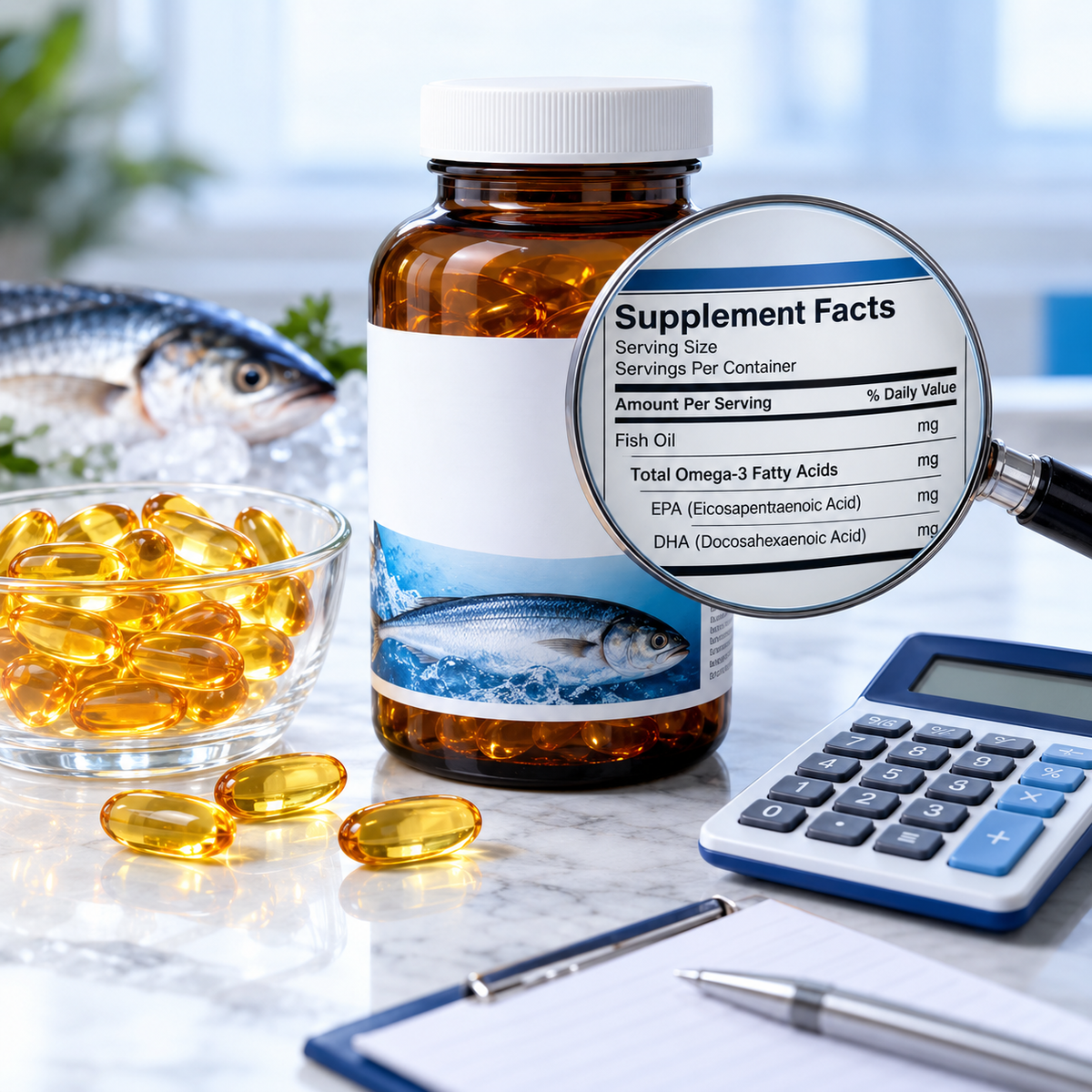
How to Choose a High-Quality Omega-3 Supplement: Checklist
Two bottles can sit side by side on a shelf, both promising "1,000 mg of fish oil" at a similar price, and still differ enormously inside the capsule. When researchers tested 26 fish oil products sold in Australia, 38% exceeded an international limit for early oxidation, and a third exceeded the limit for total oxidation (Heller et al., 2019). Choosing a high-quality omega-3 supplement therefore means looking past the front label. This buyer's checklist shows exactly what to verify, which documents to request, and which warning signs should send you to a different brand.
Quick Checklist for a High-Quality Omega-3 Supplement
Use this list before you buy. Each item is explained in the sections below.
- Identity: The label names the source (fish species, krill or algae) and the molecular form (triglyceride, re-esterified triglyceride, ethyl ester or phospholipid).
- Potency: The Supplement Facts panel states EPA and DHA in milligrams per serving, not just "fish oil."
- Freshness: The brand can show peroxide, anisidine and TOTOX results within published limits.
- Purity: Mercury, lead, cadmium, arsenic, PCBs and dioxins are tested and reported against numeric limits.
- Paperwork: A lot-specific certificate of analysis is available on request.
- Independent proof: A third-party program, not only the brand itself, has tested the product.
- Traceability: The bottle shows a lot number, a best-by date and storage directions.
- Honest marketing: No disease-cure claims, and no vague "proprietary blend" for the oil.
If a product fails two or more of these, keep looking.
Correct Identity: Species and Omega-3 Form
Identity answers two questions: what animal or organism did the oil come from, and what chemical form is it in?
Common sources include small oily fish such as anchovy, sardine and mackerel, cod liver, Antarctic krill and microalgae. Reputable labels name the source rather than hiding behind "marine oil." Vague wording makes it harder to trace the raw material and to judge sustainability claims.
Form matters because it changes how the product is made and possibly how well you absorb it. Oil in its natural triglyceride form is what fish carry. Concentrated oils are often converted to ethyl esters during processing, and some makers then convert them back to triglycerides, a form called re-esterified triglyceride. Krill oil supplies much of its omega-3 in phospholipids.
Evidence on form is real but limited. In a six-month, double-blind trial of 150 volunteers, the Omega-3 Index (a blood measure of EPA and DHA) rose 197% with re-esterified triglycerides versus 171% with ethyl esters (Neubronner et al., 2011). A review noted that plasma lipid levels appear similar between the two. Because much of the public summary of this work comes from a supplement retailer, check the original papers before treating form as a deciding factor. Treat it as a tiebreaker, not a trump card.
Source: Where Your Oil Comes From
Omega-3 fatty acids are not a "botanical compound" in the usual sense, because there is no leaf, root or seed to inspect. The closest plant-like source is algal oil, produced by cultivated microalgae, which is the usual choice for people avoiding fish.
Each source has quality questions of its own:
- Fish oil: Ask about the species, the fishery and whether the oil was refined to remove contaminants.
- Cod liver oil: It also delivers vitamin A and vitamin D, so check the label totals before combining it with a multivitamin.
- Krill oil: Its form differs from fish oil, and typical EPA and DHA amounts per capsule are lower.
- Algal oil: It is a vegetarian source, and DHA-rich blends are common, so confirm that EPA is present if you want it.
The National Institutes of Health notes that supplements come in a wide range of doses and forms, which is exactly why source and form belong on your checklist.
Potency: How Much EPA and DHA You Actually Get
"1,000 mg fish oil" describes the weight of the oil, not the omega-3 inside it. What counts is the combined EPA and DHA per serving, which the Supplement Facts panel should list separately.
The Australian study found that specially marketed products delivered less fish oil per capsule (165 mg versus 577 mg) and cost more per gram, yet were no less oxidized (Heller et al., 2019). Compare products by price per 500 mg of EPA plus DHA, not price per capsule.
Dose guidance is deliberately cautious. The NIH states that recommended amounts of EPA and DHA have not been established. For people with heart disease, the American Heart Association suggests about 1 gram a day of EPA plus DHA, preferably from oily fish, with supplements under a clinician's guidance. The FDA advises no more than 5 grams a day of EPA and DHA combined from supplements. Doses above typical label amounts may raise bleeding risk, especially alongside warfarin or other anticoagulants, so tell your clinician before starting.
Refining and Concentration Method
Crude fish oil is rarely sold as is. Manufacturers refine it to remove contaminants and strip strong odors, and many concentrate it to raise the EPA and DHA share. Each step can improve purity, and each step can also expose the oil to heat and oxygen if done poorly.
What to look for:
- A description of refining steps such as molecular distillation or filtration, stated plainly rather than as a slogan.
- The form after processing: ethyl ester, triglyceride or re-esterified triglyceride.
- For krill and some algal oils, the extraction solvent used, because solvent residues belong on the certificate of analysis.
- An added antioxidant, such as mixed tocopherols or rosemary extract, listed on the label. The industry voluntary monograph permits food-approved antioxidants to improve stability.
"Cold-pressed" and "molecularly distilled" are marketing phrases unless the brand explains and documents them.
Omega-3 Certificate of Analysis: What to Ask For
A certificate of analysis, or COA, is a laboratory report showing what a specific batch contained. It is the single most useful document a buyer can request. Insist on a lot-specific report from an independent or accredited lab, with the lot number on the bottle matching the lot on the report. A generic "typical analysis" sheet is not the same thing.
The Global Organization for EPA and DHA Omega-3s (GOED) publishes a voluntary monograph that many manufacturers use as a benchmark. The limits below come from the monograph text I reviewed. The document's cover and body carry different version labels, so confirm the figures against the current official release.
| Test | What it shows | GOED benchmark |
|---|---|---|
| Peroxide value | Early oxidation | 5 meq/kg or lower |
| p-Anisidine value | Later oxidation | 20 or lower (not applied to flavored oils) |
| TOTOX | Overall oxidation: (2 × PV) + pAV | 26 or lower (not applied to flavored oils) |
| Total PCBs | Industrial contaminants | 0.09 mg/kg or lower |
| Dioxins, furans, dioxin-like PCBs | Persistent pollutants | 3 pg WHO-TEQ/g or lower |
| Mercury | Heavy metal | Under 0.1 mg/kg |
| Cadmium | Heavy metal | Under 0.1 mg/kg |
| Inorganic arsenic | Heavy metal | Under 0.1 mg/kg |
| Lead | Heavy metal | Under 0.05 mg/kg |
The monograph covers ethyl ester and triglyceride oils, including re-esterified ones. It does not cover phospholipid-rich oils such as krill oil, so a krill product should be judged against whichever limits its maker publishes.
Oxidation: the freshness test
Oxidized oil is rancid oil. It can taste and smell unpleasant, and low-quality capsules may mask this. Peroxide and anisidine values measure it objectively. The Australian survey cited earlier found 38% of products over the primary oxidation limit and 25% over the secondary limit. A trade body, GOED, publicly questioned that study, which is a reminder to look at several sources, but the practical advice holds: ask for the numbers.
Identity Testing and Fatty Acid Profile
Identity testing confirms the product is what it claims to be. For oils, the standard method is a fatty acid profile by gas chromatography. It should show EPA and DHA levels consistent with the label claim, and the total EPA plus DHA per capsule should match the Supplement Facts panel.
Look for the actual measured values on the COA, not just a statement that the product "conforms." If a label promises 500 mg of EPA plus DHA and the report shows 380 mg, the brand has a potency problem regardless of how pure the oil is. Species identification, such as DNA testing of raw material, is less common for refined oils, so ask your supplier how they verify raw material sources.
Heavy Metals in Omega-3 Supplements
Fish can accumulate mercury, lead, cadmium and arsenic, and any of them can reach the oil. Refining removes much of the metal load, which is why finished oils are generally cleaner than the fish they came from. Even so, a quality COA lists results for mercury, lead, cadmium and arsenic with numeric limits.
Two practical notes. First, "tested for heavy metals" is not a result; a number against a limit is. Second, the form of arsenic matters, because inorganic arsenic is the toxic fraction, and the GOED benchmark above refers to it specifically. If a report lists only "total arsenic," ask how the brand interprets it.
Microbiology Testing
Highly refined oils are dry, fat-based products and carry low microbial risk. Even so, a complete COA often includes total aerobic plate count, yeast and mold, and absence of pathogens such as Salmonella and E. coli. Microbiology becomes more relevant for non-standard formats, including gummies, emulsions, liquids with flavorings and algal products, where water, sugar or plant material may be present.
Check whether the report states its limits and the method used. A line reading "passes" without numbers tells you little.
PCBs, Dioxins and Residual Solvents
Persistent organic pollutants concentrate in fatty tissue, which is why fish oil needs testing for them. The GOED benchmark caps total PCBs at 0.09 mg/kg and combined dioxins, furans and dioxin-like PCBs at 3 pg WHO-TEQ/g. California's Proposition 65 guidance applies a stricter lens to labeled servings, advising no more than 90 nanograms of PCBs per daily serving.
Residual solvents are relevant when extraction used solvents, as is common for krill and some algal oils. If the brand names a solvent, the COA should show results below pharmacopeial limits. If extraction was solvent-free, the brand should say so and be ready to document it. Pesticide testing matters mainly for algal and plant-derived products; for fish oil, persistent pollutants are the more relevant test.
Omega-3 Third-Party Testing and GMP Context
A brand testing its own product has an obvious conflict of interest. Independent verification adds credibility. Programs such as IFOS, run through SGS, test products at accredited laboratories for purity, potency and safety, with contaminants and potency named as targets. Other programs, including USP and NSF verification, review manufacturing and label accuracy for supplements generally. Each program has its own scope, so read what the seal actually certifies.
Also look for Good Manufacturing Practice (GMP) compliance. In the United States, the FDA does not approve supplements before they are sold, and manufacturers are responsible for safety. GMP certification, ideally by an outside auditor, shows the factory follows documented quality systems. A third-party seal on the bottle is useful, but a searchable certification listing for the exact product is better.
Red Flags
Walk away, or at least ask hard questions, when you see:
- No EPA or DHA amounts, only "fish oil" or "omega blend" totals
- A refusal or long delay when you request a lot-specific COA
- A COA that shows no lot number, no lab name or no numeric results
- A strong rancid smell or aftertaste, or repeated fishy burps
- Claims that the product treats, cures or prevents a disease
- A price far below competitors with an oversized "1,000 mg" claim
- No best-by date, no lot code or no storage instructions
- A "proprietary blend" that hides the amount of oil
- Seals or logos that cannot be verified on the issuing program's site

How to Read the Label
Read the Supplement Facts panel from the top.
- Serving size: Note how many capsules make a serving. Many labels show impressive totals per serving that require four capsules.
- EPA and DHA: These amounts, in milligrams, are the real potency. Add them together and divide by price.
- Total fat or fish oil weight: This is larger than EPA plus DHA because the rest is other fats. A big difference is normal; an absence of EPA and DHA lines is not.
- Form: Look for triglyceride, re-esterified triglyceride, ethyl ester or phospholipid.
- Other ingredients: Expect gelatin or plant capsules, an antioxidant and sometimes flavoring. Check allergens, including fish type.
- Vitamins: Cod liver oil adds vitamin A and vitamin D.
- Lot, expiry and storage: Store as directed, usually cool and sealed, and discard oil that smells sharply rancid.
FAQ
How can I tell if my fish oil has gone rancid?
A sharp, paint-like or strongly fishy smell and taste are warning signs, as are frequent fishy burps. Smell is not a reliable test on its own, because capsules and flavorings can hide it. Peroxide and anisidine values on the COA are the objective check.
Is a more expensive omega-3 supplement better?
Not automatically. The Australian survey found that specially marketed products cost more per gram and contained less oil per capsule, yet were not less oxidized. Compare cost per 500 mg of EPA plus DHA and the quality documents, not the brand's pricing tier.
Which is better: fish oil, krill oil or algal oil?
The NIH describes all three as available and does not rank them. Algal oil suits vegetarians. Krill oil is phospholipid-based and falls outside the GOED monograph. Fish oil has the largest body of research. Choose by diet, tolerance and verified quality.
How much EPA and DHA should I take?
No recommended amount has been established by the NIH. The American Heart Association suggests about 1 gram per day of EPA plus DHA for people with heart disease, and the FDA advises no more than 5 grams per day combined from supplements. Ask your clinician, especially if you take blood thinners.
Do I need a COA for every batch?
Ask for one tied to the lot number on your bottle. If the brand cannot provide it, or provides a generic sheet instead, treat that as a red flag.
This article is educational and is not medical advice. Talk with a pharmacist or physician before starting any supplement, particularly if you take medication or are pregnant.
References
- Heller M, et al. Oxidation of fish oil supplements in Australia. Int J Food Sci Nutr. 2019. https://pubmed.ncbi.nlm.nih.gov/30626234/
- GOED Monograph, Voluntary Monograph for EPA and DHA Omega-3 ingredients (cover labeled version 9.0, July 23, 2026; body labeled version 8.1). https://goedomega3.com/storage/app/media/Monograph/GOED%20Monograph%20-%202026%2007%2023%20version%209.0.pdf
- National Institutes of Health, Office of Dietary Supplements. Omega-3 fatty acids: consumer fact sheet. https://ods.od.nih.gov/factsheets/omega3fattyacids-consumer/
- Neubronner J, et al. Enhanced increase of omega-3 index in response to long-term n-3 fatty acid supplementation from triacylglycerides versus ethyl esters. Eur J Clin Nutr. 2011, as summarized at Cooper Complete. https://coopercomplete.com/triglycerides-vs-ethyl-ester/
- Laidlaw M, et al. 2014 randomized comparison of omega-3 formulations, and Walker R, et al. 2015 review, as summarized at Cooper Complete (same page).
- SGS. International Fish Oil Standards (IFOS) product certification. https://www.sgs.com/en-us/services/international-fish-oil-standards-ifos-product-certification
- NutraIngredients-Asia. GOED questions Aussie study on excessive oxidation in popular fish oil supplements. https://www.nutraingredients-asia.com/Article/2019/01/30/GOED-questions-Aussie-study-on-excessive-oxidation-in-popular-fish-oil-supplements
For general information only. Talk to your doctor before starting any supplement.