
How to Choose a High-Quality Moringa Seed Oil Supplement
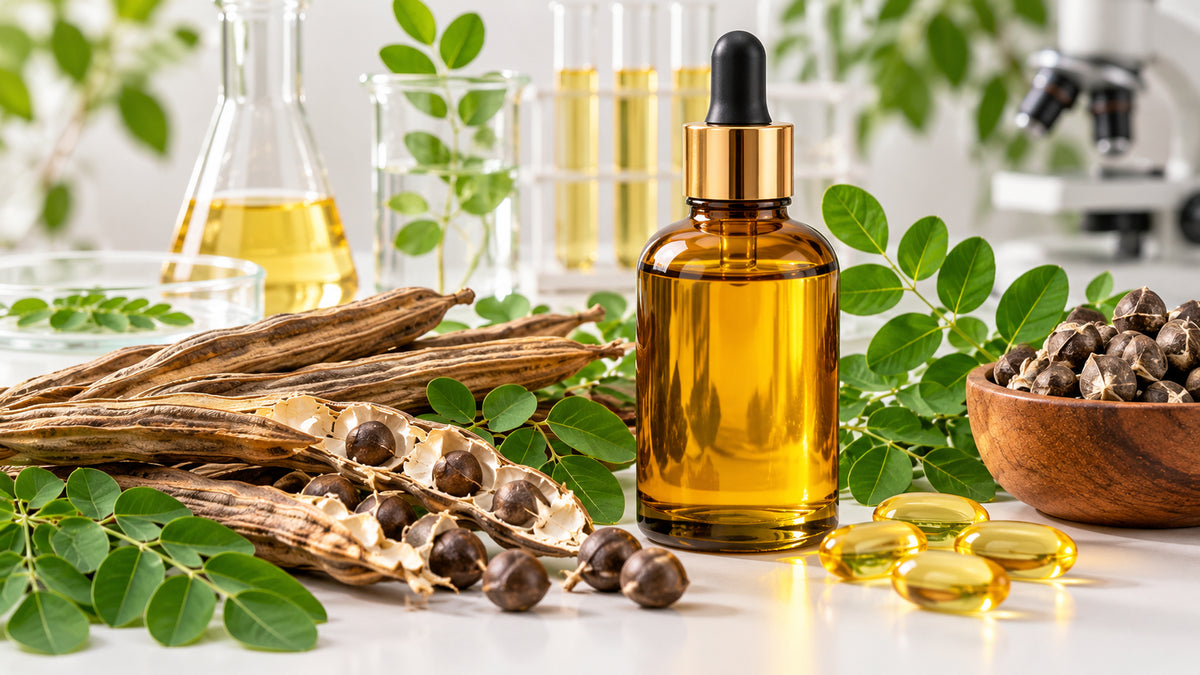
How to Choose a High-Quality Moringa Seed Oil Supplement
Two bottles of moringa seed oil supplement can sit side by side on a shelf, look almost identical, and still be very different products. One may be a verified, cold-pressed oil from Moringa oleifera seeds with a current lab report. The other may be a blend, an old batch, or an oil that was never tested for contaminants. Price and packaging rarely tell you which is which.
This matters because supplements are not approved by regulators before they are sold. The quality of what you buy depends on the brand's choices and the proof it can show. The good news is that you do not need a laboratory to judge a product. You need a clear checklist and the patience to read a label and a lab report.
Below, you will find a step-by-step buyer guide. It covers identity, plant part, potency, extraction, testing and red flags. By the end, you will be able to compare any two products with confidence and choose the one that earns your trust.
Quick Quality Checklist for a Moringa Seed Oil Supplement
Use this short table first. If a product fails several rows, move on to another brand.
|
Check |
What a good product shows |
|---|---|
|
Species |
Moringa oleifera named in Latin on the label |
|
Plant part |
Seed oil, clearly stated (not leaf or root) |
|
Form |
Softgel, liquid or capsule, with the carrier oil listed |
|
Extraction |
Cold-pressed, or a named method with solvent data |
|
Potency |
Amount of oil per serving in mg or mL |
|
Certificate of analysis |
Batch-specific report available on request or online |
|
Contaminants |
Heavy metals, microbes and pesticides tested |
|
Third-party review |
Independent lab or quality program involved |
|
Manufacturing |
cGMP-compliant facility stated |
|
Honesty |
No disease-cure claims |
The rest of this guide explains each row in plain language.
Correct Identity: Moringa Oleifera Seed Oil, Species and Form
The first question is simple: what exactly is in the bottle? The moringa genus contains about thirteen species, but Moringa oleifera is the one most often used in supplements and research. A trustworthy label gives the Latin name, not only the words "moringa extract" or "miracle tree."
Form matters too. Moringa seed oil is a fatty oil, so it usually appears as a softgel, a liquid in a dropper bottle, or an oil-filled capsule. Each form has a different carrier and shelf life. Softgels protect the oil from air, while a dropper bottle is easier to dose in small amounts but is exposed to oxygen every time it is opened.
Also be careful with names. Moringa seed oil is sometimes called ben oil or behen oil, and the same names can be used for oil from related seeds. Cosmetic-grade oil is another trap. A bottle made for skin is not automatically made, tested or labelled for swallowing. Confirm that the product says "dietary supplement" or "edible."
Plant Part and Source: Why Seeds Are Not Leaves
Moringa is a plant with many edible parts. The leaves are sold as powder and capsules, the pods are eaten as food, and the seeds are pressed for oil. These parts have different chemistry. Leaf products are known for protein, minerals and plant compounds, while the seed oil is mostly fat with a high share of oleic acid, plus small amounts of tocopherols and plant sterols (Anwar et al., 2007; Tsaknis et al., 1999).
This means research on leaf powder cannot be applied directly to seed oil. When a brand borrows leaf studies to promote an oil product, treat that as a warning. The label should say "seed oil" or "oil from seeds," and the brand should be able to tell you the country or region where the seeds were grown.
Source also affects quality. Soil, climate and harvest time influence the fatty acid profile and the level of contaminants. A brand that names its growing region, and ideally its supply chain, is showing traceability that anonymous sellers cannot match.
Standardization and Potency: What the Numbers Can Tell You
Standardization means a product is made to contain a measured amount of a marker compound. This works well for extracts with a single active ingredient. A pressed oil is different, because it is a mixture of many fats, so potency is usually described by amount and by fatty acid profile.
Look for three numbers. First, the amount of oil per serving, written in mg or mL. Second, the number of servings per container. Third, a typical profile, such as the percentage of oleic acid, supplied in the lab report. A label that only says "proprietary blend" without amounts makes it impossible to compare value or to match the dose used in studies.
Be realistic about evidence. Human research on moringa seed oil specifically is limited, and most published work uses leaf preparations or animal models (Abd Rani et al., 2018). So no brand can honestly promise a clinical result from a particular dose. A reliable seller gives clear amounts and leaves the health decisions to you and your healthcare provider.
Extraction Method: Cold-Pressed Moringa Oil vs Solvent Extraction
How the oil leaves the seed shapes its purity. Two methods are common.
Cold-pressed moringa oil is made by mechanically pressing seeds without added heat or chemicals. It usually keeps more of its natural tocopherols and has no solvent residue to worry about. The trade-off is a lower yield, which can raise the price.
Solvent extraction uses a liquid such as hexane to pull oil from the seed, and then the solvent is removed. It is efficient, but the finished oil must be tested for leftover solvent. Refining steps such as bleaching or deodorizing can also reduce natural compounds.
|
Method |
Main advantage |
Main concern |
|---|---|---|
|
Cold-pressed |
No solvent, gentle on compounds |
Higher cost, lower yield |
|
Solvent extracted |
High yield, lower cost |
Residual solvent testing needed |
|
Refined |
Mild smell and long shelf life |
Fewer natural compounds |
Note that "cold-pressed" is not a regulated term in every country. Ask the brand for the pressing temperature range, or look for it in the product documentation.
Certificate of Analysis: Your Best Proof of Quality
A certificate of analysis, often shortened to CoA, is a laboratory report for one specific batch. It lists what was tested, the method used, the result and the limit. It is the single most useful document a buyer can ask for.
A good CoA shows the lab name, the product name, a batch or lot number, the test date and the signature or stamp of a reviewer. Check that the lot number matches the number printed on your bottle. A report with no lot number, or one that looks edited, cannot prove anything about the product in your hand.
Also check whether the lab is independent. A CoA produced only by the brand's own lab is better than nothing, but a report from an accredited outside lab, for example one working to ISO/IEC 17025, carries more weight. Brands that publish reports online, or send them within a day or two of a request, usually have nothing to hide.
Identity Testing: Confirming It Is Really Moringa Seed Oil
Identity testing answers a basic question: is this truly moringa seed oil? Because oils are liquids, a plant-based oil cannot be checked by simple microscope work. Laboratories instead use methods such as gas chromatography to measure the fatty acid profile, and sometimes infrared spectroscopy to compare the oil with a reference.
Moringa seed oil has a recognizable pattern: oleic acid is the main fatty acid, with smaller amounts of palmitic, stearic and the long-chain behenic acid (Tsaknis et al., 1999). A profile that looks like cheaper sunflower or soybean oil is a sign of adulteration or dilution.
If the CoA shows only a heavy-metal screen and nothing about identity, ask the brand how it confirms the oil is what it says. A short, specific answer is a good sign.
Heavy Metals Testing in Moringa Seed Oil
Plants can take up metals such as lead, arsenic, cadmium and mercury from soil and water. Heavy metals are a concern because they can build up in the body over time. Moringa is sometimes grown in regions with variable soil quality, so testing is a sensible expectation.
A complete report lists each metal, the result and the limit it was compared with. Many manufacturers follow limits in references such as USP chapter <2232> for elemental contaminants. Pay attention to the wording "not detected" and "below the limit of quantitation," since both can be valid, while a missing metal on the list is not.
Pressed oils generally carry lower metal loads than whole-plant powders, because metals tend to stay in the solid seed cake. Even so, the test is still worth seeing for every batch.
Microbiology: Checking for Bacteria, Yeast and Mold
Oils contain little water, so microbes grow less easily than in powders. Still, contamination can happen during pressing, filling or capsule making. A microbiology panel normally reports total aerobic plate count, total yeast and mold count, and the absence of E. coli, Salmonella and Staphylococcus aureus.
For a softgel or capsule, the test should be done on the finished product when possible. A clean raw oil can become contaminated at a later stage. If the brand tests only the raw material, ask whether finished batches are checked too.
Pesticides and Residual Solvents Where Relevant
Not every test applies to every oil, so look for the ones that match the product's story.
Pesticide screening matters when seeds come from conventional farms. A multi-residue panel checks for many agricultural chemicals at once. An organic claim is helpful, yet the certificate of the farm does not replace a test of the finished oil.
Residual solvent testing matters when solvent extraction is used. Limits for solvents such as hexane are set in guidance like ICH Q3C. A cold-pressed oil can usually skip this test, but a brand that does it anyway is showing extra care.
Oxidation markers are another useful check. Peroxide value and acid value show how fresh the oil is. High numbers suggest rancidity, which means a stale smell and a lower-quality product.
Third-Party Testing and GMP Context
Two ideas often get mixed up. Good manufacturing practice, or GMP, describes how a facility is run. In the United States, dietary supplement makers must follow current GMP rules covering sanitation, record keeping, testing and complaint handling (21 CFR Part 111). Third-party testing describes who checks the product.
A brand can state that it follows GMP, but the claim is stronger when an outside audit supports it. Programs run by independent organizations such as NSF, USP or ConsumerLab verify ingredients, label accuracy and contaminants. A seal from one of these programs is easy to confirm on the program's own website, so do that rather than trusting the image alone.
Remember that a seal confirms quality and label accuracy. It does not prove that the product will work for any health goal. Keep those two questions apart.
Red Flags to Avoid When Buying Moringa Seed Oil
Some signs are easy to spot once you know them.
|
Red flag |
Why it matters |
|---|---|
|
Cure or treatment claims |
Supplements cannot legally claim to cure disease |
|
No Latin name or plant part |
Identity cannot be verified |
|
No batch number |
The CoA cannot be matched to the bottle |
|
Proprietary blend with no amounts |
Potency and value are unknown |
|
Very low price |
May signal dilution or refined filler oils |
|
Cosmetic label on an oral product |
Not made or tested for swallowing |
|
Only leaf studies cited |
Evidence belongs to a different ingredient |
|
Fake or unverifiable seals |
Quality claims cannot be confirmed |
One red flag is a reason to ask questions. Three or more is a reason to leave.
How to Read a Moringa Seed Oil Label
Start with the Supplement Facts panel. It should list the serving size, the amount of moringa seed oil per serving, and the source plant with its Latin name. Next, read the "Other ingredients" line. Softgels contain a shell made of gelatin or a plant-based alternative, plus a carrier oil or preservative, and anyone with allergies or dietary rules should check it.
Look for a lot number and an expiry date, since oils lose freshness over time. Check storage advice, which usually asks for a cool, dark place. Find the manufacturer's name and address, because a brand that hides where it is made is hard to hold accountable.
Finally, read the claims with care. Statements about general wellbeing are normal, but promises to treat or prevent illness are not. Compare the label against your CoA. If the numbers, names and lot all agree, you have a reliable product. Check with a pharmacist or physician before use if you take medicines or are pregnant, since safety data for seed oil is limited.
FAQ
What is the most important quality check for a moringa seed oil supplement? A batch-specific certificate of analysis from an independent lab, with a lot number that matches your bottle, gives the most useful proof.
Is cold-pressed always better? It avoids solvent residue and keeps natural compounds, so it is a good sign. It still needs contaminant testing and a fresh, well-stored product.
Can I use cosmetic moringa oil as a supplement? Only if the label says it is edible. Cosmetic oils are not made or tested for oral use.
Do moringa leaf studies apply to seed oil? Not directly. Leaves and seeds contain different compounds, so leaf research should not be used to promote seed oil.
How do I know the CoA is real? Check the lab name, lot number, date and method, and consider contacting the lab. Be cautious of reports with no lot number.
Is a third-party seal a guarantee of results? No. It supports quality and label accuracy, not health outcomes.
Is moringa seed oil safe for everyone? Not necessarily. People who are pregnant, nursing or taking medicines should speak with a healthcare professional first.
References
- Anwar F, Latif S, Ashraf M, Gilani AH. Moringa oleifera: a food plant with multiple medicinal uses. Phytotherapy Research. 2007;21(1):17-25.
- Tsaknis J, Lalas S, Gergis V, Dourtoglou V, Spiliotis V. Characterization of Moringa oleifera variety Mbololo seed oil of Kenya. Journal of Agricultural and Food Chemistry. 1999;47(11):4495-4499.
- Abd Rani NZ, Husain K, Kumolosasi E. Moringa genus: a review of phytochemistry and pharmacology. Frontiers in Pharmacology. 2018;9:108.
- U.S. Food and Drug Administration. Current Good Manufacturing Practice in Manufacturing, Packaging, Labeling, or Holding Operations for Dietary Supplements. 21 CFR Part 111.
- United States Pharmacopeia. General Chapter <2232> Elemental Contaminants in Dietary Supplements.
- International Council for Harmonisation. ICH Q3C Guideline for Residual Solvents.
- NIH Office of Dietary Supplements. Dietary Supplements: What You Need to Know.
For general information only. Talk to your doctor before starting any supplement.


