
Glutathione Drug, Supplement and Food Interactions
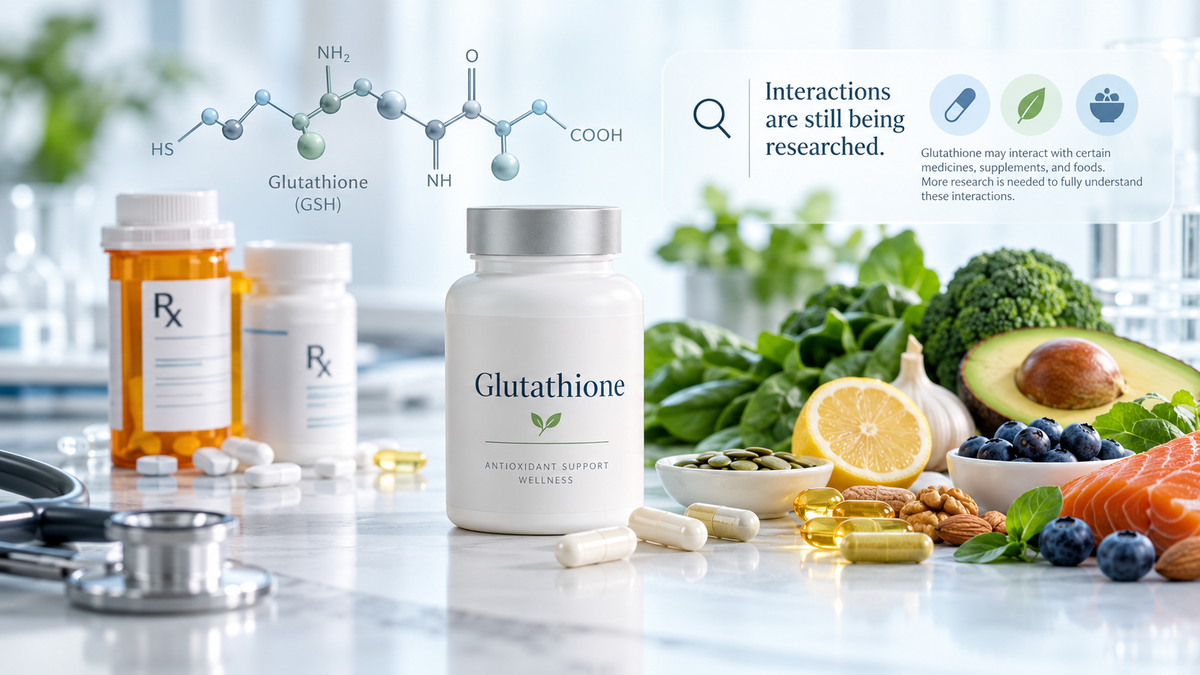
Glutathione Interactions: Drug, Supplement & Food Guide
Glutathione interactions are poorly mapped, and that gap matters more than most product labels admit. Glutathione is a three-amino-acid antioxidant (glutamate, cysteine, glycine) that every cell makes. It is also sold as an oral supplement, and in clinics as an intravenous (IV) product. People take it alongside prescription medicines, vitamins and herbal products, so the practical question is what is known, what is only suspected, and what has never been tested.
This guide separates those three categories. It draws on randomized trials, a Cochrane review and regulatory notices, and it says plainly when evidence is thin.
Glutathione Interactions at a Glance
The short version: few clinically established interactions exist, but absence of evidence is not proof of safety.
- Oral glutathione has been tested in a small number of trials. A 6-month trial in 54 healthy adults found raised glutathione levels at 250 mg and 1,000 mg daily, and it was not designed to detect drug interactions (Richie et al., 2015).
- IV glutathione has been studied mainly alongside platinum chemotherapy, where it was given to reduce nerve damage. Results were mixed.
- Consumer interaction checkers mostly report "no known interactions", which reflects limited research rather than confirmed safety.
- Product quality is a bigger documented risk than any drug pairing. FDA has warned that dietary-supplement-grade powder used to compound injectables carried endotoxin contamination.
Risk depends on the formulation, dose, route, your health, and what else you take. Nothing here implies every combination is dangerous, or that glutathione is universally safe.
How Glutathione Interactions Are Identified
Researchers use several kinds of evidence, and they carry different weight.
- Clinical trials compare outcomes with and without a combination. They are the strongest source, but few were designed to test glutathione against another agent.
- Pharmacokinetic studies ask whether one substance changes the absorption, distribution, metabolism or elimination of another.
- Pharmacodynamic studies ask whether two substances change each other's biological effect, even if blood levels stay the same.
- Case reports can flag a signal, but cannot prove cause.
- Laboratory and animal work suggests mechanisms. It often fails to translate to people.
Two cautions apply. First, a finding in cells or animals is a hypothesis, not a clinical fact. Second, "no reported interactions" usually means "not studied". A consumer drug reference states that glutathione-drug interactions are not fully understood and that research is incomplete (WebMD).
Drug Classes of Concern in Glutathione Drug Interactions
No drug class is established as incompatible with glutathione. Some classes simply deserve closer review because of how they work.
Cancer therapies. This is the main area of discussion. Many chemotherapy and radiation treatments act partly by raising oxidative stress in tumor cells. Glutathione is a cell's main defense against that stress. So a long-standing theoretical worry is that antioxidant supplements could blunt treatment. That worry is plausible, but it is a hypothesis. It does not mean every supplement harms every treatment, and the answer depends on the specific drug, dose and timing. Only the treating oncologist can weigh it.
Immunosuppressants. Glutathione participates in immune cell function, and the 2015 oral trial reported higher natural killer cell activity in the high-dose group. Whether that matters for people taking immunosuppressants has not been tested. It is a reason to ask the prescriber, not a documented interaction.
Medicines processed by the liver. Glutathione is involved in how the liver neutralizes some drug by-products. That biology does not show that supplemental glutathione changes any specific drug's levels. No human pharmacokinetic study supporting such a claim was identified.
If a combination could affect your treatment, the prescriber or pharmacist is the right person to ask.
Specific Documented Interactions
The best-documented human data involve IV glutathione given with platinum chemotherapy. Note that this is a deliberate, supervised use to protect nerves, not a supplement scenario.
Cisplatin and related drugs. A Cochrane review of randomized trials found that glutathione, along with amifostine, calcium and magnesium, and vitamin E, showed modest but borderline-significant benefit in reducing cisplatin nerve toxicity. The results relied mostly on secondary, subjective measures, and the review's authors called them promising rather than conclusive (Albers et al., Cochrane, 2014). In that analysis glutathione's relative risk for neurotoxicity was 0.29 (95% CI 0.10 to 0.85), a wide interval that reflects small trials.
Paclitaxel plus carboplatin. A larger phase III, double-blind trial (NCCTG N08CA, Alliance) randomized 185 patients to IV glutathione (1.5 g/m²) or placebo before chemotherapy. The authors concluded the study did not support glutathione for preventing this regimen's neuropathy (Leal et al., Cancer, 2014).
What these studies do and do not show:
- They tested glutathione as a nerve protector, not as an interaction hazard.
- They do not prove that glutathione is harmless to tumor treatment, because they were not built to measure cancer outcomes over the long term.
- They used IV doses under clinical supervision. They cannot be transferred to oral supplements or to wellness-clinic infusions.
No other pairing (for example with blood thinners, diabetes medicines or antibiotics) has a human interaction study that we could identify. Some commercial pages list such pairings, but they cite no primary evidence, so this guide does not repeat them. Where no study exists, the honest statement is "insufficient evidence".
Theoretical and Mechanistic Interactions
Glutathione is central to redox balance: it neutralizes reactive oxygen species, helps detoxify some compounds, and influences cell signaling. Those roles generate hypotheses.
- Oxidative-stress-dependent treatments. If a therapy works by overwhelming tumor cells with oxidative stress, extra antioxidant capacity could in theory reduce its effect. Unproven in people for oral supplements.
- Detoxification pathways. Glutathione conjugation handles certain drug metabolites. Whether supplemental glutathione alters this in a clinically meaningful way is unknown.
- Immune signaling. Raised natural killer cell activity was seen in one trial of healthy adults, but its relevance to people on immune-modulating drugs is untested.
Two limits matter. Changes in endogenous glutathione, such as depletion after acetaminophen overdose, do not tell us what supplemental glutathione does. And the 2015 trial measured blood and cell levels, not drug interactions. Treat everything in this section as hypothesis until human data exist.
Glutathione Supplement Interactions
People often take glutathione with vitamin C, vitamin E, alpha-lipoic acid, N-acetylcysteine (NAC) or milk thistle. Marketing pages often call these combinations "synergistic". Controlled human trials testing those claims were not found for this review, so they are unsupported.
What can reasonably be said:
- Overlapping effects are not automatically harmful. Several antioxidants act on related pathways. That overlap is a reason to count your total supplement intake, not a proof of danger.
- NAC is a precursor, not a duplicate. NAC supplies cysteine, which the body uses to make glutathione. It is a different compound with its own effects and should not be confused with glutathione.
- Claims about better absorption, detox or immunity from specific stacks lack trial support, and this guide makes none.
- Multiple products add up. Combination formulas and liposomal or sublingual products vary in dose and ingredients, so check each label.
If you take several supplements alongside prescription medicines, a pharmacist can review the full list in one sitting.
Food Interactions
No clinically meaningful food or drink interaction with supplemental glutathione has been demonstrated. A consumer reference likewise reports no known food or beverage interactions (WebMD), though that statement reflects the lack of studies.
It helps to separate two ideas:
- Direct interactions (a food changing how a glutathione supplement works). Not established.
- Diet and your own glutathione production. Your body builds glutathione from its amino acids, and overall nutrition affects that. Alcohol is often said to deplete liver glutathione, but whether alcohol cancels out a supplement has not been shown in trials, despite confident claims on commercial pages.
No evidence supports specific food restrictions or timing rules, such as taking glutathione on an empty stomach. If a product label gives instructions, follow them.
Laboratory Test Interference
No study identified for this review shows that glutathione invalidates routine blood tests, so no direct analytical interference is established.
One point is physiological rather than analytical. If a test measures glutathione itself, supplementation can change the result. In the 2015 trial, 1,000 mg daily raised glutathione levels in blood cells by about 30 to 35 percent after six months. That is a real biological change, not a testing error.
Because the evidence is thin, disclose any supplement or injectable product, including IV glutathione, to your care team before blood work, surgery or procedures. Let them decide whether it matters.
Severity and Strength of Evidence
The categories below describe the status of the evidence, not a guarantee of safety. No numerical risk scores are assigned, because none has a validated basis.
|
Substance |
Glutathione form |
Proposed or observed interaction |
Evidence type |
Clinical significance |
Practical precaution |
|---|---|---|---|---|---|
|
Cisplatin and related platinum drugs |
IV |
Studied for reducing nerve toxicity; modest, borderline benefit |
Cochrane review of randomized trials |
Uncertain |
Only under oncology supervision |
|
Paclitaxel plus carboplatin |
IV |
No benefit for neuropathy prevention |
Phase III randomized trial |
Not supportive of use |
Discuss with oncologist |
|
Chemotherapy and radiation (general) |
Oral, IV |
Antioxidants could blunt oxidative-stress-based treatment |
Theoretical |
Unknown |
Ask the oncologist first |
|
Immunosuppressants |
Oral |
Possible immune effects (NK activity in healthy adults) |
Theoretical |
Unknown |
Ask the prescriber |
|
Vitamin C, vitamin E, NAC, other antioxidants |
Oral |
Claimed synergy or harm; no controlled trial found |
Insufficient evidence |
Unknown |
Count total intake; pharmacist review |
|
Foods and beverages |
Oral |
No direct interaction demonstrated |
No demonstrated interaction |
None shown |
Follow label |
|
Routine lab tests |
Oral, IV |
No analytical interference shown; glutathione levels themselves rise |
Limited human data |
Low for routine tests |
Disclose use before testing |
|
Contaminated compounded injectables |
IV |
Endotoxin reactions (product quality, not a drug interaction) |
Regulatory alerts |
Potentially serious |
Use only injectable-grade, regulated products |
 Who Should Consult a Clinician
Speak with a doctor or pharmacist before using glutathione, ideally before starting, if any of these apply:
- You take prescription medicines and an interaction is plausible, especially for cancer treatment or immunosuppression.
- You have a complex medical condition or are preparing for surgery or another procedure.
- You use several supplements at once.
- You are considering IV glutathione. FDA has repeatedly warned about compounded injectables made from supplement-grade powder. In an August 2026 notice, it reported at least 30 patients with adverse events and recalls tied to elevated endotoxin levels (FDA, 2026; FDA, 2019).
- You are pregnant or breastfeeding, or the person using it is a child. Safety needs separate assessment, and adult data should not be assumed to apply. One consumer reference notes that glutathione passes into breast milk (WebMD).
What to bring: the product labels, dose and schedule, route (oral, IV, inhaled, topical), where it was obtained, and your full medication list.
Take action: review your supplements and medicines with a qualified professional. Do not stop, start or change a prescribed medicine on your own. If you suspect a reaction, contact your clinician, and report quality problems to FDA's MedWatch program.
Frequently Asked Questions About Glutathione Interactions
Does glutathione interact with prescription medicines? No interaction is firmly established for oral glutathione. The studied area is IV use with platinum chemotherapy. Many other pairings are untested, so "none known" means "not studied".
Can glutathione be taken with other antioxidants? No trial evidence shows harm or benefit from specific combinations. Count your total intake and ask a pharmacist if you take many products.
Are there known interactions with vitamins? Claims of synergy with vitamin C or E lack controlled-trial support, and no vitamin interaction was documented.
Does glutathione interact with food or beverages? None has been demonstrated. Evidence on alcohol or meal timing is insufficient.
Can it affect lab results? No analytical interference was found. Glutathione levels themselves can rise with supplementation.
Is oral different from IV? Yes. IV bypasses digestion and carries product-quality risks such as endotoxin. Trial data for each route cannot be swapped.
Should people receiving cancer treatment use it? That decision belongs to their oncology team. A trial found no neuropathy benefit with paclitaxel plus carboplatin.
Should I tell my surgeon? Yes. Disclose all supplements and injectables before procedures.
What if I suspect an interaction? Contact your clinician or pharmacist, and report adverse events to FDA MedWatch.
Where is reliable evidence? See the references below, and look for randomized trials and regulatory notices rather than product pages.
References
- Richie JP Jr, Nichenametla S, Neidig W, Calcagnotto A, Haley JS, Schell TD, Muscat JE. Randomized controlled trial of oral glutathione supplementation on body stores of glutathione. European Journal of Nutrition. 2015;54(2):251-263. Penn State record
- Albers JW, et al. Interventions for preventing neuropathy caused by cisplatin and related compounds. Cochrane Database of Systematic Reviews. 2014; CD005228.pub3. Cochrane summary · DOI 10.1002/14651858.CD005228.pub3
- Leal AD, et al. NCCTG N08CA (Alliance): The use of glutathione for prevention of paclitaxel/carboplatin induced peripheral neuropathy: a phase III randomized, double-blind placebo-controlled study. Cancer. 2014. PubMed Central
- U.S. FDA. FDA reminds compounders not to use dietary supplement grade glutathione for injectables. August 27, 2026. FDA
- U.S. FDA. FDA highlights concerns with using dietary ingredient glutathione to compound sterile injectables. 2019. FDA
- WebMD. Glutathione overview (consumer reference; cited only for the statement that drug and food interactions are not fully understood). WebMD
Limitations of the evidence: the oral trial had 54 participants and measured glutathione levels, not interactions. The chemotherapy studies used IV dosing and measured nerve toxicity. Few studies compare oral and IV routes, and long-term interaction data are lacking.
Disclaimer: this article is educational and does not replace individualized medical advice. Last reviewed October 14, 2026; it should be updated as new studies and regulatory notices appear.
For general information only. Talk to your doctor before starting any supplement.


