What Is CoQ10? Identity, Source and Supplement Use
What Is CoQ10? Identity, Source and Supplement Use
What Is CoQ10? Quick Answer
CoQ10, short for coenzyme Q10, is a fat-soluble, vitamin-like compound that the body makes and uses inside mitochondria to help generate cellular energy. It also acts as an antioxidant in cell membranes. Small amounts come from foods such as meat, fish and nuts, and it is sold as a dietary supplement in two forms: ubiquinone and ubiquinol.
Your heart beats roughly 100,000 times a day, and every beat depends on a steady supply of cellular energy. A small molecule inside your mitochondria helps make that supply possible. This guide explains what it is, where it comes from and how it appears on supplement labels, so you can read those labels with confidence.
Coenzyme Q10 Key Facts at a Glance
|
Attribute |
Detail |
|---|---|
|
Common names |
CoQ10, coenzyme Q10, CoQ-10, vitamin Q10 |
|
Scientific names |
Ubiquinone (oxidized form), ubiquinol (reduced form), ubidecarenone |
|
Chemical formula |
C59H90O4 (ubiquinone); molecular weight about 863 g/mol |
|
Category |
Lipid-soluble, vitamin-like coenzyme (not a true vitamin) |
|
Made by the body? |
Yes, in nearly all tissues |
|
Highest concentrations |
Heart, liver, kidney, skeletal muscle |
|
Dietary sources |
Organ meats, fatty fish, poultry, nuts, seeds, some vegetable oils |
|
Commercial source |
Yeast or bacterial fermentation |
|
Common label doses |
Typically 100–200 mg per serving; some products 300 mg |
|
Regulatory status (US) |
Dietary supplement; not approved to treat disease |
|
Safety |
Generally well tolerated; may interact with some medicines |
Scientific and Common Names of Ubiquinone and Ubiquinol
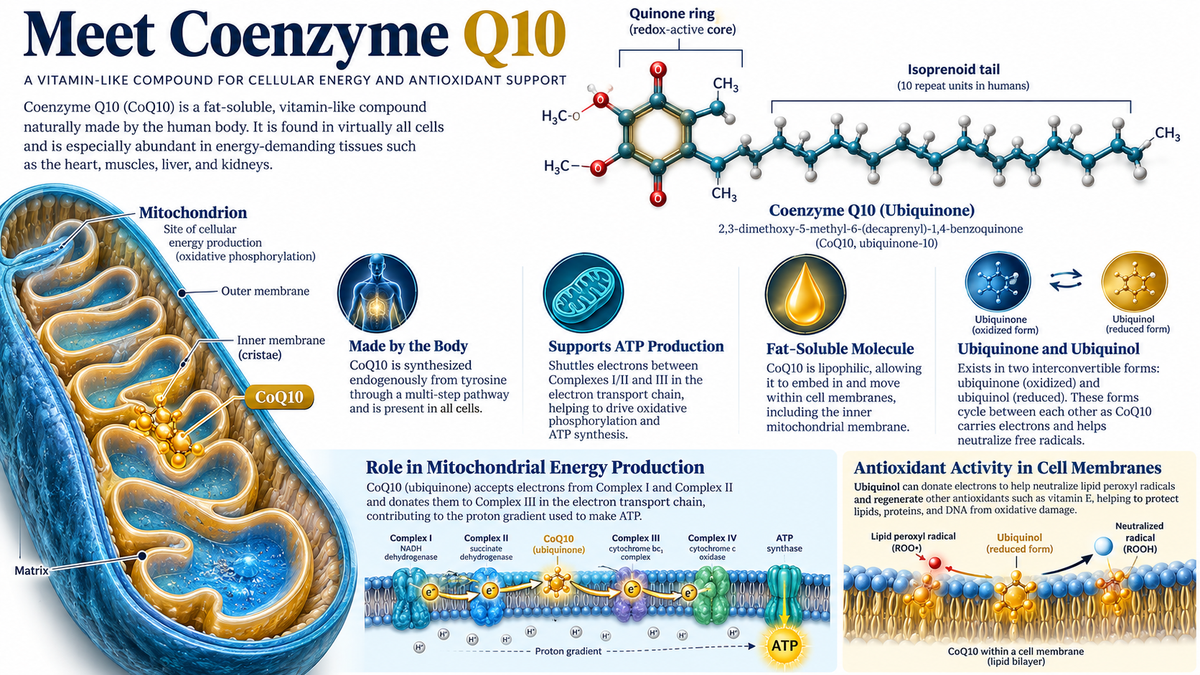
The name coenzyme Q10 describes the molecule itself. “Coenzyme” means it helps enzymes do their work, “Q” refers to its quinone ring, and “10” counts the ten isoprenoid units in its side chain. Chemists call the oxidized form ubiquinone, short for “ubiquitous quinone,” because it occurs in nearly every living cell. The reduced form is ubiquinol.
Frederick Crane and colleagues first isolated the compound from beef heart mitochondria in 1957 [1], and Karl Folkers’ group described its chemical structure the following year [2]. Other names you may see include ubidecarenone and vitamin Q10. On labels, “coenzyme Q10,” “ubiquinone” and “ubiquinol” all refer to the same core molecule in different chemical states.
Ingredient Category: A Vitamin-Like Coenzyme
This compound is a lipid-soluble benzoquinone with a long isoprenoid tail that anchors it in cell membranes [3]. It belongs to the group of coenzymes: non-protein helpers that enable enzymes to work. People call it “vitamin-like” because the body needs it but can also synthesize it, so it is not classified as a vitamin or an essential nutrient.
Its best-known job is carrying electrons in the mitochondrial respiratory chain, which drives ATP production. In membranes and lipoproteins, its reduced form also helps limit oxidative damage [3]. Tissue concentrations are highest in organs with heavy energy demand, such as the heart, liver, kidney and skeletal muscle, and levels in some tissues decline with age. In the United States it is regulated as a dietary supplement, not as a drug.
Natural Sources, Plant Part and Nutrient Forms
Unlike botanical ingredients, CoQ10 is not extracted from one particular plant part. It exists in animal, plant and microbial cells, so no single root, leaf or seed defines it. Foods with higher amounts include beef heart and liver, chicken, fatty fish such as sardines and mackerel, soybean and canola oils, peanuts, sesame seeds, broccoli and cauliflower [4,5]. Typical diets supply only about 3 to 6 mg per day, and frying can lower the amount in food [4].
As a nutrient form, the molecule exists as ubiquinone (oxidized) and ubiquinol (reduced). The natural, biologically active configuration is the all-trans isomer, which fermentation-derived products match.
Where CoQ10 Comes From: Body, Food and Fermentation
The compound reaches the body through three routes.
- Internal synthesis. Most cells build it themselves. The ring comes from the amino acid tyrosine, while the tail is assembled through the mevalonate pathway, the same pathway that produces cholesterol [3]. Because statins act on that pathway, they can lower blood levels of the coenzyme [6].
- Diet. Foods contribute a modest share, as noted above.
- Commercial production. Supplement-grade material is usually made by fermenting yeast or bacteria, then purifying and crystallizing the product. The result is a molecule identical to the one the body makes.
How a CoQ10 Supplement Is Used
A supplement adds to what the body makes and what food supplies. Product labels commonly list 100 to 200 mg per serving, and some research trials have used 300 mg per day or more. Because the molecule is fat-soluble and large, it is poorly absorbed, so it is usually taken with a meal that contains fat [7]. Higher amounts are often split into two doses, and blood levels typically rise over days to weeks of regular use.
People use these products as part of general wellness routines, alongside heart-health or statin therapy under a clinician’s guidance, and in some sports and healthy-aging plans. Look for products that state the form and amount per serving and carry third-party testing from groups such as USP or NSF. A supplement should never replace prescribed treatment.
Main Active Constituents: Ubiquinone and Ubiquinol
The active ingredient is one molecule that moves between redox states: ubiquinone-10 (oxidized), ubiquinol-10 (reduced) and a short-lived semiquinone intermediate [3]. Ubiquinone is an orange-yellow crystalline powder. Ubiquinol is paler and oxidizes more readily in air, which is why it is usually sold in sealed softgels. Cells continuously convert one form into the other, and in healthy adults most circulating coenzyme is found as ubiquinol [7]. Whether supplemental ubiquinol is better absorbed than ubiquinone is still debated, and the clinical meaning of any difference is unclear [7].
Supplement formulas also contain non-active ingredients: carrier oils, emulsifiers, capsule shells and sometimes antioxidants such as vitamin E.
Why People Research Coenzyme Q10
Interest comes from its role in energy metabolism. Current research areas include:
- Heart health. In the Q-SYMBIO trial of 420 people with heart failure, 300 mg per day for two years was linked to fewer major cardiovascular events than placebo [8]. Results support further research rather than firm conclusions.
- Statin-associated muscle symptoms. Meta-analyses have reached different conclusions about benefit [9,10].
- Migraine prevention. A 2012 American Academy of Neurology and American Headache Society guideline rated it “possibly effective” [11].
- Primary deficiency. This rare group of genetic disorders is managed by specialists [12].
- Aging and exercise. Results so far are inconsistent.
Research interest is not proof of benefit, and no supplement can diagnose, treat, cure or prevent disease.
Common Supplement Forms
|
Form |
What it is |
Notes |
|---|---|---|
|
Ubiquinone softgel |
Oxidized form dissolved in oil |
Most common and most studied |
|
Ubiquinol softgel |
Reduced form |
Costlier; sensitive to oxygen |
|
Powder capsule or tablet |
Dry crystalline powder |
Absorption is lower without dietary fat |
|
Solubilized or nano-emulsified |
Designed for better dispersion |
Absorption claims vary by product |
|
Chewable, gummy or liquid |
Convenience formats |
Check dose accuracy on the label |
|
Combination products |
Paired with vitamin E, omega-3 or other nutrients |
Confirm the CoQ10 amount per serving |
Absorption varies by product. Oil-based, solubilized and nano-emulsified forms aim to improve uptake, but head-to-head human data are limited and often come from small studies [7]. Compare dose per serving, form and independent testing rather than marketing claims.
What It Is Not: Common Confusion
- Not a vitamin. The body synthesizes it, so it does not meet the definition of an essential vitamin.
- Not a drug. The FDA has not approved these supplements to treat any disease.
- Not a statin replacement. It does not lower cholesterol, and it should not be swapped for prescribed medication.
- Not idebenone or MitoQ. These are synthetic or chemically modified analogs, not the natural molecule.
- Not a stimulant. It contains no caffeine and works in cell metabolism, so most healthy people notice no immediate effect.
Safety Note
The compound is generally well tolerated in studies. Reported side effects are usually mild and include stomach upset, nausea, diarrhea, headache, rash and trouble sleeping [15]. A published risk assessment identified 1,200 mg per day as an observed safe level for healthy adults [13].
Talk with a doctor or pharmacist first if you take warfarin, since case reports describe a reduced anticoagulant effect [14]; blood pressure or diabetes medicines, because additive effects are possible; or chemotherapy. Evidence is limited for pregnancy, breastfeeding and children, so professional advice is needed. This article is educational and is not medical advice.
Frequently Asked Questions
What does CoQ10 stand for? It stands for coenzyme Q10: “Q” for its quinone ring and “10” for the ten isoprenoid units in its tail.
Is it a vitamin? No. It is vitamin-like, but the body makes it, so it is not an essential vitamin.
What is the difference between ubiquinone and ubiquinol? Ubiquinone is the oxidized form and ubiquinol is the reduced form. The body converts between them, and the evidence for one being clearly superior is mixed.
Can I get enough from food? The body makes most of what it uses, and diets supply roughly 3 to 6 mg daily. Whether healthy adults need more is not established.
When should I take it? With a meal containing fat. No best time of day is established, though some people who notice sleep problems prefer earlier doses.
Does it interact with statins? Statins can lower blood levels. Whether supplementing helps is debated, so discuss it with your prescriber.
Is it vegan? Fermentation-derived material is typically animal-free, but capsule shells such as gelatin may not be. Check the label.
Next step: If you are considering a supplement, check the form, dose per serving and third-party testing, and review your medicines with a pharmacist. To go deeper, continue to the Complete Scientific Guide to CoQ10 [internal link].
References
- Crane FL, Hatefi Y, Lester RL, Widmer C. Isolation of a quinone from beef heart mitochondria. Biochim Biophys Acta. 1957;25(1):220-221.
- Wolf DE, Hoffman CH, Trenner NR, et al. Coenzyme Q. I. Structure studies on the coenzyme Q group. J Am Chem Soc. 1958;80(17):4752.
- Bentinger M, Tekle M, Dallner G. Coenzyme Q: biosynthesis and functions. Biochem Biophys Res Commun. 2010;396(1):74-79.
- Weber C, Bysted A, Hølmer G. Coenzyme Q10 in the diet: daily intake and relative bioavailability. Mol Aspects Med. 1997;18 Suppl:S251-S254.
- Pravst I, Zmitek K, Zmitek J. Coenzyme Q10 contents in foods and fortification strategies. Crit Rev Food Sci Nutr. 2010;50(4):269-280.
- Banach M, Serban C, Ursoniu S, et al. Statin therapy and plasma coenzyme Q10 concentrations: a systematic review and meta-analysis of placebo-controlled trials. Pharmacol Res. 2015;99:329-336.
- Mantle D, Dybring A. Bioavailability of coenzyme Q10: an overview of the absorption process and subsequent metabolism. Antioxidants. 2020;9(5):386.
- Mortensen SA, Rosenfeldt F, Kumar A, et al. The effect of coenzyme Q10 on morbidity and mortality in chronic heart failure: results from Q-SYMBIO. JACC Heart Fail. 2014;2(6):641-649.
- Banach M, Serban C, Sahebkar A, et al. Effects of coenzyme Q10 on statin-induced myopathy: a meta-analysis of randomized controlled trials. Mayo Clin Proc. 2015;90(1):24-34.
- Qu H, Guo M, Chai H, et al. Effects of coenzyme Q10 on statin-induced myopathy: an updated meta-analysis of randomized controlled trials. J Am Heart Assoc. 2018;7(19):e009835.
- Holland S, Silberstein SD, Freitag F, et al. Evidence-based guideline update: NSAIDs and other complementary treatments for episodic migraine prevention in adults. Neurology. 2012;78(17):1346-1353.
- Hargreaves I, Heaton RA, Mantle D. Disorders of human coenzyme Q10 metabolism: an overview. Int J Mol Sci. 2020;21(18):6695.
- Hathcock JN, Shao A. Risk assessment for coenzyme Q10 (ubiquinone). Regul Toxicol Pharmacol. 2006;45(3):282-288.
- Spigset O. Reduced effect of warfarin caused by ubidecarenone. Lancet. 1994;344(8933):1372-1373.
- National Library of Medicine. MedlinePlus: Coenzyme Q10. Bethesda, MD: NLM.
For general information only. Talk to your doctor before starting any supplement.