
Shilajit Dosage: Amounts Used in Human Studies Explained
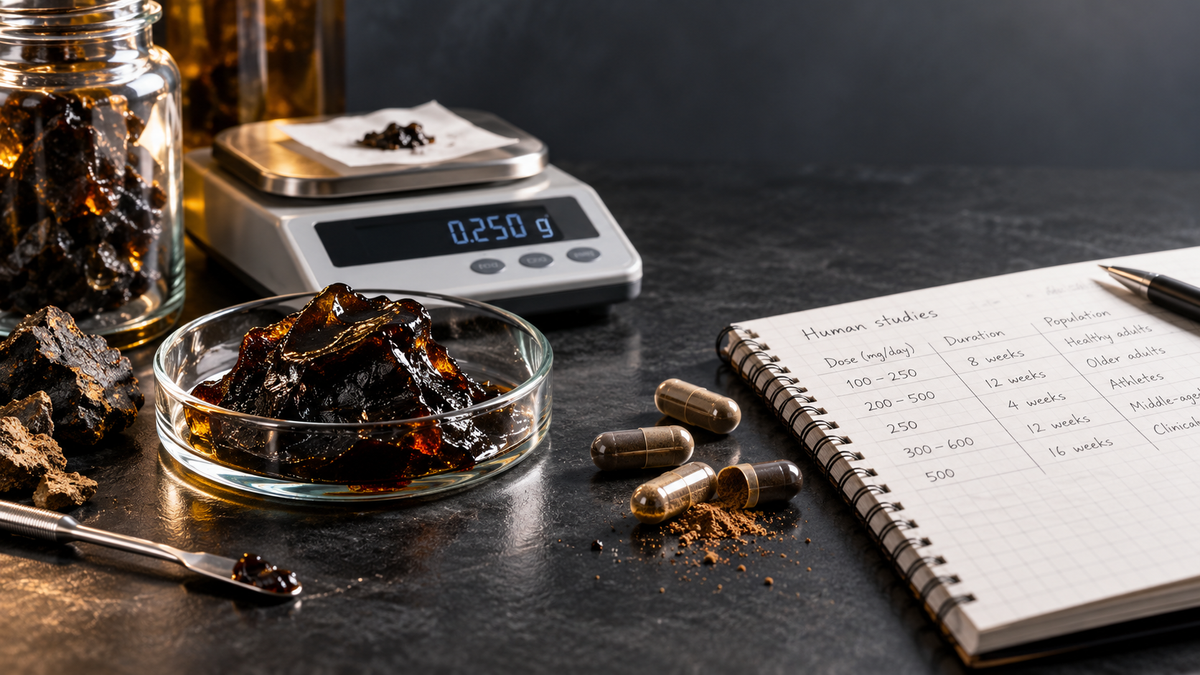
Shilajit Dosage: Amounts Used in Human Studies
Search for Shilajit and you will find confident daily amounts, pea-sized scoops and bold promises. Search for the human trials behind those claims and the picture shrinks quickly: only a handful of controlled studies report a dose, a schedule and a duration. This article lays out what those studies actually used, what they never tested, and why a number from a paper is not a recommendation for you. If you are comparing products or planning to try one, it will help you ask better questions.
1. Quick Answer: Shilajit Dosage and Medical Disclaimer
No official or established dose exists. The identifiable human trials summarized below used roughly 200 to 500 mg per day of purified, processed or standardized material, for about 8 weeks to 90 days, in specific groups of adult volunteers or patients [1][2][3]. Those figures describe research conditions. They are not proven-safe amounts, treatment protocols or targets for the general public.
Medical disclaimer: This page summarizes published studies and does not provide individualized advice. Talk to a qualified clinician before use if you have a medical condition, take any medicine, are pregnant or breastfeeding, or are planning fertility treatment. Doses in this article come from published abstracts and papers; confirm each detail in the original source.
2. Dose Depends on Form: Purified Shilajit Dosage vs Raw Resin, Capsules and Powders
The word covers very different products, and a dose only makes sense in relation to the specific preparation tested.
- Raw or crude resin. This is the tar-like exudate collected from mountain rock. Composition varies by source and batch, and unpurified material may carry heavy metals, microbes and other contaminants [4][7]. No human trial identified for this article reports a dose for raw resin.
- Purified or processed resin. Traditional Ayurvedic purification (shodhana) or modern aqueous extraction and filtration aims to remove debris and unwanted compounds. The trials in the table below used processed or purified material [1][2].
- Standardized extracts in capsules or tablets. These aim for a defined content of marker constituents, commonly fulvic acid and dibenzo-alpha-pyrones, though markers and methods differ by manufacturer [5].
- Gummies, liquids, drops and blends. No controlled human dose data were identified for these formats in the sources reviewed here.
Because purification methods, extraction solvents and marker content differ, milligrams of one preparation cannot be treated as equal to milligrams of another. A trial dose of 250 mg of a specific purified extract says little about 250 mg of a different capsule, and even less about a measure of resin described as a pea-sized portion.
3. Shilajit Dose in Human Studies: Summary Table
The table lists identifiable human studies for which I could recall a reported dose. Verify each row against the full paper before citing or acting on it, and check funding and author disclosures, since several trials used proprietary preparations.
|
Study |
Preparation |
Dose |
Frequency |
Duration |
Population |
Reported outcome |
|---|---|---|---|---|---|---|
|
Pandit et al., 2016 [1] |
Purified, standardized extract |
250 mg |
Twice daily (500 mg/day) |
90 days |
96 healthy men aged 45 to 55; randomized, placebo-controlled |
Higher total testosterone, free testosterone and DHEAS than placebo |
|
Biswas et al., 2010 [2] |
Processed resin, capsule |
100 mg |
Twice daily (200 mg/day) |
90 days |
60 men with oligospermia |
Improvements in sperm count, motility and morphology; small, early-stage study |
|
Keller et al., 2019 [3] |
Shilajit supplement (see paper for specification) |
500 mg/day |
Per paper; confirm split schedule |
8 weeks |
Healthy adult volunteers; randomized, placebo-controlled |
Smaller fatigue-related decline in some strength measures; changes in a collagen-turnover marker |
How to read this table. The studies are small, short, and differ in preparation and population, so they cannot be pooled into a single dose. Positive results in one product do not transfer automatically to others. Independent replication is limited, and the trials do not establish long-term safety [4].
4. Dose by Outcome
Matching a dose to an outcome is possible only where a human trial exists.
- Testosterone and androgen markers in healthy middle-aged men: 250 mg twice daily of a purified extract for 90 days [1]. The result concerns hormone levels, not symptoms or fertility.
- Semen parameters in men with low sperm count: 100 mg twice daily of processed resin for 90 days [2]. This was a small clinical study in patients, and it should not be read as a fertility treatment.
- Exercise-related muscle fatigue: 500 mg per day for 8 weeks in healthy volunteers [3].
-
Cognition, bone health, high-altitude adaptation, chronic fatigue, blood sugar and anemia: discussed in reviews and animal or laboratory work [5][6], but I did not identify human trials with reliable dose data for this article, so no dose is given. Absence of a number means absence of evidence, not a gap to fill with guesswork.

5. Dose by Extract and Standardization
What the capsule contains matters as much as the weight.
- Purified standardized extract: used in the testosterone trial. The paper describes the product specification, so consult it for marker content [1].
- Processed resin in capsules: used in the oligospermia study, following Ayurvedic processing principles [2].
- Supplement preparations in sports research: specifications are set out in the original paper [3].
Common marker compounds include fulvic acid, other humic substances and dibenzo-alpha-pyrones. Reviews describe a complex mixture of organic and mineral components without a single universally accepted active compound [4][5]. Marker percentages are not uniform across brands, so a label showing a milligram weight without a stated marker content or method gives you limited information. Never convert between products by weight alone.
6. Frequency
Two of the three trials above used a twice-daily schedule, each giving the daily amount in two equal portions [1][2]. The third reported a daily total [3]. No identified study compared once-daily with twice-daily dosing, so research cannot say whether splitting the dose matters. The schedule on a product label may reflect manufacturer preference, tradition or the trial it cites, not proven superiority.
7. Study Duration
The identified trials ran from 8 weeks to 90 days [1][2][3]. That is short in terms of how people actually use supplements. I found no controlled human data on continuous use for many months or years, so long-term effects on hormones, minerals, kidneys or other systems are unknown. A trial length is not a recommended period of use, and results seen at 90 days should not be extended automatically to longer periods.
8. Minimum and Maximum Amounts Studied
Among the trials above, the lowest daily amount was 200 mg (100 mg twice daily) and the highest was 500 mg per day [1][2][3]. These numbers describe only what these studies tested.
- They are not a minimum effective dose, because no dose-finding study was identified.
- They are not a maximum safe dose, because trials were not designed to find a safety ceiling.
- Amounts below or above this range were not tested in the studies reviewed here, so no conclusion can be drawn about them.

If a product asks you to take more than the amounts tested, that is a reason for caution and a conversation with a clinician, not a sign that more is better.
9. Food Timing: How to Take Shilajit
None of the identified human trials compared taking the substance with food against taking it on an empty stomach, so research cannot say which is better. Practical points therefore come from product instructions and traditional practice, not from evidence:
- Traditional use often involves dissolving purified resin in warm water or milk, and some brands repeat that instruction. This reflects custom, not trial data.
- Capsule labels vary in advising use with food, after meals or at a particular time of day. Follow the label of the specific product you buy.
- If a product upsets your stomach, speaking with a clinician or pharmacist about timing is more reliable than copying advice from social media.
- Keep any routine consistent, and note the start date so you and your clinician can judge whether anything changes.
10. Label Dose Versus Research Dose: Understanding a Shilajit Supplement Dose
A supplement label and a trial report rarely line up.
|
Question |
Why it matters |
|---|---|
|
Is the preparation the same as the one studied? |
A different extract or process can change composition |
|
Is the amount per serving stated in mg of extract, resin or powder? |
These weights are not interchangeable |
|
Are marker compounds (such as fulvic acid) quantified and tested? |
Without it, potency is unknown |
|
How many servings per day does the label suggest? |
Daily total may exceed what trials tested |
|
Is it a blend with other herbs or minerals? |
Added ingredients change both effects and risks |
|
Is a measure like pea-sized or scoop used? |
Such measures are imprecise and untested |
A practical approach: write down the product's form, amount per serving, servings per day and any other ingredients, then compare these with the table above. If your daily total is far above the amounts studied, or the form does not match any trial, treat the research as weak support at best. Choose products that publish purification methods, marker content and third-party contaminant testing.
11. Shilajit Safety Considerations and Special Populations
What is known. A review of the available evidence concluded that purified material was well tolerated in the human studies reviewed and in animal toxicity testing, while raw or unprocessed material raised concerns about contaminants [4]. That is reassuring but limited: trials were small and short, and adverse events may be under-reported.
Quality and contamination. Contamination is the most concrete risk. Studies of traditional Ayurvedic products sold online found detectable lead, mercury and arsenic in a notable share of products [7]. A mineral-rich substance from mountain rock deserves particular attention to heavy-metal testing. Look for batch-specific certificates of analysis from an accredited laboratory covering lead, cadmium, arsenic and mercury, and measured against recognized limits such as USP General Chapter 2232 [8]. Also look for microbial testing and a clear purification process.
Hormonal effects. Because one trial reported higher testosterone levels [1], people with hormone-sensitive conditions, those undergoing fertility evaluation, or anyone taking hormone-related medicines should consult a clinician first.
Minerals and metabolism. The material contains minerals, including iron, so people with iron overload conditions should seek advice. Animal data suggest effects on glucose, so people on diabetes medicines should ask a clinician or pharmacist about monitoring. Interaction data in humans are limited, and this is a precaution, not a documented interaction list.
Pregnancy and breastfeeding. I identified no adequate safety data, so use is not supported and clinician guidance is essential.
Children, older adults, and people with kidney, liver or thyroid disease. Not studied in the trials above, so individualized medical advice matters.
Long-term use. Unknown. Stop and seek medical help if you notice rash, swelling, breathing difficulty, severe stomach pain, palpitations or any unexpected symptom.
Your next step: before buying, collect the product's certificate of analysis, note its form and daily amount, and bring that information to your clinician or pharmacist, along with a list of your medicines.
12. FAQ
Is there a standard dose?
No. Trials used specific preparations at roughly 200 to 500 mg per day, but no authority has established a standard or safe upper amount [1][2][3][4].
Can I use the trial doses as my own?
Not automatically. The trials tested specific products in selected groups, and your health, medicines and product may differ. Ask a clinician [4].
Is raw resin the same as a purified extract?
No. Composition and contamination risk differ, and the human trials used processed or purified preparations, not raw resin [1][2][4].
Should I take it with food?
No identified trial tested food timing. Follow the instructions on your specific product and ask a pharmacist if you have stomach sensitivity.
How long can I use it?
The longest identified trials ran about 90 days. Long-term effects are unknown, so ask a clinician before extended use [1][2].
Does it raise testosterone?
One randomized trial in healthy middle-aged men reported higher testosterone markers than placebo after 90 days [1]. Evidence is limited, and a hormone number is not the same as a health benefit.
Is it safe in pregnancy?
Safety data are inadequate, so it should be avoided unless a clinician specifically advises otherwise.
13. References
- Pandit S, Biswas S, Jana U, De RK, Mukhopadhyay SC, Biswas TK. Clinical evaluation of purified Shilajit on testosterone levels in healthy volunteers. Andrologia. 2016;48(5):570-575.
- Biswas TK, Pandit S, Mondal S, et al. Clinical evaluation of spermatogenic activity of processed Shilajit in oligospermia. Andrologia. 2010;42(1):48-56.
- Keller JL, Housh TJ, Hill EC, Smith CM, Schmidt RJ, Johnson GO. The effects of Shilajit supplementation on fatigue-induced decreases in muscular strength and serum hydroxyproline levels. J Int Soc Sports Nutr. 2019;16:3.
- Stohs SJ. Safety and efficacy of Shilajit (mumie, moomiyo). Phytother Res. 2014;28(4):475-479.
- Agarwal SP, Khanna R, Karmarkar R, Anwer MK, Khar RK. Shilajit: a review. Phytother Res. 2007;21(5):401-405.
- Carrasco-Gallardo C, Guzmán L, Maccioni RB. Shilajit: a natural phytocomplex with potential procognitive activity. Int J Alzheimers Dis. 2012;2012:674142.
- Saper RB, Phillips RS, Sehgal A, et al. Lead, mercury, and arsenic in US- and Indian-manufactured Ayurvedic medicines sold via the Internet. JAMA. 2008;300(8):915-923.
- United States Pharmacopeia. General Chapter 2232: Elemental Contaminants in Dietary Supplements.
For general information only. Talk to your doctor before starting any supplement.


