
Moringa Seed Oil Dosage: Amounts Used in Human Studies
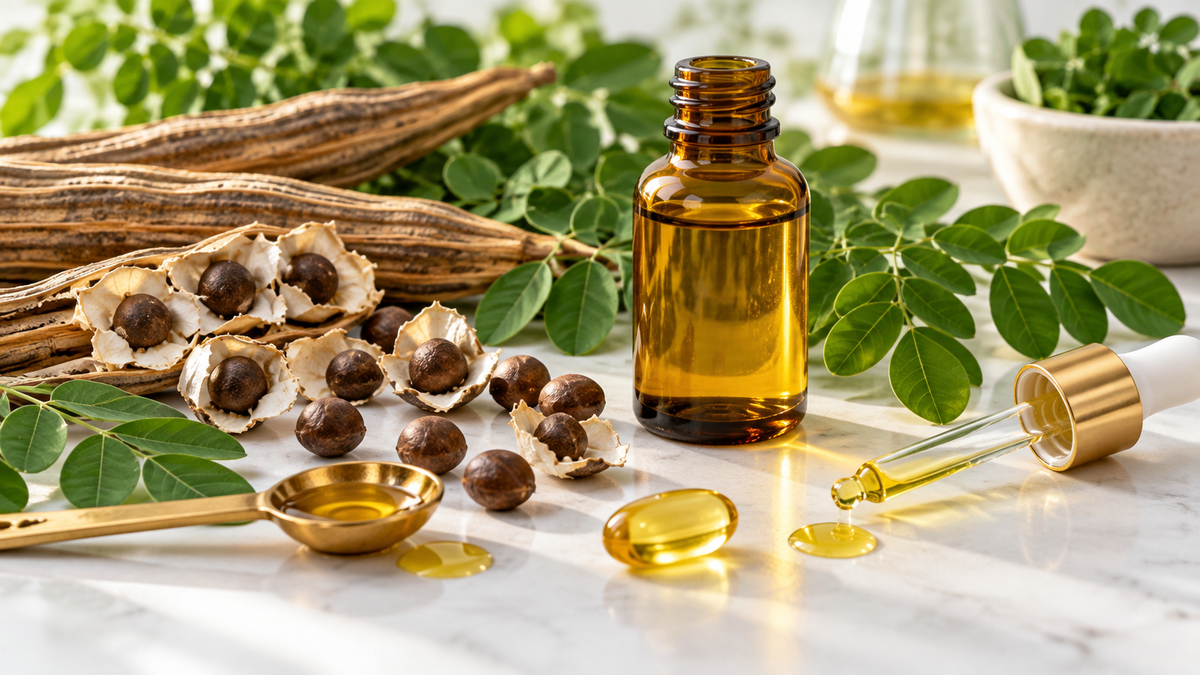
Moringa Seed Oil Dosage: Amounts Used in Human Studies
Moringa seed oil dosage is one of the most searched and least clearly answered questions about this ingredient. Product labels list serving sizes, blogs repeat guesses, and the research is thinner than most people expect. This guide summarizes the amounts reported in human research, explains why those numbers change with the product form, and shows where the evidence stops. It describes published research only. It does not recommend a personal dose.
1. Quick Answer: Moringa Seed Oil Dosage and Medical Disclaimer
Short answer: No standard, evidence-based oral dose has been established for moringa seed oil in humans. Most human trials on Moringa oleifera used dried leaf powder, usually in the range of about 4 to 8 grams per day for 40 days to 3 months. Seed oil itself has mostly been studied as a food oil, a cosmetic ingredient, and in laboratory work.
Medical disclaimer: This article is for education only. It is not medical advice, and it does not diagnose, treat, or prescribe. Doses in a study apply to that study's participants, product, and conditions. Talk to a qualified healthcare professional before using any supplement, especially if you are pregnant, breastfeeding, taking medicine, or managing a health condition.
2. Moringa Oil Dose Depends on Form
A moringa oil dose cannot be compared across products until you know what is actually in the container. "Moringa" can mean very different materials:
- Seed oil (ben oil): pressed from the seeds, rich in oleic acid and containing behenic acid. Used in cooking, skin care, and some softgel supplements.
- Leaf powder: dried, ground leaves. This is the form used in most human trials.
- Leaf or seed extracts: concentrated with water or alcohol, sometimes standardized to a marker compound.
- Seed powder or press cake: the solid material left or ground from the seed.
Because these materials differ in fat, protein, fiber, and plant compounds, one gram of leaf powder is not equal to one gram of seed oil. Research doses for one form should never be copied onto another.
3. Moringa Seed Oil Human Studies Dose Table
The table below lists examples of moringa doses reported in human research. It shows the form studied, because leaf powder results do not transfer to seed oil.
|
Form studied |
Reported amount |
Duration |
Participants |
Outcome measured |
|---|---|---|---|---|
|
Leaf powder (Kumari, 2010) |
8 g per day |
3 months |
Women with type 2 diabetes |
Blood glucose markers |
|
Leaf powder (Giridhari et al., 2011) |
8 g per day |
40 days |
Adults with type 2 diabetes |
Blood glucose |
|
Leaf powder (Kushwaha et al., 2014) |
7 g per day |
3 months |
Postmenopausal women |
Antioxidant status |
|
Seed oil, oral |
No established dose in controlled human trials found |
Not applicable |
Not applicable |
Not applicable |
|
Seed oil, topical |
Product-specific, not standardized |
Varies |
Cosmetic and small studies |
Skin feel, hydration |
Treat this table as a summary, not a recommendation. Check each original paper before quoting a number, because study design, product quality, and sample size differ.
4. Dose by Outcome
People usually ask about moringa for a specific goal. Here is what the research record shows by outcome.
Blood sugar. The most frequently reported doses come from small trials on leaf powder in adults with type 2 diabetes, around 8 grams per day. These trials were small and short, so they cannot confirm a reliable effect.
Antioxidant status. One trial in postmenopausal women used 7 grams of leaf powder daily for three months and reported changes in antioxidant markers.
Skin and hair. Seed oil is typically applied to the skin. Amounts are set by product directions, not by clinical dosing studies.
Cholesterol and inflammation. Evidence is mostly from animal and cell studies. Human dose ranges are not established.
For every outcome above, no study has set a dose of moringa seed oil taken by mouth.
5. Dose by Extract and Standardization
Standardization means a product is adjusted to contain a measured amount of a marker compound. Moringa products rarely share a standard, which makes dose comparison hard.
- Plain oil: sold by volume or weight, with fatty acid content varying by seed source and pressing method.
- Leaf extracts: may be labeled by extract ratio, such as 10:1, which means the extract was concentrated from a larger amount of leaf. A small capsule can represent a large amount of raw plant.
- Marker compounds: some extracts report isothiocyanates or phenolics, but there is no agreed benchmark across brands.
When two labels show different milligram amounts, the products may still be unrelated in strength. Extract ratio, plant part, and solvent matter as much as the number on the front.
6. Frequency of Moringa Use in Research
In the leaf powder trials above, the amount was given once daily or split into smaller portions across the day. The exact schedule was often set by the study team for practical reasons rather than because research proved one schedule superior. No trial has compared once-daily seed oil with divided dosing, so there is no evidence that frequency changes results.
7. Study Duration
Human moringa studies are short. Reported durations include single-dose meal tests, 40-day trials, and three-month trials. Long-term studies lasting a year or more are rare. That means the safety and effect of extended use is mostly unknown, and results at 40 days should not be assumed to hold at one year.
8. Minimum and Maximum Studied Amounts
The lowest and highest amounts reported depend on the form:
- Lower end: small portions of leaf powder, in the range of a few grams per day, are common in nutrition research.
- Higher end: single test meals in older glucose studies used larger leaf powder portions, around 20 grams in one sitting, under supervision.
- Seed oil: because no clear oral human trials exist, there is no studied minimum or maximum amount to report.
A studied maximum is not a safe maximum. It only shows the highest amount researchers chose to test.
9. Food Timing and Moringa Oil
Timing is mentioned in only a few studies, and results do not prove that timing changes outcomes. Because oils are fat-based, many people take them with a meal that contains other food, which may reduce stomach upset. In glucose research, test portions were tied to meals because the goal was to measure the meal response. This is a design choice, not proof of a best time. Follow the product label and your clinician's advice.
10. Label Dose vs Research Dose
A label dose is a manufacturer's serving suggestion. A research dose is the amount a study gave to its participants. They are different things.
|
Feature |
Label dose |
Research dose |
|---|---|---|
|
Set by |
Manufacturer |
Study team |
|
Based on |
Marketing, formulation, regulation |
Study question and protocol |
|
Product tested |
Usually not clinically tested |
Specific material used in the trial |
|
Applies to |
General consumers |
Selected participants |
A softgel labeled with a certain milligram amount of moringa seed oil does not mean that amount was tested for any health benefit. Look for third-party testing, a clear plant part, and a batch certificate when comparing products.
11. Moringa Seed Oil Safety Considerations
Moringa seed oil safety depends on the form and the person. Seed oil used in food or on the skin is generally considered low risk for most adults, but information is limited. Keep these points in mind:
- Pregnancy and breastfeeding: Moringa root, bark, and some extracts are a concern in pregnancy. Avoid unsupervised use and ask a clinician.
- Medicines: Moringa leaf has been studied for effects on blood sugar and blood pressure. People taking diabetes or blood pressure medicine should speak with a professional before using moringa products.
- Allergy: Patch test oil on a small skin area first. Stop use if redness, itching, or swelling appears.
- Digestive effects: Large amounts of any oil may cause loose stools or stomach upset.
- Quality: Rancid or adulterated oil can cause problems. Choose products with clear sourcing and storage guidance.
Seek medical help right away if you notice a serious reaction.
12. FAQ: Moringa Seed Oil Dosage
What is the standard moringa seed oil dosage? There is no standard, evidence-based oral dosage. Most human data are for leaf powder, not seed oil.
How much moringa was used in human studies? Examples include 7 to 8 grams of leaf powder daily for 40 days to three months. These amounts do not apply to seed oil.
Is moringa seed oil the same as moringa leaf powder? No. They come from different plant parts and contain different nutrients and compounds.
Can I take moringa seed oil every day? Long-term daily use has not been well studied. Ask a qualified healthcare professional about your situation.
Should I take moringa seed oil with food? Research does not prove one best time. Many people use oils with a meal, but follow the product label and professional advice.
Does a higher dose work better? Not necessarily. Studies have not shown that more is better, and higher amounts may raise the chance of side effects.
13. References
- Kumari DJ. Hypoglycaemic effect of Moringa oleifera and Azadirachta indica in type 2 diabetes. Bioscan. 2010.
- Giridhari VA, Malathi D, Geetha K. Anti diabetic property of drumstick (Moringa oleifera) leaf tablets. Int J Health Nutr. 2011.
- Kushwaha S, Chawla P, Kochhar A. Effect of supplementation of drumstick (Moringa oleifera) and amaranth leaves powder on antioxidant profile and oxidative status among postmenopausal women. J Food Sci Technol. 2014.
- Leone A, et al. Moringa oleifera seeds and oil: characteristics and uses for human health. Int J Mol Sci. 2016.
- Stohs SJ, Hartman MJ. Review of the safety and efficacy of Moringa oleifera. Phytother Res. 2015.
For general information only. Talk to your doctor before starting any supplement.


