
Saffron Dosage: Amounts Used in Human Studies
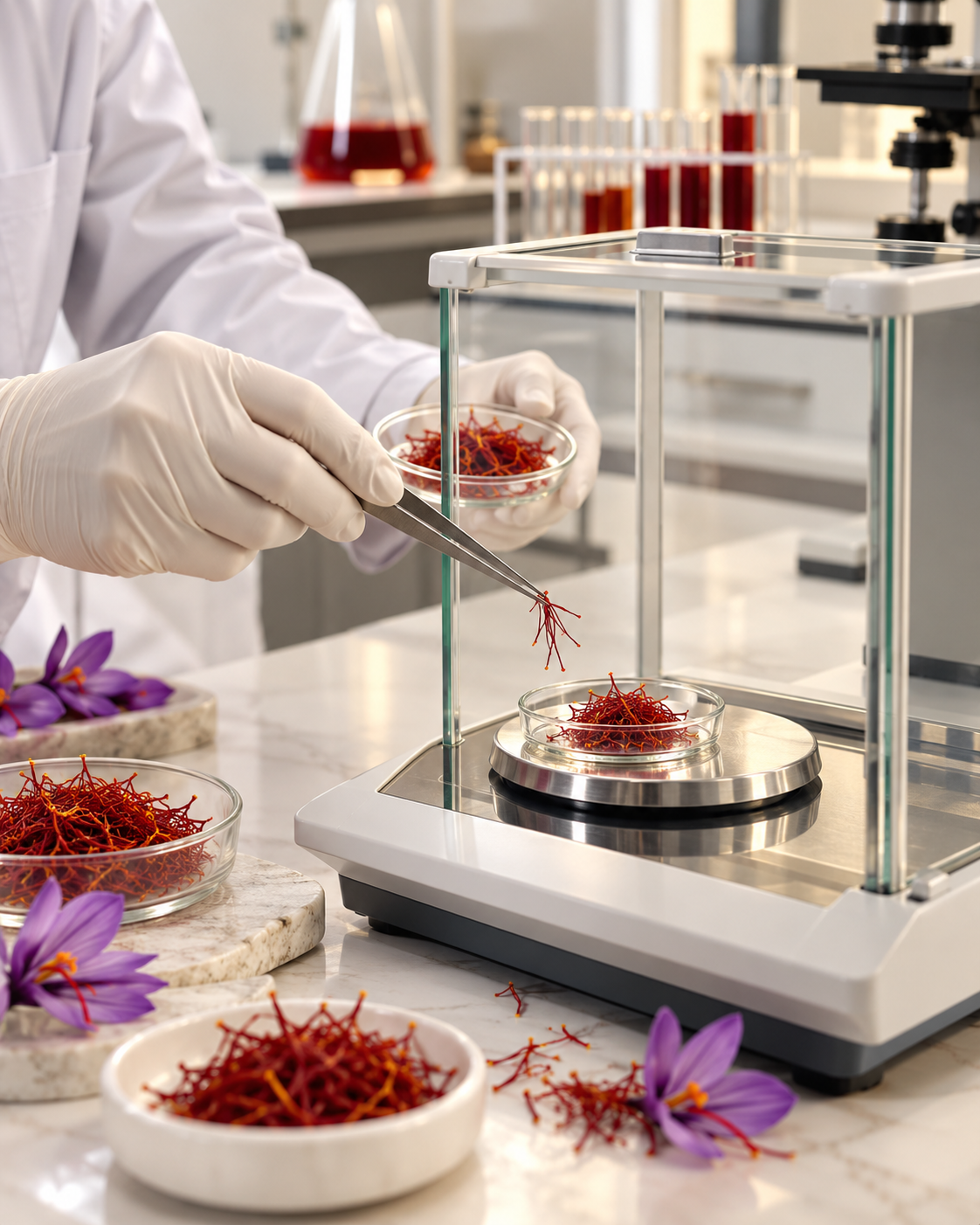
Saffron Dosage: Amounts Used in Human Studies
1. Quick Answer and Medical Disclaimer
In published human studies, saffron has most often been given as a standardised stigma extract at about 20 to 30 mg per day, commonly split into two doses of 14 to 15 mg, for periods from four weeks to about a year [1,2,9,12,15]. The single most common amount is 30 mg per day. Much higher amounts, up to 400 mg per day, have been tested only in a short safety study in healthy volunteers [18].
These are research doses, not recommendations. Trial participants were screened, monitored and given specific products. This page summarises what researchers studied. It does not tell any individual how much to take.
Medical disclaimer: This article is educational and is not medical advice, diagnosis or treatment. Saffron supplements may affect mood and may interact with medicines. Speak with a doctor or pharmacist before using saffron, especially if you are pregnant, breastfeeding, have a medical condition or take prescription medication.

2. Dose Depends on Form
A milligram of saffron is not always a milligram of the same thing. The form of the ingredient changes how much active material a dose contains.
• Whole threads or powder: dried stigma used in cooking. It is rarely tested in controlled trials, so there are almost no human dose data for it.
• Stigma extract: a hydro-alcoholic or aqueous extract in capsules. Most trials used this form, usually at 30 mg per day [1,2].
• Standardised branded extract: a stigma extract tested for marker compounds such as crocins and safranal. Studies of these products often used about 28 mg per day [5,6,7].
• Petal extract: a different material with a different chemical profile. One trial used 30 mg per day [3], but petal and stigma doses should not be treated as interchangeable.
• Isolated crocetin: one sleep study gave 7.5 mg of crocetin per day [21]. This is a single compound, not saffron itself.
Chemistry explains why form matters. The content of crocins, safranal and picrocrocin varies with growing region, harvest, drying and storage [24]. After swallowing, crocins are largely converted to crocetin in the gut, and crocetin is what appears in blood [22]. In healthy volunteers, crocetin levels peaked around four hours after a dose [20].
3. Human Study Dose Table
The table lists selected human studies with the dose, duration and population. It shows what was studied, not what is advisable.
|
Study focus |
Population |
Product |
Daily dose |
Duration |
|
Depression [1] |
Adults, mild to moderate depression |
Stigma extract |
30 mg (15 mg twice daily) |
6 weeks |
|
Depression vs fluoxetine [2] |
Adults, mild to moderate depression |
Stigma extract |
30 mg |
6 weeks |
|
Depression vs fluoxetine [3] |
Adults, depression |
Petal extract |
30 mg |
8 weeks |
|
Youth anxiety and mood [5] |
Adolescents |
Standardised extract |
About 28 mg (14 mg twice daily) |
8 weeks |
|
Low mood [6] |
Healthy adults |
Standardised extract |
About 28 mg |
4 weeks |
|
Sleep quality [7] |
Adults with poor sleep |
Standardised extract |
About 28 mg |
4 weeks |
|
Premenstrual syndrome [9] |
Women |
Stigma extract |
30 mg (15 mg twice daily) |
2 menstrual cycles |
|
Sexual dysfunction with fluoxetine [10,11] |
Men and women |
Stigma extract |
30 mg |
4 weeks |
|
Alzheimer's disease [12] |
Mild to moderate |
Stigma extract |
30 mg |
16 weeks |
|
Alzheimer's vs donepezil [13] |
Mild to moderate |
Stigma extract |
30 mg |
22 weeks |
|
Alzheimer's vs memantine [14] |
Moderate to severe |
Stigma extract |
30 mg |
12 months |
|
Early macular degeneration [15] |
Adults |
Saffron supplement |
20 mg |
3 months |
|
Early macular degeneration follow-up [16] |
Adults |
Saffron supplement |
20 mg |
About 14 months |
|
Snacking and satiety [17] |
Overweight women |
Branded extract |
176.5 mg |
8 weeks |
|
Safety study [18] |
Healthy volunteers |
Saffron tablets |
200 and 400 mg |
7 days |
Three patterns stand out. First, 30 mg per day dominates, mainly because early trials set that amount and later studies copied it. Second, durations differ far more than doses do. Third, nearly every trial tested only one dose level, so the table cannot show how effects change as the amount rises or falls.
4. Dose by Outcome
Because most trials used a single dose, outcome groups share similar amounts. This pattern reflects research habits more than any proven dose for a given purpose.
• Mood and depression: 28 to 30 mg per day for four to eight weeks [1,2,5,6].
• Sleep: about 28 to 30 mg per day for roughly four weeks in standardised-extract trials [7,8], plus 7.5 mg of crocetin in a separate study [21].
• Premenstrual symptoms and sexual function: 30 mg per day for two cycles or four weeks [9,10,11].
• Cognition and Alzheimer's disease: 30 mg per day for 16 weeks to 12 months [12,13,14].
• Eye health: 20 mg per day for three months or longer [15,16].
• Appetite and snacking: 176.5 mg per day of a specific extract for eight weeks [17].
• Metabolic markers: doses vary widely between trials, so no typical amount can be stated with confidence.
Almost no trial compared several doses of the same extract. That means researchers do not know whether 15 mg, 30 mg or 60 mg works best, or whether more is better. There is no established dose-response relationship for saffron in people.
5. Dose by Extract and Standardisation
Standardisation describes how a manufacturer measures key compounds in the product. For raw saffron, the international standard ISO 3632 grades quality by light absorbance at set wavelengths, which reflects crocin (colour), picrocrocin (bitterness) and safranal (aroma) content [24]. Supplement extracts may instead be standardised to a defined percentage of crocins and safranal.
This matters because two capsules that both say "30 mg saffron extract" can contain different amounts of crocins. Many trials reported the weight of extract but not the exact crocin content per dose, which makes comparison difficult. When a study used a branded standardised extract, its results apply to that product, and the dose may not carry over to a different brand.
Three practical points follow from this. The extract type and its marker compounds are as important as the milligram figure. A product labelled "saffron" without extraction or standardisation details is hard to compare with trial products. And results from stigma extracts should not be assumed for petal extracts, or the reverse.
6. Frequency
Most trials used 15 mg twice daily to give a total of 30 mg [1,9,10]. Some standardised-extract trials used 14 mg twice daily [5,7]. A few gave the total dose once a day. No trial cited here directly compared once-daily and twice-daily schedules of the same dose, so there is no evidence that one pattern is better.
Pharmacokinetic data offer a possible reason for splitting doses. After a single oral dose of crocetin, blood levels peaked at about four hours and then declined over several hours [20]. Dividing a daily dose could smooth exposure, but this is an inference and not a tested result.
7. Study Duration
Duration varies by purpose.
• 7 days: the healthy-volunteer safety study [18].
• 4 to 8 weeks: most mood, sleep, sexual function and appetite studies [2,6,7,10,17].
• Two menstrual cycles: the premenstrual syndrome trial [9].
• 16 to 22 weeks: Alzheimer's trials against placebo and donepezil [12,13].
• 12 months or longer: the memantine comparison and the macular degeneration follow-up [14,16].
Benefits in short trials were generally measured after at least four weeks, so these studies say little about immediate effects. Equally important, there are no controlled data beyond about a year, so long-term use is largely unstudied.
8. Minimum and Maximum Studied Amounts
The lowest dose of saffron extract in the human studies cited here was about 20 mg per day, used in eye studies [15,16]. Crocetin alone was tested at 7.5 mg per day [21]. Most efficacy trials sat at 28 to 30 mg per day.
The highest dose in a controlled efficacy study cited here was 176.5 mg per day for eight weeks [17]. The highest dose in any human study cited here was 400 mg per day for one week in healthy volunteers, which found no serious adverse effects, although some laboratory values shifted slightly [18].
Beyond these amounts, evidence changes character. Reviews cite older reports that several grams of saffron can be toxic and that around 20 g may be lethal, although those figures come from limited sources [19]. These numbers describe harm and do not define a safe or useful range. No upper intake level has been established from these studies.
9. Food Timing
No study cited here compared saffron taken with food against saffron taken without food, so there are no human data on food effects. Trials generally described twice-daily capsules and did not set strict meal rules. Crocetin is fat-soluble, which suggests food could influence absorption, but this has not been tested. Anyone using a product should follow its label and the advice of their clinician, particularly if they take other medicines.
10. Label Dose vs Research Dose
Product labels do not always match trial conditions. Some labels state the weight of extract, as trials did. Others state the weight of raw stigma powder, which is a different material and often a larger number. Some combine saffron with other ingredients in a proprietary blend that hides the amount of saffron.
• Check the material: extract or raw powder, and stigma or petal.
• Check standardisation: whether crocins or safranal are measured and stated.
• Check the serving: whether the label dose is per capsule or per day.
• Look for testing: independent quality testing helps with identity and adulteration, a known problem in saffron [24].
A label dose is a manufacturer's choice and may be higher or lower than amounts studied. Matching a research dose does not guarantee matching a research result, because the product also has to match.
11. Safety Considerations
At studied doses, saffron was generally well tolerated. Reported effects were usually mild and included nausea, headache, dry mouth, dizziness and appetite changes [19,23]. Safety is limited by the small size and short length of most trials, which were not designed to detect rare or long-term adverse effects.
• Pregnancy and breastfeeding: high intakes are avoided in pregnancy because of possible uterine stimulation [19]. Supplement doses should be discussed with a clinician.
• Mood medicines and bipolar disorder: saffron may influence serotonin signaling and mood. People taking antidepressants or with bipolar disorder should seek medical advice.
• Blood-thinning medicines: interaction data are limited, so professional guidance is sensible.
• Children: evidence is very limited, with one trial in adolescents [5].
• Allergy: people allergic to saffron or related Crocus plants should avoid it.
• Product quality: adulteration and variable standardisation add risk and uncertainty.
12. FAQ
What is the most common saffron dose in human studies?
The most common amount was 30 mg of stigma extract per day, often as 15 mg twice daily [1,9,12]. Some standardised products were studied at about 28 mg per day [5,6,7].
Is 30 mg the right dose for me?
This page cannot say. Thirty mg is a commonly studied research dose, not an individual recommendation. A doctor or pharmacist can advise based on your health and medicines.
Does a higher dose work better?
That has not been shown. Few trials tested more than one dose, and higher amounts have far less safety data.
Does cooking with saffron give the same dose as a supplement?
Not necessarily. Culinary use has not been tested the way extracts have, and the amount of crocins reaching the body depends on the recipe, the spice quality and cooking.
Should saffron be taken with food?
No study has tested this, so there is no evidence-based answer. Follow the product label.
How long did people take it in studies?
Durations ranged from one week in a safety study to about a year in dementia and eye studies, with four to eight weeks being typical for mood [2,6,14,16,18].
Can saffron be taken long term?
Controlled data extend to about a year at most [14,16]. Long-term safety beyond that has not been studied well, so ongoing use is a topic for a clinician.
Do men, women and older adults use different doses?
Trials in men, women and older adults with dementia generally used the same 30 mg per day [9,10,11,12]. No study has established sex-specific or age-specific dosing.
This article is for educational purposes and is not medical advice. Speak to a qualified healthcare professional before using saffron supplements, especially if you are pregnant, have a medical condition or take prescription medication.
13. References
[1] Akhondzadeh S, Tahmacebi-Pour N, Noorbala AA, et al. Crocus sativus L. in the treatment of mild to moderate depression: a double-blind, randomized and placebo-controlled trial. Phytother Res. 2005;19(2):148-151.
[2] Noorbala AA, Akhondzadeh S, Tamacebi-Pour N, Jamshidi AH. Hydro-alcoholic extract of Crocus sativus L. versus fluoxetine in the treatment of mild to moderate depression: a double-blind, randomized pilot trial. J Ethnopharmacol. 2005;97(2):281-284.
[3] Akhondzadeh Basti A, Moshiri E, Noorbala AA, et al. Comparison of petal of Crocus sativus L. and fluoxetine in the treatment of depressed outpatients: a pilot double-blind randomized trial. Prog Neuropsychopharmacol Biol Psychiatry. 2007;31(2):439-442.
[4] Hausenblas HA, Saha D, Dubyak PJ, Anton SD. Saffron (Crocus sativus L.) and major depressive disorder: a meta-analysis of randomized clinical trials. J Integr Med. 2013;11(6):377-383.
[5] Lopresti AL, Drummond PD, Inarejos-García AM, Prodanov M. affron®, a standardised extract from saffron (Crocus sativus L.) for the treatment of youth anxiety and depressive symptoms: a randomised, double-blind, placebo-controlled study. J Affect Disord. 2018;232:349-357.
[6] Kell G, Rao A, Beccaria G, et al. affron® a novel saffron extract (Crocus sativus L.) improves mood in healthy adults over 4 weeks in a double-blind, parallel, randomized, placebo-controlled clinical trial. Complement Ther Med. 2017;33:58-64.
[7] Lopresti AL, Smith SJ, Metse AP, Drummond PD. Effects of saffron on sleep quality in healthy adults with self-reported poor sleep: a randomized, double-blind, placebo-controlled trial. J Clin Sleep Med. 2020;16(6):937-947.
[8] Pachikian BD, Copine S, Suchareau M, Deldicque L. Effects of saffron extract on sleep quality: a randomized double-blind controlled clinical trial. Nutrients. 2021;13(5):1473.
[9] Agha-Hosseini M, Kashani L, Aleyaseen A, et al. Crocus sativus L. (saffron) in the treatment of premenstrual syndrome: a double-blind, randomised and placebo-controlled trial. BJOG. 2008;115(4):515-519.
[10] Modabbernia A, Sohrabi H, Nasehi AA, et al. Effect of saffron on fluoxetine-induced sexual impairment in men: randomized double-blind placebo-controlled trial. Psychopharmacology. 2012;223(4):381-388.
[11] Kashani L, Raisi F, Saroukhani S, et al. Saffron for treatment of fluoxetine-induced sexual dysfunction in women: randomized double-blind placebo-controlled study. Hum Psychopharmacol. 2013;28(1):54-60.
[12] Akhondzadeh S, Sabet MS, Harirchian MH, et al. Saffron in the treatment of patients with mild to moderate Alzheimer's disease: a 16-week, randomized and placebo-controlled trial. J Clin Pharm Ther. 2010;35(5):581-588.
[13] Akhondzadeh S, Shafiee Sabet M, Harirchian MH, et al. A 22-week, multicenter, randomized, double-blind controlled trial of Crocus sativus in the treatment of mild-to-moderate Alzheimer's disease. Psychopharmacology. 2010;207(4):637-643.
[14] Farokhnia M, Shafiee Sabet M, Iranpour N, et al. Comparing the efficacy and safety of Crocus sativus L. with memantine in patients with moderate to severe Alzheimer's disease: a double-blind randomized clinical trial. Hum Psychopharmacol. 2014;29(4):351-359.
[15] Falsini B, Piccardi M, Minnella A, et al. Influence of saffron supplementation on retinal flicker sensitivity in early age-related macular degeneration. Invest Ophthalmol Vis Sci. 2010;51(12):6118-6124.
[16] Piccardi M, Marangoni D, Minnella AM, et al. A longitudinal follow-up study of saffron supplementation in early age-related macular degeneration: sustained benefits to central retinal function. Evid Based Complement Alternat Med. 2012;2012:429124.
[17] Gout B, Bourges C, Paineau-Dubreuil S. Satiereal, a Crocus sativus L extract, reduces snacking and increases satiety in a randomized placebo-controlled study of mildly overweight, healthy women. Nutr Res. 2010;30(5):305-313.
[18] Modaghegh MH, Shahabian M, Esmaeili HA, Rajbai O, Hosseinzadeh H. Safety evaluation of saffron (Crocus sativus) tablets in healthy volunteers. Phytomedicine. 2008;15(12):1032-1037.
[19] Moshiri M, Vahabzadeh M, Hosseinzadeh H. Clinical applications of saffron (Crocus sativus) and its constituents: a review. Drug Res. 2015;65(6):287-295.
[20] Umigai N, Murakami K, Ulit MV, et al. The pharmacokinetic profile of crocetin in healthy adult human volunteers after a single oral administration. Phytomedicine. 2011;18(7):575-578.
[21] Umigai N, Takeda R, Mori A. Effect of crocetin on quality of sleep: a randomized, double-blind, placebo-controlled, crossover study. Complement Ther Med. 2018;41:47-51.
[22] Asai A, Nakano T, Takahashi M, Nagao A. Orally administered crocetin and crocins are absorbed into blood plasma as crocetin and its glucuronide conjugates in mice. J Agric Food Chem. 2005;53(18):7302-7306.
[23] Marx W, Lane M, Rocks T, et al. Effect of saffron supplementation on symptoms of depression and anxiety: a systematic review and meta-analysis. Nutr Rev. 2019;77(8):557-571.
[24] Melnyk JP, Wang S, Marcone MF. Chemical and biological properties of the world's most expensive spice: saffron. Food Res Int. 2010;43(8):1981-1989.
For general information only. Talk to your doctor before starting any supplement.


