
Glutathione Dosage: Amounts Used in Human Studies
Glutathione Dosage: Amounts Used in Human Studies
Quick Answer and Medical Disclaimer
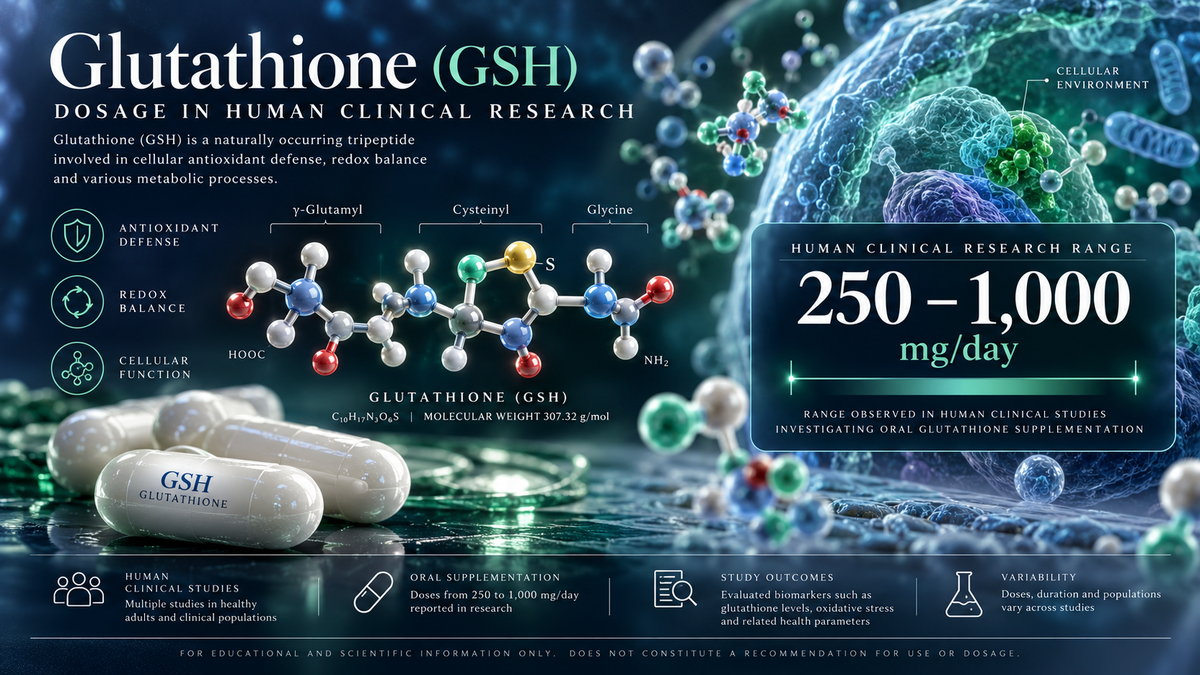
There is no single, universally established glutathione dosage. In human studies, oral reduced glutathione has most often been tested at about 250 mg to 1,000 mg per day for periods of weeks to six months, while a single 3 g oral dose in an older pharmacokinetic study did not clearly raise blood levels. Liposomal, sublingual and intravenous products have been studied differently, and their amounts cannot be swapped one for one.
This article summarizes what researchers have used. It is educational information, not medical advice, and a studied amount is not a recommended or proven-safe amount for any individual. Anyone who is pregnant, breastfeeding, taking medicines, or living with a medical condition should speak with a doctor or pharmacist before using any glutathione product.
What Is Glutathione Dosage?
Glutathione is a small molecule made of three amino acids: glutamate, cysteine and glycine. Your cells make it, and it takes part in antioxidant defence and detoxification chemistry. "Dosage" here means the amount of glutathione given in a study or listed on a product, together with how often it is taken, in what form, and for how long.
Two points matter before reading any number:
- A dose is not an outcome. A study may measure blood glutathione, an oxidative stress marker, or a skin measurement. A higher blood level does not automatically mean a health benefit.
-
A dose is not a recommendation. Researchers choose amounts to test a question safely. They are not setting a daily target for the public. No official recommended intake (like an RDA) exists for glutathione, so any "recommended glutathione dosage" you see online should be treated cautiously.

Why Glutathione Dosage Depends on Formulation
Glutathione is a tripeptide, and the digestive tract contains enzymes that can break it down. That is why early researchers doubted that swallowed glutathione would reach the bloodstream intact. Product design tries to work around this, and each approach behaves differently.
- Oral reduced glutathione (GSH): capsules or powders, the most studied supplement form. Doses in trials are usually in the hundreds of milligrams.
- Liposomal glutathione: glutathione enclosed in fat-based vesicles, marketed for better absorption. Human data exist but are limited and mostly small.
- Sublingual or oral-spray forms: meant to be absorbed through the mouth lining. Evidence in humans is very limited.
- Intravenous (IV) glutathione: given by a clinician, bypassing digestion entirely. Studied mainly in specific medical conditions, and dose logic is completely separate from supplements.
- Other forms, such as S-acetyl glutathione or oxidized glutathione (GSSG): sold commercially, but human dosing evidence is thinner.
Because absorption, delivery route and chemistry differ, 500 mg of one form is not equivalent to 500 mg of another.
Glutathione Dosage Used in Human Clinical Studies
The table below lists well-known human studies. Evidence note: these are mostly small trials in healthy volunteers, and they measured biomarkers or cosmetic endpoints rather than disease outcomes. Please check each figure against the original paper before relying on it.
|
Formulation |
Amount studied |
Frequency |
Duration |
Population |
Outcome investigated |
Key limitations |
|---|---|---|---|---|---|---|
|
Oral reduced glutathione (Richie et al., 2015) |
250 mg and 1,000 mg per day |
Daily |
6 months |
Healthy adults |
Glutathione levels in blood and other body compartments |
Biomarker study; no disease outcomes; levels reported to fall after stopping |
|
Oral reduced glutathione (Witschi et al., 1992) |
3 g, single dose |
Once |
Single dose |
Small group of healthy volunteers |
Rise in plasma glutathione after dosing |
Very small; old; no repeated dosing |
|
Oral reduced glutathione (Allen and Bradley, 2011) |
About 1,000 mg per day |
Daily (check split-dosing in paper) |
4 weeks |
Healthy adults |
Oxidative stress biomarkers |
Short; healthy participants; surrogate markers |
|
Oral reduced glutathione (Arjinpathana and Asawanonda, 2012) |
500 mg per day |
Divided doses |
4 weeks |
Healthy women |
Skin melanin index (cosmetic) |
Small, short, cosmetic endpoint; not evidence of a general benefit |
|
Liposomal glutathione (Sinha et al., 2018) |
500 mg and 1,000 mg per day |
Daily |
About 1 month |
Small group of adults |
Body glutathione stores and immune markers |
Small pilot; limited controls; surrogate markers |
|
Intravenous glutathione (Hauser et al., 2009) |
1,400 mg per infusion |
Three times weekly |
4 weeks |
Adults with Parkinson's disease |
Clinical symptom scores |
Pilot size; no clear benefit over placebo; clinical setting only |
Two patterns stand out. First, repeated daily oral dosing at roughly 1,000 mg per day has shown measurable changes in glutathione-related markers, while a single large oral dose gave inconsistent results. Second, the strongest-looking numbers come from biomarkers, which is early-stage evidence.
Glutathione Dosage by Health Outcome Investigated
Studies group loosely into a few themes. Evidence strength varies, and none of this supports promises of treatment or prevention.
- Body glutathione stores: the clearest human signal. Daily oral supplementation for months raised measured glutathione in some body compartments in healthy adults, and the effect appeared to depend on the dose.
- Oxidative stress markers: short trials at around 1,000 mg per day reported changes in some markers. Marker changes do not prove clinical benefit.
- Skin appearance: a small trial used 500 mg per day for four weeks and measured melanin index. Participants were healthy, the trial was short, and its results should not be read as proof that glutathione lightens skin safely or reliably.
- Immune markers: a small liposomal pilot reported changes in some immune measures. This is hypothesis-generating only.
- Neurological disease: IV glutathione in Parkinson's disease did not clearly outperform placebo in a randomized pilot. This does not support supplement use for the condition.
Animal and laboratory work (cell studies, rodent models) is often cited for mechanisms, but it cannot set a human dose.
Glutathione Dosage by Formulation and Standardization
Unlike a botanical extract, glutathione is a defined single compound, so there is no "percent extract" to standardize. What matters instead is identity, form and purity.
- Reduced vs oxidized form: most oral studies use reduced glutathione (GSH). The oxidized form (GSSG) behaves differently and is not directly comparable.
- Oral vs liposomal: small studies suggest liposomal products can also change body markers at 500 to 1,000 mg per day, but head-to-head comparisons against plain oral glutathione at the same dose are scarce.
- Sublingual: one comparison study examined oral, sublingual and N-acetylcysteine products on oxidative stress markers and found form-dependent differences. Study-specific doses should be read in the original paper (Schmitt et al., 2015), and results cannot be generalized to every product.
- S-acetyl glutathione: marketed as more stable. Human dose-response evidence is limited, so no study-backed amount can be stated here.
- IV: dosed by clinicians. Amounts used in trials are not guidance for supplements and should never be self-administered.
Frequency of Administration
The human trials above mostly used once-daily dosing, with some splitting a daily total into two doses. No study clearly shows that one schedule beats another. The 500 mg per day skin study, for example, used divided doses, but that was a design choice, not a proven advantage. IV trials used scheduled infusions, such as three times a week, managed by clinicians.
Duration of Use in Clinical Studies
Durations are short to medium. Many oral trials last four weeks, a few last about a month, and the longest well-known oral trial here ran six months. Long-term (multi-year) human safety and efficacy data for supplemental glutathione are lacking. Effects on blood levels appear to fade after stopping, so results from a short trial do not tell us what happens with years of daily use.
Minimum and Maximum Studied Amounts
Based on the studies discussed:
- Lowest repeated oral amount in this table: 250 mg per day for six months (Richie et al., 2015).
- Highest repeated oral amount in this table: about 1,000 mg per day, for periods up to six months.
- Highest single oral dose: 3 g in one pharmacokinetic study, which did not clearly raise plasma levels.
- IV: 1,400 mg per infusion in one Parkinson's pilot. Other IV amounts exist in the literature.
These are simply the studied boundaries from the sources reviewed here. They are not a safe minimum, effective minimum or safe maximum. Other trials not listed may have used different amounts.
Food Timing and Administration
There is no strong human evidence on whether glutathione works better with food or on an empty stomach. Some product labels suggest taking capsules on an empty stomach, which is a manufacturer instruction, not a research finding. Reasonable practical points:
- Follow the instructions printed on the specific product you are using.
- If it upsets your stomach, taking it with food is a common-sense option to discuss with a pharmacist.
- Do not assume sublingual sprays, liposomal liquids and capsules share the same timing.

Label Dose vs Research Dose
A product may say "500 mg glutathione per capsule," but that does not mean it matches a studied dose. Key reasons:
- Different form: a trial may have used plain reduced glutathione, while a product uses liposomal or S-acetyl forms.
- Blends: labels may combine glutathione with vitamin C, NAC or herbs. Trial results for glutathione alone do not transfer to a blend.
- Quality variability: independent testing for identity, strength and contaminants is not universal in the supplement market.
- Serving size: daily label totals can be above or below the amounts researchers tested.
Look for a clear ingredient name and form, a stated amount per serving, a batch number and third-party testing documentation (such as a certificate of analysis). Brands should be willing to share these.
Safety Considerations and Dosage Limitations
Glutathione dosage and safety are tightly linked to form and route.
- Oral use: in the short-term trials reviewed, serious problems were not prominently reported, but trials were small and short. Possible mild effects reported with some products include digestive discomfort, so tolerability should not be assumed for everyone.
- Long-term use: unknown. No large long-term human safety studies exist.
- IV use: carries added risks from injection, sterility, dosing errors and allergic reactions. Regulators in some countries, including the Philippines, have issued advisories cautioning against IV glutathione for cosmetic skin lightening. This should only occur under qualified medical supervision, if at all.
- Special populations: pregnancy, breastfeeding, children, people with asthma (some inhaled forms have raised concerns), liver or kidney disease, and people taking medicines have not been adequately studied. Seek professional advice first.
- Interactions: glutathione interacts with many body pathways, and interaction data are incomplete. Tell your healthcare provider about any supplement you use.
See a healthcare professional if you are considering glutathione for a medical reason, if you develop rash, swelling, breathing difficulty or severe stomach symptoms, or if a product promises dramatic results.
Frequently Asked Questions About Glutathione Dosage
What is the recommended glutathione dosage? No official recommended dosage exists. Studies have tested about 250 to 1,000 mg per day orally, but these are research amounts, not personal recommendations.
What oral glutathione dosage has been studied? Daily oral amounts of 250 mg and 1,000 mg for six months, 500 mg per day for four weeks in a skin study, and about 1,000 mg per day for four weeks in an oxidative stress study.
What liposomal glutathione dosage has been studied? A small pilot used 500 mg and 1,000 mg per day for about a month. Evidence is limited, so conclusions are tentative.
Is liposomal glutathione stronger than regular glutathione? Not proven. Direct comparisons at matched doses are scarce, so you cannot assume liposomal is better.
Is a higher dose better? Not necessarily. In one six-month study markers rose more at the higher dose, but that is not evidence that more is safer or more beneficial overall.
Should I take glutathione with food? Research gives no firm answer. Follow your product's label and ask a pharmacist if unsure.
Can glutathione whiten skin? One small, short study measured melanin index, but this does not establish safe or reliable skin lightening, and it should not be treated as a reason to use glutathione cosmetically.
How long can I take it? Human trials have run up to six months. Longer-term safety is not established.
Conclusion
Human research shows that repeated daily oral glutathione, around 250 to 1,000 mg per day, can change some glutathione-related biomarkers in healthy adults, while a single large oral dose gave inconsistent results. Liposomal forms show early promise in small pilots, and IV glutathione has been tested mainly in clinical settings, with no clear benefit in the Parkinson's pilot cited here.
What remains uncertain is a lot: clinical outcomes, long-term safety, optimal formulation, timing, and how well studied amounts translate to commercial products. Because glutathione dosage depends on form, route, population and purpose, decisions should be individual and made with a healthcare professional, and supplement labels should be treated as separate from what was actually tested.
Scientific References
Verify every citation in PubMed before publishing. DOIs are included only where known with confidence.
- Richie JP Jr, Nichenametla S, Neidig W, et al. (2015). Randomized controlled trial of oral glutathione supplementation on body stores of glutathione. European Journal of Nutrition, 54(2), 251-263. DOI: 10.1007/s00394-014-0742-x
- Witschi A, Reddy S, Stofer B, Lauterburg BH. (1992). The systemic availability of oral glutathione. European Journal of Clinical Pharmacology, 43(6), 667-669. (Search the title in PubMed.)
- Allen J, Bradley RD. (2011). Effects of oral glutathione supplementation on systemic oxidative stress biomarkers in human volunteers. Journal of Alternative and Complementary Medicine, 17(9), 827-833. (Search the title in PubMed.)
- Arjinpathana N, Asawanonda P. (2012). Glutathione as an oral whitening agent: a randomized, double-blind, placebo-controlled study. Journal of Dermatological Treatment, 23(2), 97-102. (Search the title in PubMed.)
- Sinha R, Sinha I, Calcagnotto A, et al. (2018). Oral supplementation with liposomal glutathione elevates body stores of glutathione and markers of immune function. European Journal of Clinical Nutrition, 72(1), 105-111. (Search the title in PubMed.)
- Schmitt B, Vicenzi M, Garrel C, Denis FM. (2015). Effects of N-acetylcysteine, oral glutathione (GSH) and a novel sublingual form of GSH on oxidative stress markers. Redox Biology, 6, 198-205. (Search the title in PubMed.)
- Hauser RA, Lyons KE, McClain T, Carter S, Perlmutter D. (2009). Randomized, double-blind, pilot evaluation of intravenous glutathione in Parkinson's disease. Movement Disorders, 24(7), 979-983. (Search the title in PubMed.)
- Philippines Food and Drug Administration. (2011). Advisory on the use of glutathione as a skin-lightening injectable. (Confirm exact title and link on the official FDA Philippines website.)
Suggested Internal Links
- Glutathione master thesis (pillar page): [Complete Scientific Guide to Glutathione]
- Identity: [What Is Glutathione? Forms and Sources]
- Mechanisms of action: [How Glutathione Works in the Body]
- Human clinical evidence: [Glutathione Human Clinical Research: What the Evidence Shows]
- Quality: [How to Choose a High-Quality Glutathione Supplement]
- Safety: [Glutathione Safety, Side Effects and Contraindications]
- Interactions: [Glutathione Interactions with Medicines and Supplements]
- Scientific references: [Glutathione Scientific References and Clinical Study Library]
For general information only. Talk to your doctor before starting any supplement.


