
Iron Bisglycinate Scientific References and Clinical Study Library
Iron Bisglycinate Scientific References and Clinical Study Library
Iron bisglycinate scientific references: how this library is organized
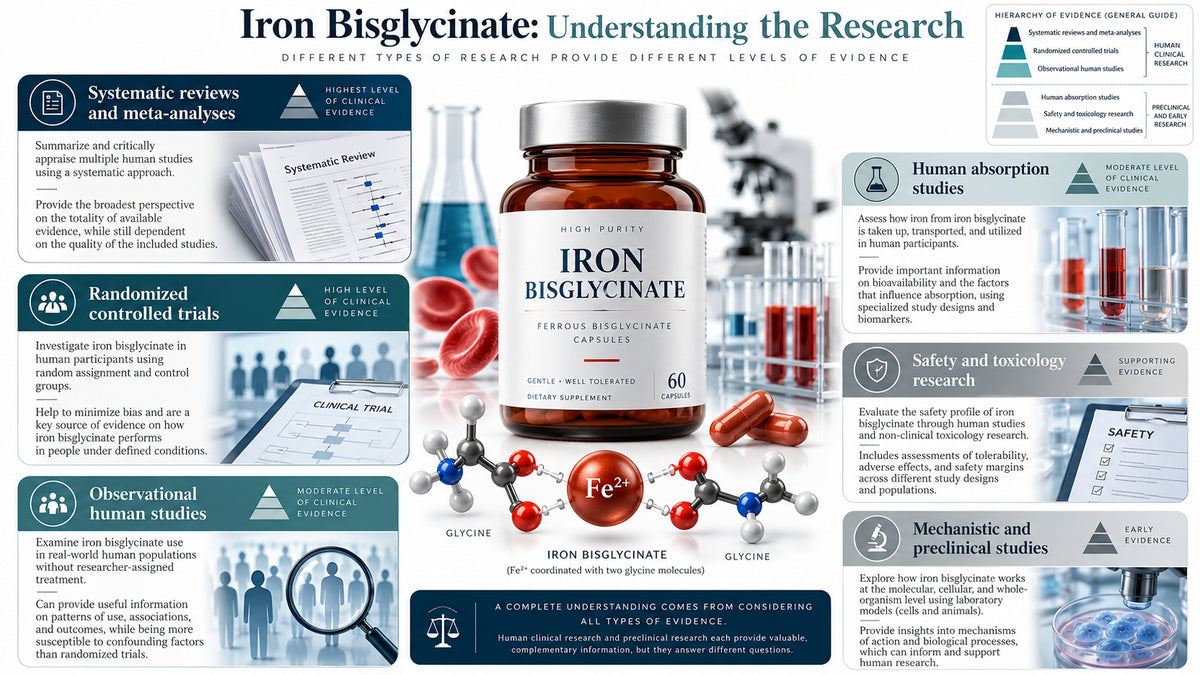
Iron bisglycinate (also called ferrous bisglycinate or ferrous glycinate) is a chelate in which one ferrous iron ion is bound to two glycine molecules. Because the evidence base mixes very different study types, the entries below are grouped from strongest to weakest evidence for human outcomes:
- Systematic reviews and meta-analyses pool trials.
- Randomized controlled trials (RCTs) compare the chelate with other iron forms.
- Observational human studies describe real-world use.
- Pharmacokinetic studies measure how much iron is absorbed.
- Safety and toxicology studies test harm at high doses.
- Mechanistic and preclinical studies (cells and animals) explain how absorption might work.
A summary table with year, design, population and dose follows the study notes, and every entry carries a DOI, PubMed or official link where one exists. Entries marked † were confirmed only through secondary summaries, so check the original before citing formally.
This is educational reference material, not medical advice. Iron needs differ widely, and iron should be taken only on the advice of a healthcare professional, especially for children and pregnancy.
Iron bisglycinate meta-analysis and systematic review evidence
The main review: Fischer et al., 2023
The central citation is a systematic review and meta-analysis of 17 randomized trials that compared ferrous bisglycinate with other iron supplements for at least four weeks (Fischer et al., 2023, Nutrition Reviews; DOI 10.1093/nutrit/nuac106; PROSPERO CRD42020196984). It followed Cochrane and PRISMA methods and searched databases up to July 17, 2020 (full text).
Key findings:
- Pregnancy (9 trials): hemoglobin was higher with the chelate, with a standardized mean difference of 0.54 g/dL (95% CI 0.15 to 0.94).
- Gastrointestinal adverse events in pregnancy: the incidence rate ratio was 0.36 (95% CI 0.17 to 0.76), meaning fewer reported events.
- Ferritin in pregnancy: only a non-significant trend toward higher values.
- Children (4 trials): no significant difference in hemoglobin or ferritin.
- Men and non-pregnant women (4 trials): evaluated qualitatively, and the authors called for more trials in these groups.
Limits worth knowing. The comparators were mixed (ferrous sulfate, fumarate, carbonyl iron, other chelates and more), and trial numbers per subgroup were small. Trade press reports state the review was conducted by a university team and that the supplier of a branded chelate included in the analysis publicized and funded follow-up research, so commercial interest is relevant when weighing the conclusions.
Related review: gastrointestinal effects of the standard comparator
Tolkien et al. pooled trials of ferrous sulfate and quantified its gastrointestinal side effects in adults (PLoS One, 2015). It is not a study of the chelate, but it explains why tolerability became the main selling point of alternatives.
What is missing
No independent, standalone systematic review without meta-analysis was found for this form, and no large meta-analysis exists for men, non-pregnant adults or people with inflammatory bowel disease. Treat the 2023 review as the best available summary, not the final word.
Ferrous bisglycinate clinical trials and observational studies
Randomized controlled trials in children
- Infants with anemia. Forty infants aged 6 to 36 months received 5 mg iron per kg daily for 28 days as ferrous sulfate or the chelate. Hemoglobin rose in both groups, but only the chelate group had a significant ferritin rise (Nutrition, 2001; DOI 10.1016/s0899-9007(01)00519-6). Small, short and matched rather than fully randomized by the abstract's wording, it should be read cautiously.
- Mexican schoolchildren. In a double-blind trial, 200 children with low iron stores but no anemia took 30 mg/day of iron as sulfate or the chelate for 12 weeks. Ferritin rose in both groups and stayed higher six months later (Nutrition Journal, 2014).
- Pakistani children with anemia. In 136 children over 12 weeks, hemoglobin rose 2.5 g/dL with the chelate versus 1.8 g/dL with ferrous sulfate (p = 0.0033) (J Rawalpindi Med Coll, 2020). It is a regional-journal single-center study.
- Brazilian schoolchildren. In 138 anemic children, weekly ferrous sulfate and chelate-enriched cookies both raised hemoglobin (1.1 and 0.9 g/dL) with no significant difference between them (Cad Saude Publica).
Randomized controlled trials in pregnancy
Several pregnancy trials feed the 2023 meta-analysis. Two titles frequently cited are a trial reporting 25 mg of chelated iron as effective as 50 mg of ferrous sulfate for prevention (Milman et al., †) and a randomized trial of the chelate combined with folinic acid (Nutrients, 2022). A Pakistani comparative study also reported higher hemoglobin and ferritin with the chelate (J Rawalpindi Med Coll). I confirmed titles and designs, not full results, so open the papers before quoting numbers.
Observational human studies
Observational evidence is thin. Two small real-world reports, a retrospective study in inflammatory bowel disease and an open-label study in women of reproductive age, appear in citation lists ([Minerva Gastroenterol Dietol †; CardioSomatics †]). Neither is strong enough to support causal claims, and both involve branded or combination products.
Reading the trial record honestly
Results are consistent in direction for pregnancy and tolerability but mixed in children, and several trials are small, short or from single centers. Equal efficacy at a lower elemental iron dose is plausible but not proven across all groups.
Iron bisglycinate absorption: pharmacokinetic and mechanistic studies
Human absorption studies
- In water (2001). Using a double-isotope method in 14 women, absorption from an aqueous solution of 15 mg/L iron was 34.6% for the chelate and 29.9% for ferrous ascorbate, not significantly different. Absorption fell as serum ferritin rose, so body iron stores regulated it (Olivares and Pizarro, 2001).
- In whole maize (2000). In iron-sufficient men, geometric mean absorption was 6.0% from the chelate versus 1.7% from ferrous sulfate, roughly four times higher, and absorption was again inversely related to ferritin (Bovell-Benjamin et al., Am J Clin Nutr 2000).
- In milk (1997). Absorption was about 11% in milk versus 46% in water, and ascorbic acid raised it to 15% (Nature.com record †). Food matrix clearly matters, even for a chelate.
Which pathway does the chelate use?
The sources disagree, which is itself a finding. An 85-woman isotope study concluded the chelate competes with ferrous sulfate for the non-heme pathway and joins the non-heme iron pool (Pizarro et al., Am J Clin Nutr 2003). A CRISPR study in DMT1-knockout Caco-2 cells concluded most chelate iron enters mainly through DMT1, as sulfate does, with Zip14 possibly contributing (Yu et al., Nutrients 2019). A pig intestinal cell study reported higher expression of both DMT1 and the peptide transporter PepT1 with the chelate (J Anim Feed Sci, 2014). Popular claims that the chelate uses a separate peptide route are therefore not settled.
An Italian Caco-2 comparison of three products (Nutrients, 2017) came from a company-linked group and tested a rival formulation, so it is weak evidence about the chelate itself.
Iron bisglycinate safety and preclinical studies
- Rat toxicology. The acute oral LD50 in rats was 2,800 mg/kg of the compound (560 mg/kg iron). In a feeding study at up to 500 mg/kg body weight per day, no biologically or statistically significant dose-related effects appeared on growth, blood chemistry, organ weights or tissue findings, giving a no-observed-adverse-effect level of 500 mg/kg per day, the highest dose tested (Food Chem Toxicol, 1999; DOI 10.1016/s0278-6915(99)00052-6).
- Regulatory review. The European Food Safety Authority panel assessed ferrous bisglycinate as an iron source for foods and supplements and later used its subchronic data to support the safety of other mineral bisglycinates, while noting long-term chronic and carcinogenicity data were limited (EFSA panel opinions, 2006 and 2008 †, secondary report).
-
Practical safety. Animal and cell data cannot replace human monitoring. Iron overload, hemochromatosis, accidental pediatric overdose and drug interactions apply to every iron form, including this one.

Iron bisglycinate study table: year, design, population and dose
|
Year |
Study |
Design |
Population |
Dose or duration |
Link |
|---|---|---|---|---|---|
|
2023 |
Fischer et al. |
Systematic review and meta-analysis, 17 RCTs |
Pregnant women, children, adults |
4 to 20 weeks |
|
|
2015 |
Tolkien et al. |
Systematic review and meta-analysis (ferrous sulfate comparator) |
Adults |
Varied |
|
|
2020 |
Perveen et al. |
RCT |
136 children with anemia |
12 weeks |
|
|
2014 |
Mexican schoolchildren trial |
Double-blind RCT |
200 children, low ferritin |
30 mg/day iron, 12 weeks |
|
|
n/a |
Brazilian schoolchildren trial |
Randomized community trial |
138 anemic children |
Weekly vs 3 times weekly, 8 weeks |
|
|
2001 |
Infant anemia trial |
Controlled trial |
40 infants |
5 mg/kg iron daily, 28 days |
|
|
2022 |
Ferrous bisglycinate plus folinic acid |
RCT |
Pregnant women |
See paper |
|
|
2003 |
Pizarro et al. |
Isotope absorption studies (6) |
85 healthy women |
Tracer doses |
|
|
2001 |
Olivares and Pizarro |
Double-isotope absorption |
14 women |
15 mg/L iron in water |
|
|
2000 |
Bovell-Benjamin et al. |
Isotope absorption |
Men and 23 mixed-status adults |
3 mg iron in maize or water |
|
|
1999 |
Safety evaluation |
Rat toxicology |
Sprague-Dawley rats |
Up to 500 mg/kg/day |
|
|
2019 |
Yu et al. |
Cell model (DMT1 knockout Caco-2) |
Human intestinal cells |
Varied concentrations |
|
|
2014 |
Pig intestinal cell study |
In vitro |
Pig intestinal epithelial cells |
1 mmol/L |
Using this iron bisglycinate evidence library responsibly
The pattern across the literature is consistent but not conclusive. Pregnancy trials and their pooled analysis favor the chelate for hemoglobin and tolerability; children's trials are mixed; absorption studies show ferritin-regulated uptake; safety data are reassuring but mostly animal or regulatory. Some of the strongest pro-chelate summaries trace back to industry-linked groups, which does not invalidate them but is a reason to read the primary papers.
Next steps
- Open the PubMed or DOI link before quoting any number from this page.
- Prefer systematic reviews, then RCTs, then mechanistic work when you cite.
- Ask a clinician or pharmacist about dose, testing (ferritin, hemoglobin) and interactions before starting iron.
- Keep iron products away from children; accidental overdose is dangerous.
Iron bisglycinate FAQ
Is iron bisglycinate better absorbed than ferrous sulfate? Some isotope studies report higher absorption in specific meals, but absorption is regulated by iron stores, and trial outcomes (hemoglobin, ferritin) are only clearly better in pregnancy.
Does it cause fewer side effects? The 2023 meta-analysis found fewer gastrointestinal events in pregnant women (rate ratio 0.36). Evidence is less clear in other groups.
Is it safe? Rat studies and regulatory reviews are reassuring, but all iron can be harmful in overload or overdose.
Can I take it with food? Milk lowered chelate absorption in one study, so meals can matter. Follow your clinician's advice.
Does it work in children? Trials show iron status improves, but the pooled analysis found no significant difference from other iron forms.
For general information only. Talk to your doctor before starting any supplement.


