
How Vitamin B12 Works: Mechanisms of Action
How Vitamin B12 Works: Mechanisms of Action from Molecule to Physiology
Vitamin B12 (cobalamin) is a cobalt-containing nutrient that humans cannot make, yet two human enzymes cannot work without it. When the supply of this vitamin fails, blood cells stop dividing normally, nerves lose their protective myelin, and two metabolites, homocysteine and methylmalonic acid, accumulate. This article follows the vitamin's full journey: from food, through a multistep absorption pathway, into cells, and onto the two enzymes that depend on it. Along the way it separates what is firmly established from what is still hypothesis, because a plausible mechanism is not the same as a proven clinical benefit.
Quick Facts: How Vitamin B12 Works at a Glance
- Identity: a water-soluble corrinoid with a central cobalt atom, made only by certain bacteria and archaea [1][2].
- Human enzymes that need it: cytosolic methionine synthase (methylcobalamin) and mitochondrial methylmalonyl-CoA mutase (adenosylcobalamin) [2][3].
- Absorption: a saturable, intrinsic-factor-dependent route in the distal ileum, plus a small passive route that takes up roughly 1% of a large oral dose [1][4].
- Biomarkers: serum cobalamin, holotranscobalamin, methylmalonic acid and total homocysteine each have limitations [5][6].
- Deficiency consequences: megaloblastic anemia and neurological injury, which can occur separately or together [7][8].
- Key caution: biochemical plausibility does not prove that supplements improve outcomes in people who are not deficient [9].
Vitamin B12 Definition and Biochemical Identity
"Vitamin B12" is a family name for cobalamins, compounds that share a corrin ring and cobalt core but differ in the group attached to the cobalt. A vitamin, by definition, is an organic compound required in small amounts that the body cannot make in sufficient quantity. Cobalamin fits: it is synthesized only by microorganisms, and animals acquire it from microbial production in their own gut or from food of animal origin [1][10]. Plant foods contain essentially none unless fortified or contaminated by bacteria, which explains why vegans carry a higher risk of low status [10][11].
The adult recommended intake is 2.4 µg per day in the United States, set by the Institute of Medicine to maintain adequate status, and the European Food Safety Authority sets an adequate intake of 4 µg per day for adults [1][13]. Because the body stores several milligrams, intake shortfalls usually take years to become clinical deficiency [7].
Chemical Classification and Molecular Structure
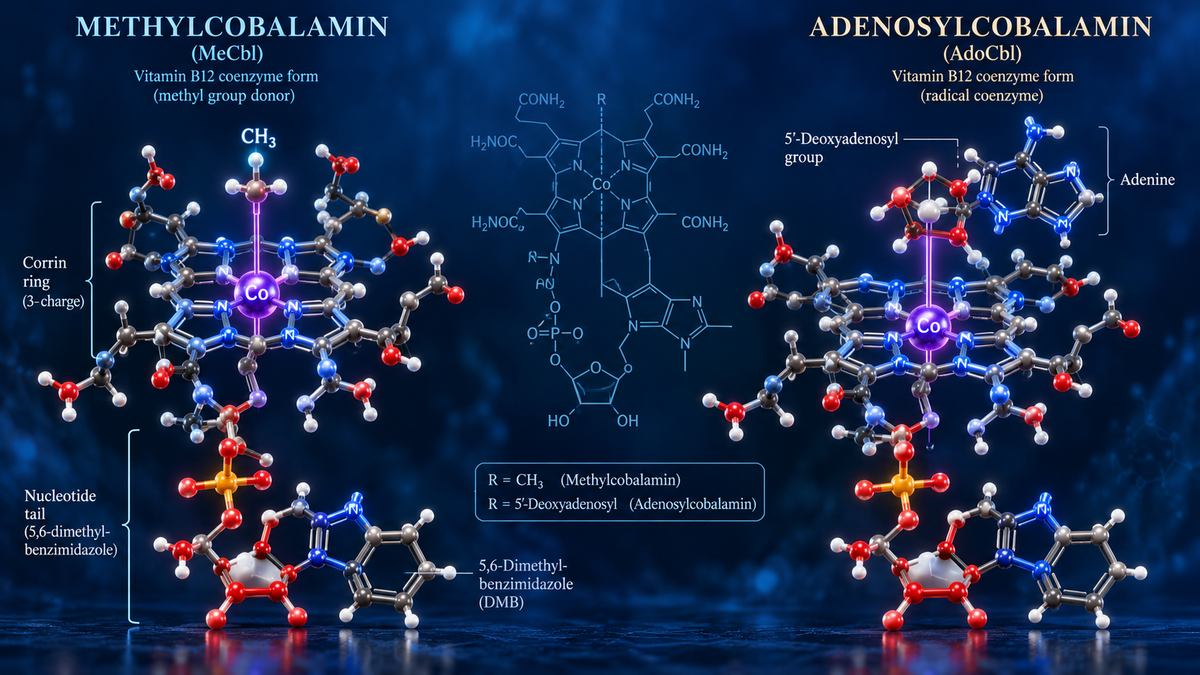
Cobalamin is a corrinoid, a tetrapyrrole related to heme but built around cobalt instead of iron. Four pyrrole-derived rings form the corrin macrocycle. Cobalt sits in the center and can exist in three oxidation states: Co(III), Co(II) and Co(I). This redox flexibility is the chemical basis of cobalamin catalysis [2].
The cobalt has six coordination positions:
- four are occupied by the nitrogen atoms of the corrin ring;
- the lower (alpha) axial position is occupied by a dimethylbenzimidazole nucleotide tail;
- the upper (beta) axial position carries the variable ligand that defines each form.
The upper ligand matters because the cobalt-carbon bonds in methylcobalamin and adenosylcobalamin are among the rare organometallic bonds in human biochemistry, and they are cleaved and reformed during catalysis [2].
Main Forms: Methylcobalamin, Adenosylcobalamin, Hydroxocobalamin and Cyanocobalamin
Four forms dominate nutrition and medicine. Two are the active coenzymes. Two are stable precursors that cells must convert.
|
Form |
Upper ligand |
Role |
Typical context |
|---|---|---|---|
|
Methylcobalamin |
Methyl group |
Coenzyme for methionine synthase |
Natural form in cytosol; supplements |
|
Adenosylcobalamin |
5'-deoxyadenosyl |
Coenzyme for methylmalonyl-CoA mutase |
Natural form in mitochondria; supplements |
|
Hydroxocobalamin |
Hydroxyl |
Natural precursor; converted intracellularly |
Injectable therapy; food-derived |
|
Cyanocobalamin |
Cyanide |
Synthetic, very stable precursor |
Fortified foods; most supplements |
The cyanide in cyanocobalamin is present in a tiny, pharmacologically trivial amount, and cells remove it during processing (see below) [2][14]. A central point for interpreting marketing claims is that supplement form and intracellular coenzyme form are different things. After uptake, cells strip the original upper ligand from every form and rebuild the two coenzymes from a common intermediate [2][14]. Consequently, a claim that one supplement form is categorically "active" and another "inactive" oversimplifies the biochemistry. Small studies suggest differences in absorption and retention between forms, but evidence that any form yields better clinical outcomes in deficient people is limited [9][15].
Vitamin B12 Absorption in the Gastrointestinal Tract
Vitamin B12 absorption is one of the most elaborate nutrient uptake pathways in human physiology, with several carrier proteins acting in sequence [4][16]:
- Release from food. Stomach acid and pepsin free protein-bound cobalamin from food.
- Capture by haptocorrin. Free cobalamin binds haptocorrin (R-binder) from saliva and gastric secretions, which protects it in acid.
- Handover in the duodenum. Pancreatic proteases degrade haptocorrin, releasing cobalamin to intrinsic factor.
- Uptake in the ileum. The intrinsic factor-cobalamin complex binds the receptor cubam (cubilin plus amnionless) on distal ileal enterocytes and is internalized [4][16].
- Release into blood. Inside the enterocyte, intrinsic factor is degraded, cobalamin is freed, and it is exported to plasma bound to transcobalamin.
Because each step relies on acid, enzymes or intact ileal tissue, disruption at any point reduces uptake. Examples include atrophic gastritis, gastric surgery, pancreatic insufficiency and ileal disease or resection [7][16].
The Role of Intrinsic Factor in Vitamin B12 Absorption
Intrinsic factor is a glycoprotein secreted by gastric parietal cells. It binds cobalamin with extremely high affinity and, unlike haptocorrin, resists pancreatic proteolysis while directing the vitamin to ileal receptors [4][16]. The ileal system saturates at about 1.5 to 2 µg per meal, so splitting intake across meals can modestly raise total absorption of small doses [1].
Pernicious anemia, an autoimmune condition in which antibodies attack parietal cells or intrinsic factor, removes this pathway and is a classic cause of severe deficiency [7][17].
Passive absorption. At pharmacological doses, a small fraction (about 1%) crosses the mucosa independently of intrinsic factor, probably by diffusion [1][18]. This mechanism is why high oral doses can correct deficiency even in pernicious anemia, as shown in early work and later randomized trials (see below) [18][19][20].
Transport of Vitamin B12 Through the Bloodstream
Plasma cobalamin travels on two carrier proteins [4][21]:
- Transcobalamin (TC, also called TCN2): carries a minority (roughly 10-30%) of circulating cobalamin as holotranscobalamin, the fraction that can deliver the vitamin to cells through the receptor CD320. Holotranscobalamin is therefore considered the "active" transport fraction.
- Haptocorrin: carries most circulating cobalamin, but cells take it up poorly, so it acts largely as a reservoir. The liver takes up haptocorrin-bound cobalamin through other routes.
This split explains a frequent interpretive problem: total serum cobalamin includes the large haptocorrin-bound pool and can look normal despite low cellular availability [5][6].
Vitamin B12 Cellular Mechanisms: Uptake and Intracellular Processing
Holotranscobalamin binds CD320 on the cell surface and is endocytosed. In the lysosome, transcobalamin is degraded and free cobalamin is exported to the cytosol through the transporters LMBD1 and ABCD4 [2][22]. The cytosolic chaperone MMACHC (the cblC protein) then removes the upper ligand: it decyanates cyanocobalamin and dealkylates alkylcobalamins, producing a common intermediate. Downstream chaperones, including MMADHC (cblD), direct cobalamin either to the cytosolic branch or to mitochondria [2][22].
Inherited defects in these steps (complementation groups cblA to cblG, among others) cause early-onset disorders with elevated methylmalonic acid, homocysteine or both, which has been crucial for mapping the pathway [22].
Conversion into Biologically Active Coenzyme Forms
The common intermediate is converted to the two coenzymes by compartment-specific machinery [2][22]:
- Cytosol: reduction and methylation produce methylcobalamin, which is delivered to methionine synthase.
- Mitochondria: reduction and adenosylation, catalyzed by the adenosyltransferase MMAB, produce adenosylcobalamin, which is delivered to methylmalonyl-CoA mutase.
This "one precursor, two coenzymes" design is the basis for the statement that the form swallowed does not fix the form used. It also explains why a defect in any single processing gene can disrupt one or both enzyme systems.
Methionine Synthase Activity and One-Carbon Metabolism
Methionine synthase (MTR) transfers a methyl group from 5-methyltetrahydrofolate (5-methyl-THF) to homocysteine, forming methionine and tetrahydrofolate (THF) [2][23]. The catalytic cycle alternates cobalt between Co(I) and methyl-Co(III). Occasionally the highly reactive Co(I) is oxidized to Co(II), which inactivates the enzyme. Methionine synthase reductase (MTRR) restores activity using S-adenosylmethionine as a methyl donor [2][23].
This single reaction connects three processes:
- Methionine regeneration. Methionine is converted to S-adenosylmethionine (SAM), the universal methyl donor for DNA, RNA, protein, phospholipid and neurotransmitter methylation.
- Homocysteine clearance. The reaction is one of two remethylation routes for homocysteine (the other uses betaine in the liver and kidney).
- Folate recycling. It releases THF from 5-methyl-THF, which is needed to build other one-carbon folate forms.
The methyl-folate trap hypothesis
The long-standing explanation of why B12 deficiency mimics folate deficiency is the "methyl-folate trap". Because the reduction of methylenetetrahydrofolate to 5-methyl-THF is essentially irreversible, a block at methionine synthase leaves folate stranded as 5-methyl-THF, which cannot be used for nucleotide synthesis [24][25]. The hypothesis remains well supported biochemically, though its relative contribution to different tissues is still debated [23][25].
Methylmalonyl-CoA Mutase Activity and Energy Metabolism
Methylmalonyl-CoA mutase (MMUT) is a mitochondrial enzyme that rearranges L-methylmalonyl-CoA into succinyl-CoA, which can enter the citric acid cycle. It sits at the end of a pathway that processes propionyl-CoA derived from odd-chain fatty acids, branched-chain amino acids (valine, isoleucine), threonine, methionine and cholesterol side chains [2][26].
Adenosylcobalamin acts here as a radical generator. Its cobalt-carbon bond breaks homolytically to create a 5'-deoxyadenosyl radical, which abstracts a hydrogen atom from the substrate and drives the rearrangement [2]. When the enzyme lacks its cofactor, methylmalonyl-CoA accumulates and is hydrolyzed to methylmalonic acid (MMA), which spills into blood and urine [5][26].
Vitamin B12 Biochemical Functions: DNA Synthesis, Cell Division and Red Blood Cells
DNA synthesis and cell division
Thymidylate synthase needs a folate cofactor (5,10-methylene-THF) to convert deoxyuridine monophosphate to thymidine monophosphate. If folate is trapped, thymidylate falls, uracil is misincorporated into DNA, repair attempts cause strand breaks, and cells stall in S-phase [24][25]. Rapidly dividing tissues, especially bone marrow and intestinal mucosa, are the most sensitive.
Red blood cell formation
In the marrow, impaired DNA synthesis uncouples nuclear maturation from cytoplasmic and hemoglobin development. The result is large, immature megaloblasts, ineffective erythropoiesis (many cells die in the marrow), macrocytosis (high mean corpuscular volume), and anemia [7][8]. Hypersegmented neutrophils and mild pancytopenia can accompany it. Importantly, anemia is absent in a meaningful minority of people with neurological deficiency, so a normal blood count does not exclude low B12 [7][27].
Vitamin B12 Neurological Function and Myelin Maintenance
The neurological consequences of deficiency are well documented clinically: peripheral neuropathy, subacute combined degeneration of the spinal cord, cognitive and mood changes, and optic neuropathy in severe cases [7][27]. The underlying mechanisms are less settled. Leading, non-exclusive hypotheses include:
- Impaired methylation. Reduced SAM may impair methylation of myelin basic protein and phospholipids [28][29].
- Abnormal fatty acids. Methylmalonyl-CoA accumulation may allow odd-chain and branched-chain fatty acids to be incorporated into myelin lipids, destabilizing membranes. This is supported by animal and biochemical data but is not conclusively demonstrated in humans [28].
- Cytokine and growth factor imbalance. In rodent models, deficiency raises neurotoxic signals such as tumor necrosis factor alpha and lowers neurotrophic signals such as epidermal growth factor [28].
- Homocysteine toxicity. Elevated homocysteine and its derivatives may stress neurons and vessels, though trial evidence for benefit from lowering them is mixed (see below) [30][31].
In short, B12-dependent neurological injury is real, but which pathway dominates in which patient remains unresolved.
Homocysteine Metabolism and Biochemical Pathways
Homocysteine is a sulfur amino acid at a metabolic crossroads. It is either remethylated to methionine (requiring B12 and folate, via methionine synthase, or betaine) or transsulfurated to cysteine (requiring vitamin B6 through cystathionine beta-synthase and cystathionase) [23][30]. Low B12 reduces remethylation, so total homocysteine rises. The same occurs in folate or B6 deficiency, renal impairment, hypothyroidism, certain drugs and common genetic variants such as MTHFR 677C>T, so elevated homocysteine is sensitive but not specific [5][30].
Although observational studies link high homocysteine with cardiovascular and cognitive outcomes, large randomized trials of B-vitamin lowering have generally not shown meaningful reductions in cardiovascular events, and cognitive results are inconsistent except possibly in people with high baseline homocysteine or low B12 status [31][32]. Mechanistic plausibility has not translated reliably into clinical benefit.
Methylmalonic Acid Metabolism and Its Relationship with Vitamin B12 Status
Methylmalonic acid rises when adenosylcobalamin is insufficient for methylmalonyl-CoA mutase, so it is a functional marker of cellular B12 sufficiency [5][6]. It tends to be more specific than homocysteine because it is not influenced by folate status, but it can also rise with reduced kidney function, small-intestinal bacterial overgrowth (bacterial propionate production) and aging, and it can be elevated by inherited mutase disorders [5][6][22].
Vitamin B12 Metabolism: Storage, Distribution and Recycling
The adult body holds roughly 2 to 5 mg of cobalamin, with about half in the liver [7][33]. Daily losses are small, perhaps 0.1% of body stores, in part because of enterohepatic circulation: the liver secretes roughly 1 to 10 µg per day into bile, and a large share is reabsorbed in the ileum via intrinsic factor [1][33]. This efficient recycling explains the long lag, often several years, between onset of malabsorption and clinical disease, and the faster onset in people with ileal disease or pernicious anemia, who also lose the recycling pathway [7][33].
Pharmacokinetics and Elimination
Absorbed cobalamin appears in plasma bound to transcobalamin, with delayed peaks several hours after a dose. Injected hydroxocobalamin or cyanocobalamin gives high initial plasma levels, but a large portion of the dose is excreted in urine once carrier proteins are saturated, and hydroxocobalamin is retained longer than cyanocobalamin [1][34]. Elimination is mainly urinary (free vitamin) and biliary-fecal (the portion that is not reabsorbed). Because the half-life of the total body pool is long (on the order of a year or more, estimates vary), correction of deficiency is gradual [33][34].
Factors Affecting Vitamin B12 Absorption and Biological Utilization
|
Factor |
Mechanism |
Evidence quality |
|---|---|---|
|
Atrophic gastritis, older age |
Reduced acid and pepsin; poor release from food (supplement forms are unaffected) |
Strong |
|
Pernicious anemia |
Loss of intrinsic factor |
Strong |
|
Ileal disease or resection |
Loss of receptor surface and recycling |
Strong |
|
Metformin |
Associated with lower B12; mechanism debated (calcium-dependent ileal uptake interference proposed) |
Moderate (trial data show lower levels) [35] |
|
Proton pump inhibitors, H2 blockers |
Reduced acid release from food |
Moderate, observational; association with deficiency in long-term use [36] |
|
Vegan or vegetarian diet |
Low intake |
Strong [10][11] |
|
Bacterial overgrowth, fish tapeworm |
Competition for cobalamin |
Moderate |
|
Genetic variants (TCN2, FUT2, CUBN) |
Alter binding or transport |
Emerging |
Note that food-cobalamin malabsorption (poor release from food) differs from intrinsic factor failure: in the first, crystalline cobalamin in supplements and fortified food is generally still absorbed [1][7].
Mechanistic Differences Between Oral and Injectable Vitamin B12
Injection (intramuscular or subcutaneous) bypasses the gut entirely, delivering the vitamin straight into plasma. High-dose oral therapy depends on passive absorption of roughly 1% of the dose. Some practical findings:
- A dose-finding trial in older people with low B12 found that oral cyanocobalamin at about 500 µg or more daily normalized markers effectively, and 647 µg per day was estimated to be needed in some subgroups [19].
- Systematic reviews (Cochrane) found that oral and intramuscular routes were similar in normalizing serum B12 levels in deficient people, though evidence on neurological outcomes and severe presentations is limited [20][37].
- Clinical guidelines still generally recommend injections initially for patients with neurological involvement or severe deficiency, and when malabsorption is certain [7][38].
The mechanism therefore supports oral dosing as viable for many people, but clinical decisions depend on severity and symptoms rather than the mechanism alone.
Differences Between Vitamin B12 Forms and Their Biological Functions
Because cells convert any incoming cobalamin into a shared intermediate, the biological function of the vitamin does not depend on which form was consumed, with a few nuances [2][14][15]:
- Cyanocobalamin requires decyanation by MMACHC, with minor consequences for most people. It is the most studied form in trials.
- Hydroxocobalamin binds proteins strongly and persists longer after injection, and it is the standard injectable therapy in many countries.
- Methylcobalamin and adenosylcobalamin are light-sensitive and are converted during processing, so providing them directly does not bypass the cell's need to handle the vitamin.
- Claims that specific forms suit people with particular gene variants (for example MTHFR or MMACHC variants) are largely hypothetical, with limited clinical trial support, and should be treated as emerging [15].
Mechanisms Associated with Vitamin B12 Deficiency
Deficiency arises from three broad mechanisms: inadequate intake, impaired absorption (the commonest cause in developed countries) and impaired transport or intracellular metabolism (rare, often inherited) [7][8]. Once cellular supply falls, the two enzyme blocks produce the cardinal biochemical signature: rising homocysteine (methionine synthase block), rising MMA (mutase block), and a methyl-folate trap that compromises DNA synthesis [5][24]. These changes can precede anemia and neurological signs, which is why functional markers are useful in borderline cases.
Biomarkers Used to Assess Vitamin B12 Status
|
Marker |
What it measures |
Strength |
Key limitations |
|---|---|---|---|
|
Serum total B12 |
Haptocorrin plus transcobalamin-bound B12 |
Cheap, widely available |
Poor sensitivity and specificity near the borderline range; affected by haptocorrin changes, liver disease, myeloproliferative disease [5][6] |
|
Holotranscobalamin |
Transport-bound, cell-available fraction |
Earlier indicator in many studies |
Cut-offs vary; kidney function interferes [5][39] |
|
Methylmalonic acid |
Functional mutase activity |
Relatively specific to B12 |
Raised by kidney impairment, bacterial overgrowth, age [5][6] |
|
Total homocysteine |
Functional methionine synthase activity |
Sensitive |
Not specific: folate, B6, kidney, genetics, drugs [5][30] |
Commonly cited thresholds (for example serum B12 below about 148 pmol/L, or 200 pg/mL, as indicating deficiency, with a borderline zone above it) vary between laboratories and guidelines, and a combined approach using at least two markers is generally recommended when results are ambiguous [6][38].
Evidence from Laboratory and Preclinical Research
The core enzyme mechanisms are supported by decades of structural biochemistry, crystallography, kinetics and genetic studies of inherited disorders [2][22][23]. Animal models of cobalamin deficiency reproduce demyelination, altered cytokine and growth factor profiles, and altered methylation, supporting the neurological hypotheses above [28]. However, such models often use extreme deficiency, differ from human physiology, and cannot establish effect sizes for supplementation in people with ordinary diets.
Human Clinical Evidence Supporting Proposed Mechanisms
|
Mechanism |
Clinical evidence |
Strength |
|---|---|---|
|
Intrinsic-factor absorption |
Pernicious anemia; ileal resection; receptor gene defects [4][16] |
Strong |
|
Cofactor roles (MTR, MMUT) |
Elevated homocysteine and MMA in deficiency; normalization after treatment [5][7] |
Strong |
|
Megaloblastic anemia from B12 lack |
Classic clinical syndrome; response to treatment [7][8] |
Strong |
|
Passive absorption |
Early high-dose oral studies; randomized oral vs. intramuscular trials [18][19][20] |
Moderate-strong |
|
Homocysteine lowering improves clinical outcomes |
Large B-vitamin trials largely negative for cardiovascular events [31] |
Weak/negative |
|
B12 supplementation improves cognition in non-deficient people |
Mixed or null trials [30][32] |
Weak |
Vitamin B12 Mechanism of Action: Established Mechanisms Versus Emerging Hypotheses
Established: cofactor roles for methionine synthase and methylmalonyl-CoA mutase; the multistep absorption and transport pathway; the link between deficiency, hematological effects and neurological injury; the usefulness of MMA and homocysteine as functional markers [2][5][7].
Emerging or uncertain:
- The dominant neurological mechanism (methylation, abnormal fatty acids, cytokines) in humans [28].
- Whether differences between supplement forms are clinically important [15].
- Roles in epigenetic regulation, mitochondrial function, and effects of marginal (subclinical) status on cognition or bone health [30][32].
- Gut microbiome interactions and microbial cobalamin competition or sharing [40].
Factors That May Modify Biological Responses
Individual responses vary with age, gastric function, kidney function, genetic variants affecting transport and processing (for instance, TCN2, FUT2, CUBN, MTRR), baseline folate and B6 status, and medications [22][35][36]. A high folic acid intake can correct the anemia of B12 deficiency without correcting the neurological damage, which is a clinical reason to identify B12 deficiency rather than treat anemia with folate alone [7][41]. Observational data suggest that high folate with low B12 status is associated with worse cognitive and hematological indicators in older adults, but causality is unproven [41].
Safety Considerations and Clinical Relevance
No tolerable upper intake level has been set by the Institute of Medicine or EFSA because of low toxicity in healthy people, even at high oral doses [1][13]. Rare adverse events include acneiform eruptions and hypersensitivity reactions, especially to injectable forms, and treatment of severe megaloblastic anemia can cause hypokalemia as blood cells recover rapidly [7][38]. People with suspected deficiency, neurological symptoms or ongoing risk factors should be evaluated by a clinician rather than self-treating, since supplements can obscure diagnosis and the underlying cause (for example, pernicious anemia) may need long-term management [7][38].
Research Gaps and Unresolved Mechanistic Questions
- Better cut-offs for borderline status that predict functional outcomes, not just biomarker levels [5][39].
- Long-term trials comparing oral and injectable B12 for neurological recovery [20][37].
- Human evidence for specific neurological pathways and for whether subclinical deficiency has meaningful health effects [28][32].
- The clinical significance of genetic variants and of different supplement forms [15][22].
Frequently Asked Questions
How does Vitamin B12 work in the body? It serves as a cofactor for two human enzymes: methionine synthase (linking homocysteine, methylation and folate recycling) and methylmalonyl-CoA mutase (processing propionyl-CoA metabolites in mitochondria). Through these roles it supports DNA synthesis, red blood cell formation and nervous system maintenance [2][7].
What is intrinsic factor and why does it matter? Intrinsic factor is a stomach-made protein that binds cobalamin and guides it to ileal receptors. Without it, as in pernicious anemia, absorption falls sharply, though high doses can still be absorbed passively [4][18].
Is methylcobalamin better than cyanocobalamin? Cells convert all forms into the same intermediate before building the two coenzymes. Evidence that one form gives better outcomes is limited, although direct comparisons are small and short [14][15].
Why do homocysteine and methylmalonic acid rise in deficiency? Homocysteine accumulates when methionine synthase is not working. Methylmalonic acid accumulates when the mutase is not working. Both can also be affected by other conditions, so they are interpreted alongside clinical context [5][6].
Can oral Vitamin B12 work if absorption is impaired? Often yes, for many people, because roughly 1% of a high oral dose is absorbed passively. Clinicians may still prefer injections initially in severe or neurological cases [19][20][38].
Does a normal blood count rule out deficiency? No. Neurological problems can occur without anemia, and total serum B12 can be misleading [7][27].
Conclusion
Vitamin B12 is best understood as a trace cofactor with an outsized metabolic footprint. Its absorption depends on acid, haptocorrin, intrinsic factor and ileal receptors; transport depends on transcobalamin; and cells convert every dietary form into two coenzymes that support methionine synthase and methylmalonyl-CoA mutase. These reactions underpin methylation, folate recycling, DNA synthesis and the metabolism of odd-chain and branched-chain substrates, explaining the hematological and neurological consequences of deficiency. The clinical relevance is clearest where deficiency is diagnosed or risk is high (pernicious anemia, malabsorption, strict vegan diets, older age, certain medications). By contrast, the mechanistic story does not by itself prove that supplements improve cognition, cardiovascular outcomes or other endpoints in people who are replete. Open questions include optimal biomarker thresholds, the dominant neurological pathways, form-specific effects and genetic modifiers.
For general information only. Talk to your doctor before starting any supplement.


