
How Zinc Works: Mechanisms of Action in the Human Body
How Zinc Works: Mechanisms of Action in the Human Body
Zinc is present in every cell of your body, yet most people cannot say what it actually does there. If you have ever wondered how zinc works, the short answer is that it acts as a structural scaffold, a catalytic partner for enzymes, and a signaling ion that helps cells decide when to grow, defend themselves and repair damage. The longer answer is far more interesting. This guide walks through the biology step by step, separates what laboratory studies show from what human trials confirm, and explains why dose and balance matter as much as the mineral itself.
How Zinc Works at a Glance: Executive Summary
Zinc is an essential trace mineral. The adult body holds roughly 2 to 3 grams, mostly in skeletal muscle and bone, and it cannot store large reserves for later use. That is why steady intake matters.
At the molecular level, zinc does four main jobs:
- Catalytic: it sits inside the active site of hundreds of enzymes and helps them convert one molecule into another.
- Structural: it holds proteins in the correct three-dimensional shape, most famously in zinc finger proteins that read DNA.
- Regulatory: it acts like a second messenger, with short-lived rises in free zinc switching signaling pathways on or off.
- Protective: it supports antioxidant enzymes and limits some forms of oxidative damage.
These roles explain why zinc status is linked to immune defense, skin integrity, growth, taste, vision and neurological function. They also explain why researchers study it so intensively. Importantly, a mechanism that works in a cell culture does not automatically translate into a benefit for a healthy person, a point we return to in the sections on human versus laboratory evidence.
Research Question and Scientific Scope
This article asks one question: through which biological mechanisms may zinc influence human physiology? It is an explanatory piece, not a treatment guide. We focus on the pathways that are best documented in peer-reviewed literature, including absorption, transport, enzyme function, gene regulation, immune signaling, antioxidant defense, DNA synthesis, neurological activity, skin repair and inflammation.
The scope has limits. We do not discuss zinc as a treatment for any disease, and we do not compare brands or formulations. Where evidence comes from cell or animal studies, we say so. Where human data exist, we describe their strength honestly. The sources behind each section are listed in the references, and the content draws on the National Institutes of Health Office of Dietary Supplements, the Institute of Medicine and reviews published in journals such as Physiological Reviews and Advances in Nutrition.
Zinc Absorption and Cellular Uptake
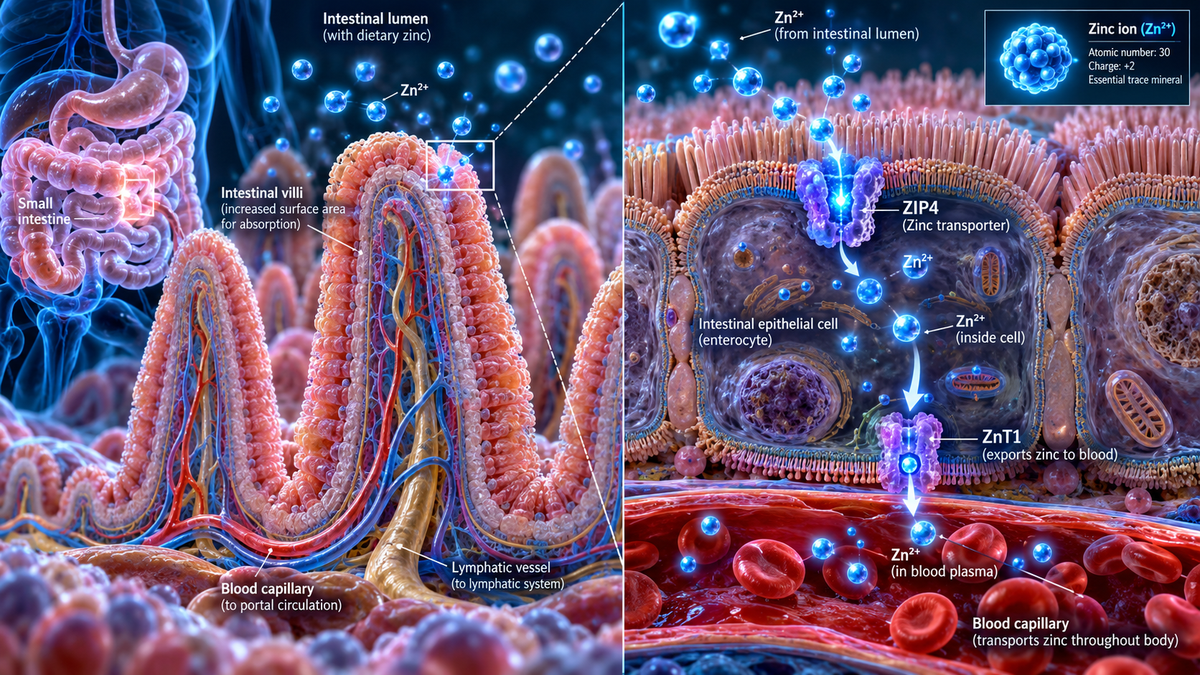
Before zinc can do anything, it has to get into the body. Zinc absorption happens mainly in the duodenum and jejunum, the upper parts of the small intestine. On a typical mixed diet, the body absorbs roughly a third of the zinc it eats, though the figure varies widely with diet and zinc status.
Several factors shape how much gets through:
- Phytates, found in whole grains, legumes and seeds, bind zinc in the gut and reduce its uptake.
- Animal protein and certain amino acids, such as histidine and cysteine, tend to improve absorption.
- Competing minerals, especially iron and copper at high supplemental doses, can interfere with zinc uptake.
- Existing zinc status: when body stores are low, the gut absorbs a larger fraction; when stores are replete, absorption falls.
At the intestinal cell, zinc enters mainly through a protein called ZIP4 on the surface facing the gut. This is not a minor detail: rare mutations in the gene for ZIP4 cause acrodermatitis enteropathica, a serious inherited zinc-deficiency disorder. Once inside the cell, zinc is either used locally, stored by binding proteins, or released into the bloodstream, where it travels mostly bound to albumin on its way to tissues.
Zinc Transporters and Homeostasis
Because free zinc ions can be harmful in excess, cells keep them at extremely low levels and guard them with a dedicated transport network. Two families do most of the work.
The ZIP family (SLC39 genes, with 14 members in humans) moves zinc into the cytoplasm from outside the cell or from internal compartments. The ZnT family (SLC30 genes, with 10 members) moves zinc out of the cytoplasm, either across the cell membrane or into organelles such as the Golgi apparatus and vesicles.
A third group, the metallothioneins, are small cysteine-rich proteins that bind zinc and release it on demand. They act as buffers, storing surplus zinc and smoothing out fluctuations. Their production rises when zinc intake rises, which is one reason excess zinc can indirectly reduce copper absorption: metallothionein in intestinal cells binds copper tightly and traps it.
Together, transporters and buffers create what scientists call zinc homeostasis, a tightly regulated balance. This is the central principle behind zinc biology: the body does not simply accumulate more zinc as intake rises. It adjusts absorption, excretion and tissue distribution to keep levels within a narrow window.
Enzyme Activity and Catalytic Functions
Zinc is the only metal that appears in all six major classes of enzymes, which is a remarkable distinction. Classic reviews cite more than 300 zinc-dependent enzymes, and later genomic analyses suggest the number of human zinc-binding proteins is far higher, with about 10 percent of the human proteome predicted to bind zinc.
What does zinc actually do inside an enzyme? In many cases it acts as a Lewis acid, polarizing a water molecule or substrate so that a chemical bond can be broken or formed more easily. Familiar examples include:
- Carbonic anhydrase, which helps regulate acid-base balance and carbon dioxide transport.
- Alcohol dehydrogenase, involved in alcohol metabolism.
- Carboxypeptidases and matrix metalloproteinases, which cut proteins and remodel tissue.
- Alkaline phosphatase, important in bone and liver function.
- Copper-zinc superoxide dismutase, which neutralizes superoxide radicals.
Because so many metabolic steps rely on these enzymes, even modest zinc shortfalls can ripple across carbohydrate, lipid, protein and nucleic acid metabolism. This breadth is the main reason zinc deficiency presents with such varied symptoms.
Gene Expression and Transcription Factors
One of the most important structural roles of zinc is in zinc finger proteins. In these proteins, a zinc ion is held by cysteine and histidine residues, folding a short stretch of amino acids into a finger-like shape that can recognize and bind specific DNA sequences. The discovery of zinc fingers, described by Aaron Klug and colleagues, transformed our understanding of how genes are switched on and off.
The human genome encodes many hundreds of zinc finger transcription factors. They regulate processes from cell differentiation to metabolism and immune response. Nuclear hormone receptors, including those for steroid hormones, thyroid hormone and vitamin D, also use zinc finger domains to attach to DNA.
Zinc also influences gene expression indirectly. A well-studied example is the metal-responsive transcription factor MTF-1, which senses intracellular zinc and activates genes for metallothionein and zinc transporters. In effect, zinc regulates the machinery that regulates zinc. When zinc is scarce, the activity of zinc-dependent transcription factors may fall, which is one proposed way that deficiency alters so many tissues at once.
Protein Synthesis and Cellular Signaling
Zinc supports protein synthesis in several ways. RNA polymerases, the enzymes that copy DNA into RNA, depend on zinc. Many aminoacyl-tRNA synthetases, which attach amino acids to transfer RNA before they are assembled into proteins, also require it. This is part of why zinc is linked to growth, tissue turnover and rapidly dividing cells.
Beyond building proteins, zinc acts as an intracellular signaling ion. Researchers distinguish two types of zinc signals. Early zinc signals are fast releases from internal stores or transporter activity that occur within minutes of a cell receiving a stimulus. Late zinc signals follow changes in gene expression, for example altered transporter levels, and unfold over hours.
These zinc signals influence protein kinases and phosphatases, the enzymes that add or remove phosphate groups and thereby switch proteins on or off. By inhibiting certain phosphatases, zinc can prolong signaling cascades such as those downstream of insulin and growth factor receptors. This is an active research area, and much of the evidence still comes from cell experiments.
Zinc Immune Function: Mechanisms in Innate and Adaptive Defense
The link between zinc and immunity is among the best-supported in nutrition science. Zinc immune function depends on the mineral at nearly every stage, from physical barriers to specialized white blood cells.
In innate immunity, zinc supports the integrity of skin and mucosal barriers, and influences the phagocytic activity of neutrophils and macrophages. It is also required for natural killer cell function. In adaptive immunity, zinc is needed for the development and maturation of T lymphocytes. A key example is thymulin, a thymic hormone that only works when bound to zinc. In deficiency, the thymus can shrink and lymphocyte numbers can fall, and these changes reverse when zinc is restored.
Zinc also modulates how immune cells communicate. It affects cytokine production and the signaling cascades inside T cells and B cells. Reviews by Haase and Rink describe how changes in free zinc inside immune cells act as signals that shape activation and response.
On the practical side, a Cochrane review of zinc lozenges and syrup for the common cold found that, when started within 24 hours of the first symptoms, zinc may shorten the duration of a cold. The review noted variation between trials in formulation and dose, so this finding should be read as promising rather than settled.
Antioxidant Defense and Oxidative Stress
Zinc is not a classic antioxidant that donates electrons like vitamin C. Instead, it is better described as a pro-antioxidant mediator, working through indirect routes:
- Enzyme support: it is a structural component of copper-zinc superoxide dismutase, a first-line defense against superoxide radicals.
- Metallothionein induction: metallothioneins are rich in cysteine and can scavenge hydroxyl radicals.
- Competition with redox-active metals: zinc can displace iron and copper from certain binding sites, which may reduce their ability to catalyze radical formation.
- Protection of thiol groups: by binding sulfhydryl groups on proteins, zinc may help shield them from oxidation.
- Nrf2 pathway activity: laboratory work suggests zinc influences the Nrf2 pathway, which controls many antioxidant genes.
The relationship is also two-sided. Oxidative stress can release zinc from metallothionein, creating a signal that triggers protective responses. This helps explain why zinc homeostasis and redox balance are so closely tied together. Evidence for these mechanisms is strongest in cell and animal models; human data on antioxidant outcomes remain mixed.
DNA Synthesis, Repair and Cell Division
Cells that divide quickly, such as those in the gut lining, skin and immune system, are especially sensitive to zinc supply. The reason is that several enzymes at the heart of DNA synthesis require it, including DNA polymerases, thymidine kinase and ribonucleotide reductase-related pathways.
Zinc also contributes to genome maintenance. Several DNA repair proteins use zinc finger domains, among them PARP-1, XPA and certain proteins involved in base excision repair. When zinc is limited, experimental studies show increased DNA strand breaks and reduced repair capacity in cultured cells.
Zinc also influences the cell cycle. It affects progression through checkpoints and is involved in programmed cell death, or apoptosis. Both too little and too much zinc can disturb these processes, so the aim is not maximum intake but adequate, stable availability.
Growth, Development and Tissue Maintenance
Growth requires cells to divide, build proteins and differentiate on schedule, and zinc is involved in all three. During pregnancy, infancy, childhood and adolescence, demand rises sharply, which is why these life stages are treated as higher-risk for inadequate intake.
Zinc supports bone formation through alkaline phosphatase and through its effects on osteoblasts, the cells that build bone. It also takes part in the activity of insulin-like growth factor 1 (IGF-1), a major growth-promoting signal. In children, large public health analyses have linked zinc deficiency to impaired growth, and the World Health Organization recognizes it as a concern in several regions of the world.
In adults, ongoing tissue maintenance, including muscle protein turnover, hair and nail growth and the renewal of epithelial linings, relies on the same zinc-dependent machinery. Estimates of global zinc deficiency risk, such as those by Wessells and Brown, suggest it affects a substantial share of the world's population, mostly in low-resource settings.
Neurological Functions and Neurotransmission
The brain contains some of the highest zinc concentrations in the body. A subset of glutamate-releasing neurons, especially in the hippocampus, stores zinc inside synaptic vesicles and releases it together with glutamate when the neuron fires.
Once released, synaptic zinc modulates several receptors. It inhibits certain NMDA receptors, which are central to learning and memory, and it influences GABA-A and AMPA receptors. In other words, zinc may help fine-tune the balance between excitation and inhibition in neural circuits. The review by Frederickson, Koh and Bush remains a foundational summary of this field.
Zinc is also needed for the function of enzymes involved in neurotransmitter metabolism and for neural development. At the same time, too much free zinc outside neurons can be toxic under conditions such as injury, which shows once more that this is a balance, not a case of more is better. Most of this evidence comes from animal and cell studies, and human trials on cognition and mood have produced mixed results.
Skin Integrity and Wound Healing
Skin holds about 5 percent of the body's zinc, with the highest concentration in the epidermis. Zinc supports skin in several overlapping ways.
During wound repair, zinc is involved in each phase. In the inflammatory phase it helps regulate immune cell activity. In the proliferative phase, it supports keratinocyte migration, collagen synthesis and the activity of matrix metalloproteinases, the zinc-dependent enzymes that remodel tissue. In the final phase, it contributes to maturation of the new tissue. Lansdown and colleagues provide a detailed review of these roles.
Zinc deficiency is classically associated with skin lesions, delayed wound healing and hair loss, which illustrates how dependent these tissues are on zinc. Clinical benefit from added zinc is best demonstrated in people who are actually deficient. In people with adequate status, evidence for faster healing is limited, so the mechanism does not guarantee a result.
Inflammatory Signaling Pathways
Zinc has a nuanced relationship with inflammation. Rather than simply suppressing it, zinc helps keep inflammatory responses proportionate.
A central mechanism involves NF-kB, a transcription factor that drives many pro-inflammatory genes. Zinc can influence NF-kB signaling in part through A20, a zinc finger protein that acts as a brake on the pathway. Zinc may also inhibit certain phosphodiesterases and affect cytokine production, including interleukin-6 and tumor necrosis factor alpha, in cultured immune cells.
The direction of the effect depends on context. Low zinc is associated with a heightened inflammatory state in experimental models, while very high zinc can impair immune cell function. This is why researchers describe zinc as an immunomodulator rather than a simple anti-inflammatory agent. Human studies on inflammatory markers after supplementation have shown inconsistent results, suggesting that baseline status, dose and duration all matter.
Evidence from Mechanistic Studies
Most of what we know about the molecular details comes from several kinds of research:
- Biochemical studies that isolate enzymes and show zinc is required for activity.
- Structural biology, such as X-ray crystallography, which reveals exactly how zinc is held inside proteins.
- Cell culture experiments that manipulate zinc levels and observe the effects on signaling, gene expression and survival.
- Animal models, including zinc-deficient diets and transporter knockout mice, which show what happens at the level of whole organisms.
- Human genetics, where inherited mutations in zinc transporters provide natural experiments.
These methods are powerful for establishing that a mechanism is possible and biologically plausible. The structural and genetic evidence in particular is very strong. For example, the effect of ZIP4 mutations in people is direct proof that zinc transport is essential. However, mechanistic studies cannot, by themselves, tell us how much a given supplement will change health outcomes in the general population.
Human Evidence Versus Laboratory Evidence
It is worth being explicit about what each type of evidence can and cannot support.
Well supported in humans: zinc is essential; deficiency causes growth impairment, immune dysfunction, skin changes and delayed wound healing; correcting deficiency reverses many of these problems. Evidence for reduced duration of common colds with early zinc lozenge use is moderate, with differences between studies.
Mixed or limited in humans: effects on cognition and mood, inflammatory markers, antioxidant status and wound healing in people who are not deficient. Trials often differ in dose, form of zinc, duration and population, which makes comparison difficult.
Mostly laboratory-based: many details of zinc signaling, such as precise roles of individual ZIP transporters in specific tissues, the Nrf2 connection and the fine-tuning of neurotransmitter receptors.
This gradient matters for readers. A cell study showing that zinc inhibits an inflammatory pathway is a reason for scientific interest, not a reason to expect the same effect from a supplement. Responsible interpretation keeps these levels separate.
Dose-Dependent Effects and Zinc Homeostasis
Zinc follows a classic U-shaped curve: too little causes problems, and too much does as well.
In the United States, the Recommended Dietary Allowance is 11 mg per day for adult men and 8 mg per day for adult women, with higher figures during pregnancy (11 mg) and lactation (12 mg). The tolerable upper intake level for adults is 40 mg per day from all sources. These values come from the Institute of Medicine and are summarized by the NIH Office of Dietary Supplements.
At intakes well above the upper level over extended periods, zinc can induce copper deficiency by way of metallothionein, which in turn may cause anemia and neurological symptoms. High intakes may also cause nausea and other gastrointestinal effects, and some evidence points to reduced immune cell function. Intranasal zinc products have been linked to loss of smell, which is why they are treated separately from oral intake.
Because of homeostatic regulation, increasing intake does not mean proportionally higher tissue zinc in people who are already replete. Anyone considering supplements, particularly those who are pregnant, take regular medication or have a medical condition, should speak with a doctor or registered dietitian first.
Limitations and Unresolved Mechanisms
Honest science acknowledges its gaps. Several questions remain open:
- Measuring status: there is no single reliable biomarker for individual zinc status. Plasma zinc is widely used but is affected by inflammation, fasting and time of day.
- Free zinc dynamics: measuring tiny, rapidly changing pools of free zinc inside living cells is technically difficult, so some signaling models remain provisional.
- Transporter specificity: the function of each ZIP and ZnT transporter in each tissue is not fully mapped.
- Form and dose: it is unclear whether different forms, such as gluconate, picolinate, citrate or oxide, produce meaningfully different outcomes in people.
- Population differences: genetics, age, diet and health status may all alter how individuals respond.
- Long-term outcomes: many supplementation trials are short, and long-term benefit or risk in healthy adults is poorly characterized.
These limitations do not weaken the evidence that zinc is essential. They simply remind us that the finer details of how zinc acts, and who benefits from extra intake, are still being worked out.
Scientific Conclusion
The science of how zinc works comes down to a few connected ideas. Zinc is a catalytic cofactor for hundreds of enzymes, a structural element in the proteins that read and repair DNA, and a signaling ion that helps coordinate immune, neural and tissue responses. The body controls it through an elegant system of transporters and buffers, which keeps free zinc levels tightly regulated.
For readers, three practical takeaways follow. First, zinc matters most when intake is inadequate, and the strongest human evidence is for correcting deficiency. Second, balance is key: more is not better, and long-term high doses carry real risks. Third, claims should be judged by the quality of evidence behind them, not just by the existence of a plausible mechanism.
If you want to go deeper, explore the references below, check the label of any supplement for the exact amount of elemental zinc per serving, and discuss your personal needs with a qualified healthcare professional before changing your intake.
This article is for educational purposes only and is not medical advice. It does not diagnose, treat or prevent any condition. Consult a healthcare professional before using any supplement.
FAQ
What is the main way zinc works in the body? Zinc works mainly as a cofactor and structural component of proteins. It helps enzymes catalyze reactions, stabilizes zinc finger proteins that regulate genes, and acts as a signaling ion in cells.
How is zinc absorbed? Most zinc absorption occurs in the small intestine, largely through the ZIP4 transporter. Absorption is reduced by phytates and high doses of competing minerals, and it is increased when body stores are low.
Why does zinc matter for the immune system? Zinc is required for the development and function of many immune cells, including T cells, neutrophils and natural killer cells, and it helps regulate cytokine signaling. Deficiency is linked to impaired immune responses.
Does zinc act as an antioxidant? Indirectly. It supports antioxidant enzymes such as copper-zinc superoxide dismutase, induces metallothionein and competes with redox-active metals, rather than directly donating electrons like vitamin C.
Can you take too much zinc? Yes. The tolerable upper intake level for adults is 40 mg per day from all sources. Long-term excess can lead to copper deficiency and gastrointestinal discomfort.
Is evidence from laboratory studies enough to prove a health benefit? No. Laboratory studies show that a mechanism is plausible, but human trials are needed to show that a specific dose produces a specific outcome.
Who should be most careful about zinc intake? People who are pregnant or breastfeeding, those taking medications, and anyone with a medical condition should speak to a healthcare professional before using supplements.
References
- National Institutes of Health, Office of Dietary Supplements. Zinc: Fact Sheet for Health Professionals.
- Institute of Medicine. Dietary Reference Intakes for Vitamin A, Vitamin K, Arsenic, Boron, Chromium, Copper, Iodine, Iron, Manganese, Molybdenum, Nickel, Silicon, Vanadium, and Zinc. Washington, DC: National Academies Press; 2001.
- Maret W. Zinc biochemistry: from a single zinc enzyme to a key element of life. Adv Nutr. 2013;4(1):82-91.
- Prasad AS. Discovery of human zinc deficiency: its impact on human health and disease. Adv Nutr. 2013;4(2):176-190.
- Kambe T, Tsuji T, Hashimoto A, Itsumura N. The physiological, biochemical, and molecular roles of zinc transporters in zinc homeostasis and metabolism. Physiol Rev. 2015;95(3):749-784.
- Krebs NF. Overview of zinc absorption and excretion in the human gastrointestinal tract. J Nutr. 2000;130(5S Suppl):1374S-1377S.
- Lonnerdal B. Dietary factors influencing zinc absorption. J Nutr. 2000;130(5S Suppl):1378S-1383S.
- Andreini C, Banci L, Bertini I, Rosato A. Counting the zinc-proteins encoded in the human genome. J Proteome Res. 2006;5(1):196-201.
- Vallee BL, Falchuk KH. The biochemical basis of zinc physiology. Physiol Rev. 1993;73(1):79-118.
- Klug A. The discovery of zinc fingers and their applications in gene regulation and genome manipulation. Annu Rev Biochem. 2010;79:213-231.
- Haase H, Rink L. Functional significance of zinc-related signaling pathways in immune cells. Annu Rev Nutr. 2009;29:133-152.
- Prasad AS. Zinc in human health: effect of zinc on immune cells. Mol Med. 2008;14(5-6):353-357.
- Singh M, Das RR. Zinc for the common cold. Cochrane Database Syst Rev. 2013;(6):CD001364.
- Powell SR. The antioxidant properties of zinc. J Nutr. 2000;130(5S Suppl):1447S-1454S.
- Prasad AS, Bao B. Molecular mechanisms of zinc as a pro-antioxidant mediator: clinical therapeutic implications. Antioxidants (Basel). 2019;8(6):164.
- Frederickson CJ, Koh JY, Bush AI. The neurobiology of zinc in health and disease. Nat Rev Neurosci. 2005;6(6):449-462.
- Lansdown ABG, Mirastschijski U, Stubbs N, Scanlon E, Agren MS. Zinc in wound healing: theoretical, experimental, and clinical aspects. Wound Repair Regen. 2007;15(1):2-16.
- Wessells KR, Brown KH. Estimating the global prevalence of zinc deficiency: results based on zinc availability in national food supplies and the prevalence of stunting. PLoS One. 2012;7(11):e50568.
- Plum LM, Rink L, Haase H. The essential toxin: impact of zinc on human health. Int J Environ Res Public Health. 2010;7(4):1342-1365.
For general information only. Talk to your doctor before starting any supplement.


