
How Shilajit Works: Mechanisms of Action and Evidence
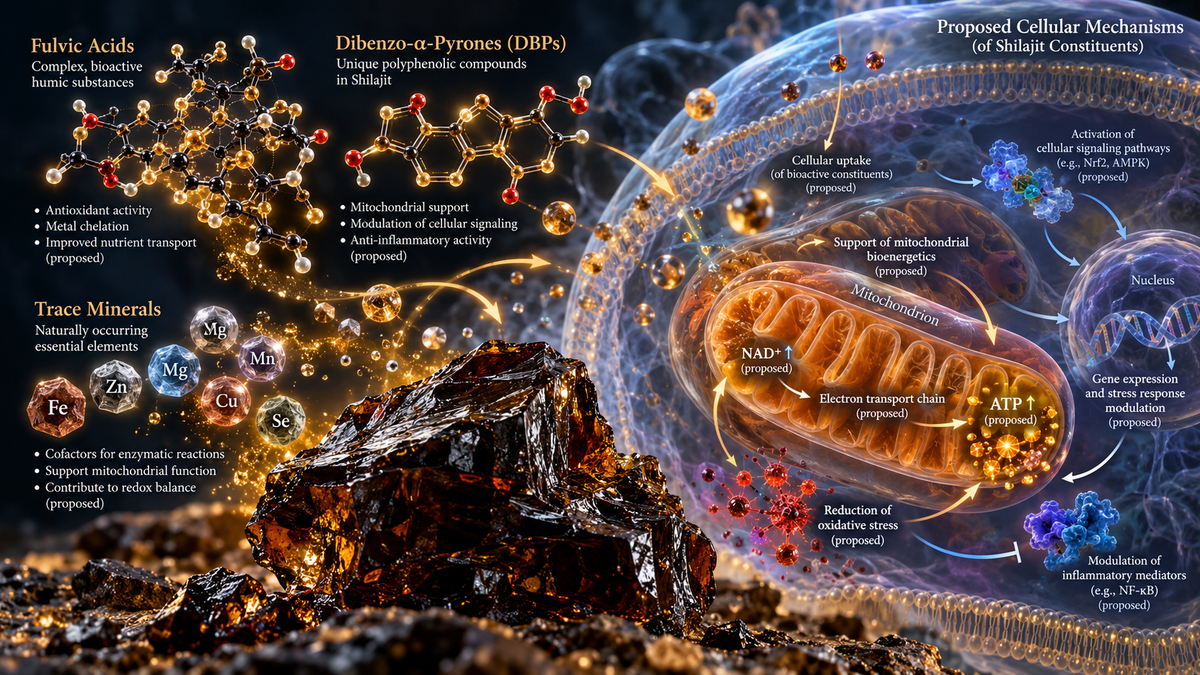
How Shilajit Works: Mechanisms of Action and Evidence
Shilajit has been used in traditional Ayurvedic practice for centuries, and today it is sold as a resin, powder, capsule and tablet with bold promises about energy and vitality. But what is this dark, tar-like material, and how might it act inside the body? The honest answer is that researchers are still working it out. This article explains the proposed biology step by step, from its chemistry to mitochondria and oxidative stress, and it separates test-tube findings, animal studies and human data so you can see what is established, what is plausible and what is still a hypothesis.
How Shilajit Works: Mechanism Overview
The short version is that no single mechanism has been proven to explain the effects attributed to this substance. Instead, researchers have proposed several overlapping routes, each with a different level of support.
- Chemical complexity: it is a mixture of humic substances, small organic molecules and minerals, not one active compound.
- Cellular energy: laboratory and animal work suggests possible effects on mitochondria, the structures that produce most of a cell's usable energy.
- Redox balance: constituents show radical-scavenging behavior in test systems.
- Minerals and trace elements: the material contains metals that are cofactors in many enzymes, although amounts vary and typical doses are small.
- Inflammatory signaling: a few animal and cell studies point to modulation of inflammatory pathways.
A key principle runs through everything below: a proposed mechanism explains how an effect could happen. It does not show that the effect occurs in people, and it does not establish any health benefit. Evidence from cells and animals is a reason to run careful human trials, not a substitute for them.
How we rate the evidence
We use four tiers throughout the article:
- In vitro: experiments in test tubes or cultured cells.
- Animal: studies in rodents or other animals.
- Human mechanistic: measurements of biological markers in people, such as hormone levels or biochemical markers.
- Human clinical outcomes: trials measuring how people feel, function or whether disease occurs.
As you will see, most of the mechanistic literature sits in the first two tiers.
Shilajit Bioactive Compounds and Chemical Variability
This natural exudate seeps from rock layers in high mountain regions, including the Himalayas, the Altai range and the Caucasus. It is believed to form over very long periods from the decomposition of plant matter, with microbial action and mineral interaction. Because it comes from natural geological and biological processes, its composition differs between regions, altitudes and even batches.
The constituents most often described in the literature include:
- Humic substances, especially fulvic acids, often reported as a major part of the organic fraction.
- Dibenzo-alpha-pyrones (DBPs) and related chromoproteins, a group of low-molecular-weight aromatic compounds studied by the chemist Shibnath Ghosal and colleagues.
- Small organic acids and phenolic compounds, such as benzoic acid derivatives and hippuric acid.
- Amino acids and peptides in smaller amounts.
- Lipid-like and triterpenoid components reported in some analyses.
- Minerals and trace elements, including calcium, magnesium, iron, zinc, copper, manganese and potassium.
Two cautions follow. First, percentages quoted online, such as a specific share of fulvic acid, are not standardized, and different laboratories use different extraction and measurement methods. Second, raw material can contain unwanted contaminants, so purification and testing matter. This chemical variability is probably the largest obstacle to interpreting the research: a result from one sample may not apply to another product, and many studies did not report detailed chemical profiles. Reviews by Wilson and colleagues and by Stohs describe this complexity and its consequences for research and safety.
Fulvic Acid in Shilajit: Relevance and Limits
Fulvic acid gets most of the attention, so it deserves a careful look. Fulvic acids are a class of humic substances: heterogeneous, relatively small, oxygen-rich organic molecules that dissolve in water across a range of acidity. They are found in soil, peat and similar material, and they carry many carboxyl and phenolic groups that can bind metal ions and take part in redox reactions.
What the research suggests:
- Metal binding: fulvic acids can chelate (bind) metal ions in laboratory systems, which may affect how minerals dissolve and move.
- Redox activity: their phenolic groups can donate electrons, which is the basis of many antioxidant claims in test systems. The same chemistry can act in the opposite direction under some conditions.
- Anti-inflammatory and cell-protective signals: a review of fulvic acid research summarized cell and animal studies in inflammatory and metabolic models, while noting that the evidence base is limited and mostly preclinical.
- Protein aggregation in vitro: one laboratory study reported that fulvic acid inhibited aggregation of tau protein fibrils in a test-tube system. This is an isolated chemistry result and does not show an effect in the human brain.
And what limits interpretation:
- Fulvic acid is not a single defined molecule, so results depend on its source and preparation, and fulvic acid from soil or coal is not necessarily equivalent to that in this material.
- How much is absorbed, in what form and in which tissues is poorly characterized in humans.
- Percentages on product labels are not a reliable guide to biological activity.
In short, fulvic acid is a plausible contributor, but it is not established as the active ingredient.
Proposed Biological Pathways
Several pathways have been proposed. They are best read as hypotheses to test.
Cellular energy and mitochondria
The idea is that constituents may support mitochondrial function, either by influencing enzymes of the respiratory chain, by affecting levels of coenzymes such as coenzyme Q10, or by reducing oxidative damage to mitochondrial components. Support comes mainly from animal studies.
Redox signaling
Phenolic and humic constituents may scavenge reactive oxygen species or influence the activity of antioxidant enzymes. Support comes mainly from in vitro and animal studies.
Stress-response and endocrine signaling
In a rat model of chronic stress, researchers reported effects on the hypothalamic-pituitary-adrenal axis, the body's stress-hormone system. Small human studies have measured reproductive hormone markers, discussed below.
Connective tissue and muscle
A small human trial examined hydroxyproline, a marker related to collagen turnover, in the context of muscle fatigue. It is an interesting but preliminary lead.
Inflammatory signaling
A few older animal studies explored anti-inflammatory effects, and fulvic acid has been studied in cell models of inflammation.
These pathways can interact, since energy production, oxidative stress and inflammation are closely linked in cells. That interconnection makes them biologically plausible, but it also makes it hard to tell which, if any, is the primary driver.
Shilajit Mitochondrial Function and Energy Metabolism
Mitochondria convert nutrients and oxygen into ATP, the cell's energy currency, and they are also a major source of reactive oxygen species. Interest in the link between this material and mitochondrial function has three sources.
Animal evidence. In a rat model of chronic-stress-induced fatigue, researchers reported that treatment improved behavioral signs of fatigue and altered markers related to stress hormones and mitochondrial bioenergetics. This is a single model, in rodents, and the results need independent replication.
Structural analogy. DBPs share a core structure with the urolithins, compounds produced by gut bacteria from ellagic acid-rich foods. Urolithin A has been shown to induce mitophagy, the removal and renewal of damaged mitochondria, in worms and rodents, and a human study showed it was safe and changed molecular markers linked to mitochondrial health. This is relevant by analogy only. Whether DBPs from this substance act the same way, and at what doses, has not been demonstrated.
Cofactor hypothesis. It has been proposed that DBPs may interact with coenzyme Q10 or help carry it across membranes. This remains a hypothesis, and strong independent human data are lacking.
What we cannot say: there is no robust human evidence that supplementation changes mitochondrial function in tissues, nor that any change would translate into more energy in daily life. Fatigue and energy are complex outcomes influenced by sleep, diet, mood and illness. Research on this topic should be read as preliminary.
Shilajit Antioxidant Effects and Redox Mechanisms
Oxidative stress describes an imbalance between reactive oxygen species and the body's antioxidant defenses. Extracts of this material have shown radical-scavenging activity in test-tube assays, which is not surprising given the abundance of phenolic and humic groups. Early animal work also reported effects on free radical markers and antioxidant enzymes.
Several caveats matter:
- Test-tube antioxidant capacity is not the same as an effect in the body. Many compounds scavenge radicals in a dish but are poorly absorbed or rapidly changed in vivo.
- Antioxidants are context-dependent. Large trials of other antioxidant supplements have been disappointing, and some showed harm, which warns against assuming that more antioxidant activity is better.
- Redox chemistry is two-sided. Humic substances containing quinone and phenol groups can, under some conditions, generate reactive species.
- Few human biomarker data exist. We are not aware of strong independent human trials showing that supplementation changes validated oxidative stress markers in a meaningful way.
So the antioxidant mechanism is plausible and supported by in vitro and some animal data, but it is far from proven in humans.
Mineral and Trace-Element Contributions
Analyses of samples have reported a range of minerals, including iron, zinc, copper, manganese, magnesium and calcium. These elements are cofactors for many enzymes, including antioxidant enzymes and components of mitochondrial respiration, so a mineral contribution is biologically plausible.
However, there are good reasons for restraint:
- Variable content. Concentrations differ widely between samples and sources.
- Small doses. Studies commonly used a few hundred milligrams per day. Even a mineral-rich sample is likely to provide small amounts of most minerals compared with daily nutritional needs, so a meaningful effect from the minerals alone is uncertain.
- Binding and bioavailability. Fulvic acid may bind metals, but whether this improves or reduces absorption in people is not well established.
- Possible unwanted metals. Natural material may also contain arsenic, lead, mercury or cadmium unless it is purified and tested. Studies of traditional Ayurvedic products in general have found metal contamination in some products, which is a reason to buy only tested, purified material.
People with iron overload conditions, kidney disease or those taking mineral-sensitive medicines should discuss any use with a clinician.
Inflammation-Related Pathways Where Studied
Inflammation is a protective response that can become harmful when excessive or prolonged. Research on this material and inflammation is limited.
- Animal studies: older rodent experiments reported anti-inflammatory and anti-ulcer effects, with limited detail about the composition of the material tested.
- Fulvic acid research: cell and animal studies have explored effects on inflammatory signaling, including pathways involving cytokines and the transcription factor NF-kB, according to a published review. The evidence is mostly preclinical.
- Human data: we are not aware of well-controlled human trials that establish effects on inflammatory pathways or clinical inflammatory conditions.
Because inflammation is tightly linked to oxidative stress and mitochondrial function, the three mechanisms may be connected, but that connection is hypothetical for this substance.
Preclinical Versus Human Evidence
The gap between laboratory and human research is the central issue in this field.
In vitro. Test-tube and cell studies show antioxidant capacity, metal binding and, for fulvic acid, effects on protein aggregation and inflammatory signaling. Concentrations used are often higher than what could be reached in the body.
Animal studies. Rodent studies explored stress, fatigue, learning, inflammation and oxidative markers. Animals differ from humans in metabolism and gut bacteria, and the preparations used varied.
Human mechanistic data. A few small controlled trials have measured biological markers. One randomized, placebo-controlled trial in 75 healthy men taking a purified preparation for 90 days reported changes in testosterone and related hormones. A small randomized trial in healthy adults examined muscle strength after fatiguing exercise and a collagen-related marker. A study in men with low sperm counts reported improvements in semen parameters with processed material. These studies are small, short and sometimes lack detail on funding or independence, so they need replication.
Human clinical outcomes. Large, long, independent trials showing that supplementation improves health outcomes are lacking. Safety, interactions and long-term effects are also not well characterized.
Established Findings Versus Hypotheses
Reasonably established
- The material is chemically complex and variable, with humic substances, DBPs and minerals reported in analyses.
- Extracts show antioxidant activity in laboratory assays.
- Contaminants, including heavy metals, are a recognized quality concern for unpurified material.
Plausible but unproven
- Effects on mitochondrial function in humans.
- Meaningful antioxidant effects in the body.
- A direct mineral contribution at typical doses.
- Anti-inflammatory effects.
Speculative
- DBPs acting like urolithins to promote mitophagy.
- DBPs carrying coenzyme Q10 into cells.
- Fulvic acid affecting protein aggregation in the human brain.
Shilajit Mechanism of Action: Summary Table
|
Proposed mechanism |
Possible constituents |
Strongest evidence |
Evidence level |
Confidence |
|---|---|---|---|---|
|
Mitochondrial support |
DBPs, fulvic acid |
Rat stress-fatigue model |
Animal |
Low |
|
Mitophagy (by analogy to urolithin A) |
DBPs |
Urolithin A studies, not this material |
Analogy only |
Very low |
|
Antioxidant and redox effects |
Phenolics, fulvic acid |
Radical-scavenging assays, early animal work |
In vitro and animal |
Low |
|
Mineral cofactor supply |
Fe, Zn, Cu, Mn, Mg, Ca |
Chemical analyses |
Chemical analysis |
Low |
|
Inflammatory signaling |
Fulvic acid |
Older animal studies, cell studies |
In vitro and animal |
Low |
|
Tau aggregation inhibition |
Fulvic acid |
Test-tube study |
In vitro |
Very low |
|
Stress-axis modulation |
Unknown |
Rat chronic-stress model |
Animal |
Low |
|
Reproductive hormone markers |
Unknown |
Small human trials |
Human mechanistic |
Low to moderate, needs replication |
Limitations of Mechanistic Research
- No standardized material. Without a consistent chemical definition, results cannot be compared or reproduced reliably.
- Unknown active constituents. Fulvic acid, DBPs and other components are all candidates, but none has been shown to account for the effects.
- Poorly understood absorption. How fulvic acid and DBPs are absorbed, metabolized and distributed in humans is not well characterized.
- High test concentrations. Many in vitro effects occur at levels that may not be achievable in the body.
- Small, short human studies. Sample sizes are modest and durations short, limiting conclusions about long-term effects and safety.
- Limited independence. Few findings have been replicated by independent groups. Readers should check disclosures about funding and product supply.
- Surrogate endpoints. Hormone and biochemical markers do not necessarily reflect improved health.
- Publication bias. Positive results from small studies are more likely to be published.
- Safety data gaps. Long-term safety, drug interactions and use in pregnancy or chronic illness are insufficiently studied.
The field needs standardized, well-characterized material, pharmacokinetic studies, and larger independent randomized trials with clear primary endpoints.
Scientific Conclusion
The biology behind this material is intriguing but unproven. It is a chemically complex natural mixture, and its proposed actions on mitochondria, oxidative stress, minerals and inflammation are biologically plausible. Almost all of the mechanistic support comes from test tubes and animals, with a handful of small human studies measuring biomarkers. None of this establishes that it treats, prevents or cures any disease.
If you are considering a product, look for independent laboratory testing for heavy metals and microbes, a clear description of the extract, and transparent dosing. Talk with a doctor or pharmacist first, especially if you are pregnant, have a medical condition, or take prescription medicines. To explore the underlying evidence further, use the references below.
This article is for educational purposes only and is not medical advice. It does not diagnose, treat or prevent any condition.
FAQ
What is the main idea behind how Shilajit works? Researchers propose that a mix of humic substances such as fulvic acid, DBPs and minerals may influence cellular energy, oxidative stress and inflammatory signaling. These are hypotheses, mostly supported by laboratory and animal studies.
Is fulvic acid the active ingredient? It is a leading candidate but has not been proven to be responsible for any effect in people. Fulvic acid is a heterogeneous group of molecules, and its content varies between products.
Does Shilajit boost mitochondrial function in humans? There is animal evidence and a plausible mechanism, but we are not aware of strong human data showing improved mitochondrial function. It should be considered unproven.
Is it a real antioxidant? Extracts show antioxidant activity in test-tube assays. Whether this translates to useful effects in the body has not been established.
Are there safety concerns? Unprocessed material may contain heavy metals or microbial contaminants. People with iron overload, kidney disease or those taking medicines should speak with a clinician first.
Why do studies give different results? The material varies by source and batch, and studies use different preparations, doses and designs.
References
- Wilson E, Rajamanickam GV, Dubey GP, et al. Review on shilajit used in traditional Indian medicine. J Ethnopharmacol. 2011;136(1):1-9. DOI
- Stohs SJ. Safety and efficacy of shilajit (mumie, moomiyo). Phytother Res. 2014;28(4):475-479. DOI
- Agarwal SP, Khanna R, Karmarkar R, Anwer MK, Khar RK. Shilajit: a review. Phytother Res. 2007;21(5):401-405. DOI
- Meena H, Pandey HK, Arya MC, Ahmed Z. Shilajit: a panacea for high-altitude problems. Int J Ayurveda Res. 2010;1(1):37-40. DOI
- Ghosal S. Chemistry of shilajit, an immunomodulatory Ayurvedic rasayan. Pure Appl Chem. 1990;62(7):1285-1288. DOI
- Schepetkin I, Khlebnikov A, Kwon BS. Medical drugs from humus matter: focus on mumie. Drug Dev Res. 2002;57(3):140-159. DOI
- Carrasco-Gallardo C, Guzman L, Maccioni RB. Shilajit: a natural phytocomplex with potential procognitive activity. Int J Alzheimers Dis. 2012;2012:674142. DOI
- Winkler J, Ghosh S. Therapeutic potential of fulvic acid in chronic inflammatory diseases and diabetes. J Diabetes Res. 2018;2018:5391014. DOI
- Cornejo A, Jimenez JM, Caballero L, Melo F, Maccioni RB. Fulvic acid inhibits aggregation and promotes disassembly of tau fibrils associated with Alzheimer's disease. J Alzheimers Dis. 2011;27(1):143-153. DOI
- Surapaneni DK, Adapa SR, Preeti K, et al. Shilajit attenuates behavioral symptoms of chronic fatigue syndrome by modulating the hypothalamic-pituitary-adrenal axis and mitochondrial bioenergetics in rats. J Ethnopharmacol. 2012;143(1):91-99. Link: locate via PubMed title search.
- Ryu D, Mouchiroud L, Andreux PA, et al. Urolithin A induces mitophagy and prolongs lifespan in C. elegans and increases muscle function in rodents. Nat Med. 2016;22(8):879-888. DOI
- Andreux PA, Blanco-Bose W, Ryu D, et al. The mitophagy activator urolithin A is safe and induces a molecular signature of improved mitochondrial and cellular health in humans. Nat Metab. 2019;1(6):595-603. DOI
- Goel RK, Banerjee RS, Acharya SB. Antiulcerogenic and anti-inflammatory studies with shilajit. J Ethnopharmacol. 1990;29(1):95-103. Link: locate via PubMed title search.
- Pandit S, Biswas S, Jana U, et al. Clinical evaluation of purified shilajit on testosterone levels in healthy volunteers. Andrologia. 2016;48(5):570-575. DOI
- Biswas TK, Pandit S, Mondal S, et al. Clinical evaluation of spermatogenic activity of processed shilajit in oligospermia. Andrologia. 2010;42(1):48-56. DOI
- Keller JL, Housh TJ, Hill EC, et al. The effects of shilajit supplementation on fatigue-induced decreases in muscular strength and serum hydroxyproline levels. J Int Soc Sports Nutr. 2019;16(1):3. Link: locate via PubMed title search.
- Saper RB, Phillips RS, Sehgal A, et al. Lead, mercury, and arsenic in US- and Indian-manufactured Ayurvedic medicines sold via the Internet. JAMA. 2008;300(8):915-923. DOI
For general information only. Talk to your doctor before starting any supplement.


