
Omega-3 Human Clinical Research: What the Evidence Shows
Omega-3 Human Clinical Research: What the Evidence Shows
Few supplements have been tested in as many people as omega-3 fatty acids. Tens of thousands of volunteers have taken capsules of fish oil or purified EPA and DHA in randomized trials, and the headlines from those studies have swung from “miracle nutrient” to “waste of money” and back again. If you have felt confused by this, you are not alone. This page walks through the human omega-3 clinical research in plain language: which trials matter, what they found, how strong the evidence is and where the gaps remain.
Executive Evidence Summary: Omega-3 Clinical Research at a Glance
The short version, based on the largest randomized trials and systematic reviews:
- Triglycerides: strongest and most consistent finding. EPA and DHA reliably lower blood triglycerides, especially at prescription-level doses.
- Heart disease in the general population: large trials of standard doses (about 1 g per day) mostly found no significant reduction in major cardiovascular events.
- Heart disease in high-risk patients: results are split. One high-dose, purified EPA trial showed a clear benefit, while a high-dose EPA and DHA trial showed none.
- Atrial fibrillation: meta-analyses suggest a small increase in risk at higher doses.
- Pregnancy: moderate-certainty evidence links supplementation to a lower risk of preterm birth.
- Brain, mood, eyes and joints: results are mixed or weak, with a few encouraging signals and many null findings.
- Overall: omega-3 supplements are not a universal health booster, but they have a real role for specific people and specific outcomes.
(Evidence grades for each outcome appear later in this guide.)
Research Question
Clinical research is only useful if the question is precise. This review asks one main question:
In human randomized trials and the systematic reviews built from them, do omega-3 supplements change clinically meaningful health outcomes, and for whom?
That question has three layers. First, does it work at all? Second, does the answer depend on the dose, the form (EPA alone versus EPA plus DHA) and the comparator used? Third, does it depend on who takes it, such as healthy adults versus people with existing disease?
Search and Inclusion Methodology
This page is an evidence synthesis, not a new systematic review. It is built from the highest-quality human evidence that is publicly indexed in PubMed and the Cochrane Library, plus major trial publications in leading journals.
Included:
- Randomized controlled trials in humans testing marine omega-3s (EPA, DHA or both) from fish oil, algal oil or purified prescription products
- Systematic reviews and meta-analyses of those trials
- Studies reporting clinical outcomes (events, symptoms, mortality) rather than only lab markers, except for triglycerides, where the lab marker is itself a clinical target
Excluded or down-weighted:
- Animal and cell studies
- Observational studies used to claim cause and effect (they appear only as background)
- Trials of plant-based ALA (from flax or chia) unless specifically stated, because the body converts ALA to EPA and DHA poorly
- Very small or unblinded studies when larger trials exist on the same question
Readers who want the exact figures should check the original papers listed in the references. Numbers are rounded and described in my own words.
Evidence by Health Outcome for Omega-3 Supplements
Blood triglycerides
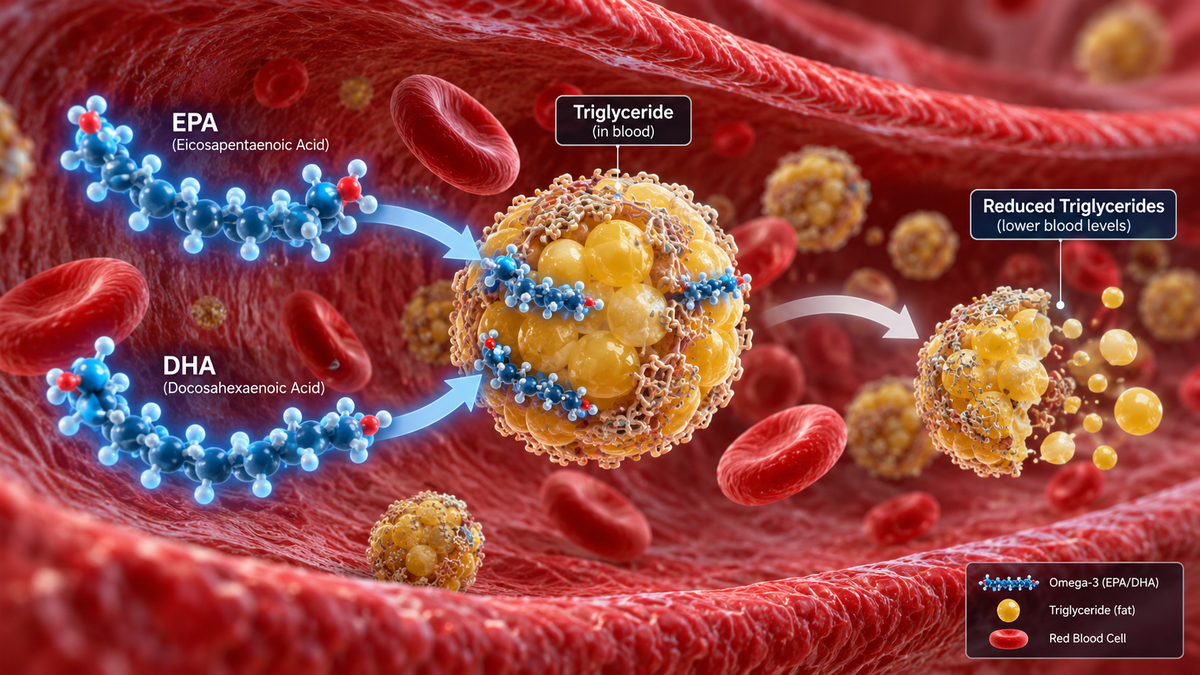
This is the best-supported use. Prescription forms of EPA and DHA at about 4 g per day lower triglycerides substantially in people with very high levels, and they are approved for that purpose in many countries. Systematic reviews, including the large Cochrane review, rate the evidence for triglyceride lowering as high certainty. Lower-dose supplements also reduce triglycerides, but by smaller amounts.
One caution: in some people, DHA-containing products can modestly raise LDL (“bad”) cholesterol, while pure EPA products generally do not.
Cardiovascular events
This is where most of the controversy lives. The trials are best understood in three groups.
Early trials (before widespread statin use). The Italian GISSI-Prevenzione trial gave about 1 g per day of EPA and DHA to over 11,000 people who had recently had a heart attack. It reported a modest reduction in a combined outcome of death, non-fatal heart attack and stroke. It was open-label, meaning participants knew what they were taking.
Modern trials in the general population. Three large trials tested a standard 1 g daily dose against placebo in people without prior heart disease or with diabetes or other risk factors:
- VITAL (about 25,800 US adults) found no significant reduction in the main cardiovascular outcome, though heart attacks specifically were lower in a secondary analysis.
- ASCEND (about 15,500 adults with diabetes) found no significant reduction in serious vascular events.
- Risk and Prevention (about 12,500 Italian adults) and ORIGIN (about 12,500 people with blood sugar problems) also found no benefit.
High-dose trials in high-risk patients. Here the story becomes interesting, and contradictory:
- JELIS (Japan, about 18,600 people with high cholesterol, all taking statins) added 1.8 g per day of purified EPA and saw a relative reduction of around 19% in major coronary events. It was open-label.
- REDUCE-IT (about 8,200 high-risk patients on statins) used 4 g per day of icosapent ethyl, a purified EPA product, and found a 25% relative reduction in the main composite outcome.
- STRENGTH (about 13,000 high-risk patients) used 4 g per day of an EPA and DHA product and found no benefit. It was stopped early for futility.
Why did these two similar-looking trials disagree? Researchers have proposed several explanations: EPA alone may behave differently from EPA plus DHA; the mineral oil placebo in REDUCE-IT may have slightly raised inflammation and LDL in the comparison group and exaggerated the apparent benefit; and the trials differed in baseline risk. No single explanation has been proven. The honest reading is that high-dose purified EPA has a signal worth taking seriously, but the question is not fully closed.
Atrial fibrillation (irregular heartbeat)
A 2021 meta-analysis of randomized trials found that omega-3 supplementation was associated with a higher risk of atrial fibrillation, with the increase appearing larger at doses above 1 g per day. The absolute risk remains small, but it is a real safety consideration, particularly for people at high risk of rhythm problems.
Pregnancy and early life
A Cochrane review of dozens of trials found that omega-3 supplementation during pregnancy reduces the chance of preterm birth (before 37 weeks) by roughly a tenth, and early preterm birth (before 34 weeks) by a larger proportion, along with a lower risk of low birth weight babies. Evidence for effects on long-term child development is less consistent. This is one of the more encouraging areas of omega-3 clinical research, but pregnant women should always discuss doses with their midwife or doctor.
Depression and mood
Meta-analyses have produced conflicting results. Some find a benefit mainly for formulas with a higher share of EPA, while a Cochrane review concluded that the evidence for omega-3 as a treatment for depression is low certainty, with little to no clear effect overall. Omega-3 should be seen as, at most, a possible add-on and not a replacement for standard care.
Brain function and dementia
Trials in cognitively healthy older adults have generally found no meaningful improvement in memory or thinking from supplements. A trial of high-dose DHA in people with mild to moderate Alzheimer’s disease did not slow cognitive decline. Observational studies link higher fish intake to lower dementia risk, but the supplement trials have not confirmed that result.
Dry eye
The DREAM trial gave 3 g per day of omega-3 to over 500 people with moderate to severe dry eye disease for a year. It found no advantage over an olive oil placebo, which surprised many eye specialists who had been recommending fish oil.
Joint pain and rheumatoid arthritis
Pooled analyses of smaller trials suggest that fish oil can reduce joint tenderness, morning stiffness and the need for anti-inflammatory painkillers in rheumatoid arthritis. The trials are generally small and short, so the evidence is modest, but this is among the more consistent non-cardiac signals.
Cancer
VITAL found no reduction in cancer incidence with 1 g per day of omega-3 over about five years.
Human Studies Table: Key Fish Oil and Omega-3 Trials
| Trial | Participants | Dose and form | Duration | Main finding |
|---|---|---|---|---|
| GISSI-Prevenzione (1999) | ~11,300 post-heart-attack patients | ~1 g/day EPA+DHA ethyl esters | ~3.5 years | Modest reduction in combined events (open-label) |
| JELIS (2007) | ~18,600 Japanese adults with high cholesterol, on statins | 1.8 g/day purified EPA | ~4.6 years | About 19% fewer major coronary events (open-label) |
| ORIGIN (2012) | ~12,500 adults with blood sugar problems | 1 g/day EPA+DHA | ~6 years | No benefit |
| Risk and Prevention (2013) | ~12,500 adults with multiple risk factors | 1 g/day EPA+DHA | ~5 years | No benefit |
| ASCEND (2018) | ~15,500 adults with diabetes | 1 g/day EPA+DHA | ~7.4 years | No significant reduction in vascular events |
| VITAL (2019) | ~25,800 adults without prior CVD | ~1 g/day EPA+DHA (about 460 mg EPA, 380 mg DHA) | ~5.3 years | No significant effect on main outcome or cancer |
| REDUCE-IT (2019) | ~8,200 high-risk patients with high triglycerides, on statins | 4 g/day icosapent ethyl (EPA) | ~4.9 years | 25% relative reduction in main composite outcome |
| STRENGTH (2020) | ~13,000 high-risk patients | 4 g/day EPA+DHA carboxylic acids | Stopped early | No benefit |
| DREAM (2018) | ~535 adults with dry eye | 3 g/day EPA+DHA | 12 months | No better than placebo |
| OMEMI (2021) | ~1,000 older adults after heart attack | 1.8 g/day EPA+DHA | ~2 years | No significant benefit |
Study Design Quality
Not all trials are equal. When judging this research, look for five quality markers:
- Randomization and blinding. Double-blind, placebo-controlled trials are more reliable than open-label ones. GISSI and JELIS were open-label, so expectations could have influenced reporting.
- Choice of placebo. Mineral oil, corn oil and olive oil are not neutral. Each can affect cholesterol or inflammation, which can distort the comparison.
- Sample size and event counts. Large trials with thousands of participants are far more trustworthy than small studies, which often exaggerate effects.
- Adherence. If many people stop taking capsules, a real benefit can be diluted. Blood omega-3 levels, when measured, help confirm that participants actually took the product.
- Pre-specified outcomes. Results for the main, pre-planned outcome carry more weight than findings from subgroup analyses.
The best trials, such as VITAL, ASCEND, REDUCE-IT and STRENGTH, were large, randomized and double-blind.
Participant Characteristics
Who was studied makes a major difference:
- Age. Most large trials enrolled middle-aged and older adults, often over 60. Younger adults are poorly represented.
- Baseline risk. Trials in healthy people have few events, making small benefits hard to detect. Trials in high-risk patients show clearer signals.
- Baseline omega-3 status. People who already eat fish regularly may gain less than people with low intake. Many trials did not select participants by baseline omega-3 level, which may mute real effects.
- Background treatment. Modern trials include participants on statins and other effective drugs, leaving less room for added benefit than early trials did.
- Diversity. Most participants were of European, North American or Japanese background, so findings may not apply equally everywhere.
Dose and Form Used
Doses in the research fall into three broad bands:
- Low to standard (about 0.5–1 g/day EPA+DHA): typical of over-the-counter fish oil and used in VITAL, ASCEND and ORIGIN.
- Moderate (about 1.8–3 g/day): used in JELIS, OMEMI and DREAM.
- High, prescription-level (about 4 g/day): used in REDUCE-IT and STRENGTH, and for triglyceride treatment.
Forms also vary. Common ones are ethyl esters, natural triglycerides, re-esterified triglycerides, phospholipids (as in krill oil) and carboxylic acids. Some evidence suggests triglyceride forms may be absorbed better than ethyl esters when taken without food, but head-to-head clinical outcome data are limited. EPA-only and EPA-plus-DHA products are not interchangeable, and results from one cannot be assumed for the other.
Duration
Trial lengths range from a few weeks (triglyceride and inflammatory marker studies) to more than seven years (ASCEND). Cardiovascular outcome trials typically run four to seven years, because heart attacks and strokes take time to accumulate. Mood and joint trials are usually only 8 to 24 weeks. Short trials cannot say anything about long-term disease prevention, and long trials may lose participants over time.
Primary Endpoints
A primary endpoint is the single outcome the trial was designed to test. Examples include:
- REDUCE-IT: a composite of cardiovascular death, heart attack, stroke, revascularization and unstable angina
- VITAL: major cardiovascular events (heart attack, stroke, cardiovascular death) and cancer
- DREAM: change in a dry eye symptom score
- Pregnancy trials: preterm birth and birth weight
Composite endpoints combine several events and increase statistical power, but they can hide the fact that benefits come from only one component. Always check which parts of a composite actually changed.
Results: Putting the Numbers in Context
Across the major trials, results fall into a clear pattern. Standard-dose trials in general populations tend to show relative changes close to zero. High-dose EPA trials in high-risk, statin-treated patients show larger effects in two of three cases. Safety signals, mainly atrial fibrillation and a small increase in minor bleeding at high doses, show up more clearly at higher doses.
Clinical Significance
Statistical significance is not the same as clinical importance. Ask three questions of any result:
- How big is the absolute effect? A 25% relative reduction sounds large, but what matters is how many fewer people actually have events. In REDUCE-IT, about 5 percentage points separated the two groups (17.2% versus 22.0%) over several years in a high-risk population. That is meaningful for that group but does not translate to healthy adults.
- Who benefits? Benefits seen in patients with high triglycerides on statins cannot be assumed for healthy people.
- What is the trade-off? Possible increases in atrial fibrillation, cost and pill burden should be weighed against expected gains.
Conflicts of Interest and Funding
Funding shapes research, so it deserves a transparent look:
- REDUCE-IT was funded by the manufacturer of icosapent ethyl. STRENGTH was funded by the manufacturer of the product it tested. Industry sponsorship is common in drug trials and does not by itself invalidate results, but readers should consider it.
- VITAL and ASCEND were funded mainly by public or charitable research bodies, with supplement or placebo capsules supplied by manufacturers.
- JELIS was supported by a pharmaceutical company in Japan.
The strongest conclusions are those supported by both industry-funded and independently funded trials. Notably, the null results in the independently funded trials make the case that fish oil is not a cure-all, and the industry-funded trials themselves disagree with each other.
Consistency Across Trials
Consistency is a key test of whether a finding is real. Triglyceride lowering is consistent: nearly every trial shows it. Benefits for cardiovascular events are not consistent: standard-dose trials mostly show nothing, while high-dose EPA trials show conflicting results. Benefits in pregnancy are moderately consistent across many trials. Findings for depression, cognition and dry eye are inconsistent, often differing by dose, formulation and population.
Inconsistency does not mean omega-3s are useless. It more often means the effects are small, specific to certain people or formulations, or masked by differences in study design.
Meta-Analyses and Systematic Reviews of Omega-3 Clinical Research
Pooled analyses give the clearest overview:
- Cochrane review (2020): examined 86 trials with over 160,000 participants. It concluded that increasing EPA and DHA intake probably makes little or no difference to all-cause mortality, cardiovascular events or stroke. It found a slight reduction in coronary heart disease events and deaths, and high-certainty evidence for triglyceride lowering.
- Hu et al. (2019, JAHA): pooled 13 randomized trials and linked supplementation to modest reductions in heart attack and coronary heart disease death, with a possible dose-response pattern.
- Gencer et al. (2021, Circulation): pooled seven trials and found a higher risk of atrial fibrillation, particularly above 1 g per day.
- Pregnancy (Cochrane 2018): found reductions in preterm birth and low birth weight.
- Depression (Cochrane 2021): judged the evidence as low certainty with little to no overall effect.
Meta-analyses are only as good as the trials inside them. Because they combine trials with very different doses, forms and populations, their averages can obscure real differences.
Evidence Grading
The grades below are my summary judgment, informed by the GRADE approach used by Cochrane reviewers (high, moderate, low, very low certainty). They are an editorial interpretation, not an official rating.
| Outcome | Evidence grade | Interpretation |
|---|---|---|
| Triglyceride lowering | High | Consistent and well-established |
| Preterm birth reduction in pregnancy | Moderate | Encouraging, supported by many trials |
| Cardiovascular events, high-dose EPA in high-risk patients | Moderate, conflicting | Strong signal in one trial, null in another |
| Cardiovascular events, standard-dose supplements in general population | Moderate (for little or no effect) | Large trials mostly show no meaningful effect |
| Atrial fibrillation risk increase | Moderate | Consistent across trials, more at high doses |
| Rheumatoid arthritis symptoms | Low to moderate | Small trials, modest benefit |
| Depression | Low | Mixed and inconsistent |
| Cognitive decline and dementia | Low | Largely null in supplement trials |
| Dry eye | Moderate (for little or no effect) | Large trial found no benefit over placebo |
| Cancer prevention | Low to moderate (for no effect) | No benefit in the largest trial |
Limitations of the Current Evidence
Several limits apply to all omega-3 clinical research, including this review:
- Heterogeneity. Trials differ widely in dose, EPA-to-DHA ratio, form, placebo and population.
- Baseline status. Few trials selected people with low omega-3 levels, who may be the ones most likely to benefit.
- Placebo problems. Oils used as placebos can have biological effects of their own.
- Short follow-up for outcomes that develop over decades, such as dementia.
- Product quality. Over-the-counter supplements vary in actual EPA and DHA content and freshness, and trial products may not match what shoppers buy.
- Publication and funding bias can skew which results reach the public.
- This review’s scope. It summarizes major trials and reviews rather than every study ever published, and it should be updated as new evidence emerges.
Bottom-Line Interpretation
Desire
If you are healthy and eat fish a couple of times a week, the human evidence does not show that adding standard-dose fish oil capsules will prevent heart attacks, cancer or cognitive decline. Money may be better spent on food.
Omega-3 supplements do have a clear and well-proven role in lowering very high triglycerides, a likely role in reducing preterm birth risk in pregnancy, and a possible role for high-dose purified EPA in selected high-risk heart patients under medical supervision. They may offer small symptom relief in rheumatoid arthritis. The risks, particularly atrial fibrillation at higher doses, are small but real.
Action
Before starting a supplement, ask your doctor whether your triglycerides, heart risk or pregnancy status make one worthwhile. Check the label for the actual EPA and DHA content per serving (not just “fish oil” weight), choose a product with third-party testing and avoid high doses without medical advice. Regulators generally suggest keeping combined EPA and DHA intake from all sources at or below about 3 g per day, with no more than 2 g from supplements.
Safety note: Omega-3 supplements can interact with blood-thinning medicines, may affect blood pressure, and are linked to atrial fibrillation at higher doses. People with fish or shellfish allergy, heart rhythm problems, bleeding disorders or upcoming surgery should consult a professional first.
References
- GISSI-Prevenzione Investigators. Dietary supplementation with n-3 polyunsaturated fatty acids and vitamin E after myocardial infarction. Lancet. 1999;354:447–455.
- Yokoyama M, et al. Effects of eicosapentaenoic acid on major coronary events in hypercholesterolaemic patients (JELIS). Lancet. 2007;369:1090–1098.
- ORIGIN Trial Investigators. n-3 fatty acids and cardiovascular outcomes in patients with dysglycemia. N Engl J Med. 2012;367:309–318.
- Roncaglioni MC, et al. n-3 fatty acids in patients with multiple cardiovascular risk factors. N Engl J Med. 2013;368:1800–1808.
- ASCEND Study Collaborative Group. Effects of n-3 fatty acid supplements in diabetes mellitus. N Engl J Med. 2018;379:1540–1550.
- Manson JE, et al. Marine n-3 fatty acids and prevention of cardiovascular disease and cancer (VITAL). N Engl J Med. 2019;380:23–32.
- Bhatt DL, et al. Cardiovascular risk reduction with icosapent ethyl for hypertriglyceridemia (REDUCE-IT). N Engl J Med. 2019;380:11–22.
- Nicholls SJ, et al. Effect of high-dose omega-3 fatty acids vs corn oil on major adverse cardiovascular events (STRENGTH). JAMA. 2020;324(22):2268–2280.
- Kalstad AA, et al. Effects of n-3 fatty acid supplements in elderly patients after myocardial infarction (OMEMI). Circulation. 2021;143:528–539.
- Abdelhamid AS, et al. Omega-3 fatty acids for the primary and secondary prevention of cardiovascular disease. Cochrane Database Syst Rev. 2020;3:CD003177.
- Hu Y, et al. Marine omega-3 supplementation and cardiovascular disease: an updated meta-analysis of 13 randomized controlled trials. J Am Heart Assoc. 2019;8:e013543.
- Gencer B, et al. Effect of long-term marine omega-3 fatty acids supplementation on the risk of atrial fibrillation in randomized controlled trials of cardiovascular outcomes. Circulation. 2021;144:1981–1990.
- Middleton P, et al. Omega-3 fatty acid addition during pregnancy. Cochrane Database Syst Rev. 2018;11:CD003402.
- Asbell PA, et al. Effect of omega-3 supplementation on dry eye disease (DREAM). N Engl J Med. 2018;378:1681–1690.
- Quinn JF, et al. Docosahexaenoic acid supplementation and cognitive decline in Alzheimer disease. JAMA. 2010;304:1903–1911.
- Goldberg RJ, Katz J. A meta-analysis of the analgesic effects of omega-3 polyunsaturated fatty acid supplementation for inflammatory joint pain. Pain. 2007;129:210–223.
- Deane KHO, et al. Omega-3 and polyunsaturated fat for prevention of depression and anxiety symptoms. Cochrane Database Syst Rev. 2021.
Medical disclaimer: This article is for general education only and is not medical advice. Consult a qualified healthcare professional before using any supplement.
For general information only. Talk to your doctor before starting any supplement.


