
CoQ10 Human Clinical Research: What the Evidence Shows
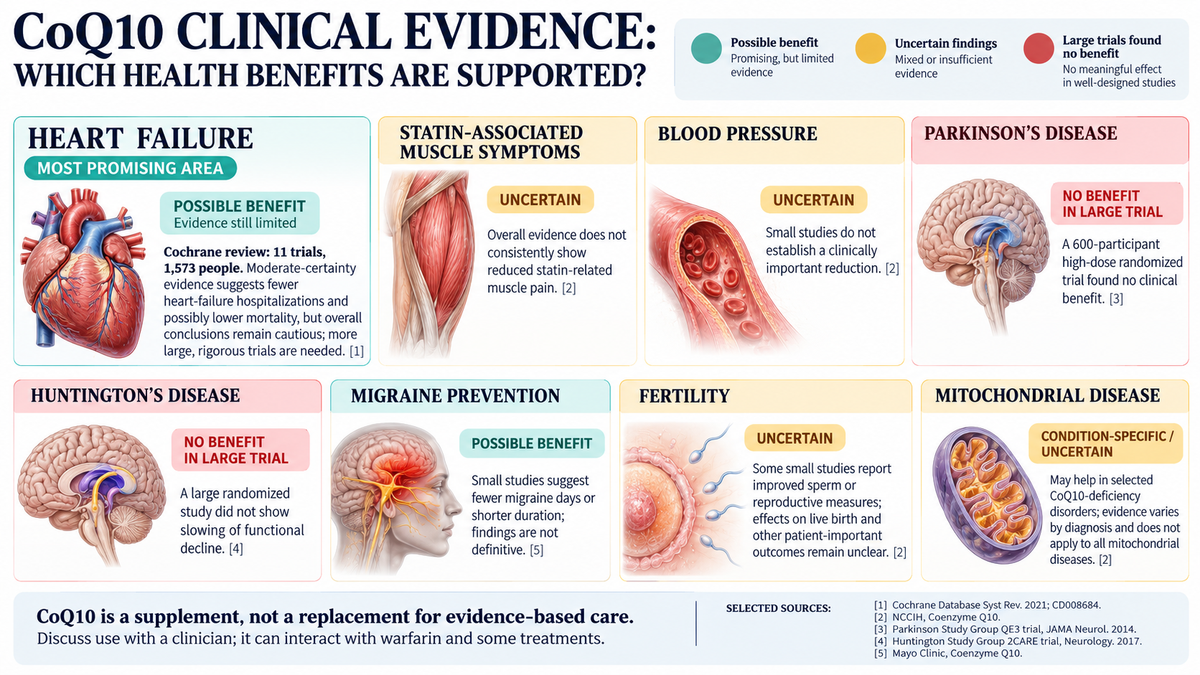
CoQ10 Human Clinical Research: What the Evidence Shows
Coenzyme Q10 is one of the most heavily marketed supplements, yet claims about it often run well ahead of the data. CoQ10 human clinical research now spans more than three decades and thousands of participants, with a few encouraging signals and several clear disappointments. This page separates what has been tested in people from what has only been shown in cells or animals.
If you are deciding whether CoQ10 deserves a place in your routine, or evaluating it for a client or patient, you need more than headlines. You need to know which outcomes have supportive trials, how good those trials were, who paid for them, and how large the effects were in practical terms.
Below, each health outcome is reviewed in turn, with a study table, quality ratings, and a plain-language bottom line.
1. Executive Evidence Summary
- Heart failure: The best-known trial (Q-SYMBIO) reported fewer major cardiovascular events with CoQ10 added to standard care. Supporting data are limited, and the trial was a single, moderately sized study. Evidence: low to moderate.
- Statin-associated muscle symptoms: Pooled results and a careful randomized trial do not show reliable benefit. Evidence: low, mostly negative.
- Blood pressure: Older meta-analyses suggested reductions, but they relied on small, heterogeneous trials. Evidence: low.
- Parkinson’s disease and Huntington’s disease: Early promising results were not confirmed in large phase III trials, which stopped for futility. Evidence: moderate that it does not work for slowing progression.
- Migraine prevention: Small positive trials exist, and guidelines list CoQ10 as “possibly effective.” Evidence: low to moderate.
- Fertility: Early trials are interesting but small and inconsistent. Evidence: low.
- Safety: CoQ10 is generally well tolerated in trials at typical doses. Mild gastrointestinal effects are the most common complaint.
Plain-language takeaway: CoQ10 is not a proven treatment for most conditions it is promoted for. It may offer modest benefit in specific, well-defined situations, most notably as an add-on in heart failure under medical supervision.
2. Research Question
This page asks one question: what do human clinical studies show about the effects of CoQ10 supplementation on health outcomes, and how reliable is that evidence?
Two distinctions matter throughout:
- Clinical vs. mechanistic evidence. CoQ10 participates in the mitochondrial electron transport chain and acts as a lipid-soluble antioxidant. These are laboratory-level facts. They suggest why CoQ10 might help, but they do not demonstrate that supplementing helps people. Many conditions involve low tissue CoQ10, yet raising it by supplementation has repeatedly failed to change outcomes.
-
Surrogate vs. clinical endpoints. A change in a blood marker is not the same as fewer hospitalizations or better daily function. This page emphasizes outcomes patients feel.

3. Search and Inclusion Methodology
This article is a narrative evidence review, not a new systematic review. The approach was:
- Sources prioritized: Cochrane reviews, meta-analyses of randomized controlled trials (RCTs), landmark individual RCTs, and clinical practice guidelines.
- Inclusion: Human studies of oral CoQ10 (ubiquinone or ubiquinol) with clinically meaningful endpoints.
- Exclusion from conclusions: Cell, animal, and purely mechanistic studies, and uncontrolled case series. These are discussed only to explain rationale, never as proof of benefit.
- Where possible, pooled estimates were preferred over single trials, and trial funding and author disclosures were noted.
Transparency note: This is not a living review and may not include trials published recently. Check PubMed for newer RCTs before making decisions.
4. CoQ10 Evidence by Health Outcome
Heart Failure
Heart failure is the strongest case for CoQ10, because heart muscle is energy-hungry and often shows lower CoQ10 concentrations in affected patients.
The Q-SYMBIO trial (Mortensen et al., 2014) randomized 420 patients with moderate to severe heart failure to 300 mg/day of CoQ10 or placebo for two years, on top of standard therapy. The primary endpoint was a composite of major adverse cardiovascular events (MACE). Fewer events occurred in the CoQ10 group (about 15% vs. 26%), and cardiovascular and all-cause mortality were also lower. The short-term, 16-week primary endpoint (change in NT-proBNP and functional measures) had been negative or neutral, which is worth noting.
A meta-analysis by Fotino and colleagues (2013) pooled 13 trials and found a small improvement in ejection fraction of about 3–4 percentage points, with substantial variability across trials. A Cochrane review (Madmani et al., 2014) concluded the evidence was insufficient because included trials were small and had heterogeneous designs.
Clinical significance: An ejection fraction change of a few points is modest. The mortality and MACE signal is more important but rests largely on one trial. Larger confirmatory trials would be needed before CoQ10 could be considered established therapy.
Statin-Associated Muscle Symptoms
Statins reduce CoQ10 levels in blood, which led to the hypothesis that supplementation would relieve muscle pain. The Banach et al. (2015) meta-analysis of six RCTs (302 participants) did not find a significant overall benefit on muscle pain. Taylor et al. (2015) ran a randomized trial in patients with confirmed statin myopathy and found no benefit over placebo with 600 mg/day for 12 weeks.
Clinical significance: Lower blood CoQ10 on a statin is a mechanistic observation. It has not translated into a symptomatic benefit from supplementation. Muscle symptoms on statins should be discussed with a prescriber, who can adjust the drug or dose.
Blood Pressure
A meta-analysis by Rosenfeldt et al. (2007) reported potential systolic reductions of up to roughly 10 mmHg in some trials. However, the underlying studies were small, of mixed quality, and used different populations. Newer higher-quality data have not consistently reproduced effects of that size.
Clinical significance: If a reduction exists, it is likely small relative to standard antihypertensive therapy, and CoQ10 should not replace prescribed medication.
Parkinson’s Disease and Huntington’s Disease
A phase II trial (Shults et al., 2002) showed a trend toward slower functional decline at 1,200 mg/day in early Parkinson’s disease. It was small and exploratory. The follow-up phase III QE3 trial (Beal et al., 2014) enrolled 600 patients and tested 1,200 mg and 2,400 mg per day against placebo. It was stopped early for futility: CoQ10 did not slow disease progression.
In Huntington’s disease, the large 2CARE trial (McGarry et al., 2017) tested 2,400 mg/day in 609 participants. It also found no slowing of functional decline.
Clinical significance: This is a textbook example of why mechanism is not proof. Strong biological rationale, positive early signals, and negative definitive trials.
Migraine Prevention
A small RCT (Sándor et al., 2005) of 42 patients using 300 mg/day for three months reported that significantly more patients on CoQ10 achieved a ≥50% reduction in attack frequency compared with placebo. The American Academy of Neurology and American Headache Society guideline (Holland et al., 2012) rated CoQ10 as “possibly effective” (Level C).
Clinical significance: The evidence is limited, but CoQ10 is low-risk, so some clinicians consider it as an adjunct. It is not a first-line treatment.
Fertility
In men, the Cochrane review of antioxidants for male subfertility (Showell et al., 2020) suggested antioxidants as a group may improve live birth and pregnancy rates, but the certainty was low and CoQ10-specific trials were small. In women with diminished ovarian reserve, one small RCT (Xu et al., 2018) reported improved ovarian response and embryo quality with pretreatment CoQ10.
Clinical significance: Interesting, preliminary, and not yet sufficient to recommend CoQ10 as a fertility treatment. Any use should be coordinated with a reproductive specialist.
Mitochondrial Disease
A Cochrane review (Pfeffer et al., 2012) found no clear evidence supporting CoQ10 for mitochondrial disorders, largely because trials were few and small. Primary CoQ10 deficiency, a rare genetic condition, is a separate case where supplementation is an accepted treatment, but that is a different population from general supplement users.
5. Human Studies Table
| Outcome | Study (year) | Design | N | Dose | Duration | Main finding |
|---|---|---|---|---|---|---|
| Heart failure | Mortensen (Q-SYMBIO, 2014) | RCT, double-blind | 420 | 300 mg/day | 2 years | Fewer MACE and lower mortality vs. placebo |
| Heart failure | Fotino (2013) | Meta-analysis | 13 trials | Varied | Varied | Small LVEF improvement (~3–4 points); heterogeneity |
| Statin muscle symptoms | Banach (2015) | Meta-analysis | 6 RCTs, 302 | 100–600 mg/day | 4–12 weeks | No significant benefit |
| Statin muscle symptoms | Taylor (2015) | RCT | 76 | 600 mg/day | 12 weeks | No benefit over placebo |
| Blood pressure | Rosenfeldt (2007) | Meta-analysis | 12 trials | Varied | Varied | Possible reduction; low-quality data |
| Parkinson’s | Beal (QE3, 2014) | RCT, phase III | 600 | 1,200–2,400 mg/day | 16 months | Stopped for futility |
| Huntington’s | McGarry (2CARE, 2017) | RCT, phase III | 609 | 2,400 mg/day | 5 years | No slowing of decline |
| Migraine | Sándor (2005) | RCT | 42 | 300 mg/day | 3 months | Higher responder rate vs. placebo |
| Male subfertility | Showell (Cochrane, 2020) | Systematic review | Many | Varied | Varied | Low-certainty benefit for antioxidants overall |
| Ovarian reserve | Xu (2018) | RCT | 169 | 600 mg/day | ~2 months | Improved ovarian response and embryo quality |
| Mitochondrial disease | Pfeffer (Cochrane, 2012) | Systematic review | Few small trials | Varied | Varied | No clear evidence |
Sample sizes and doses for some entries are summarized from published abstracts. Confirm exact figures in the original papers.
6. Study Design Quality
The strongest designs are double-blind, placebo-controlled RCTs with pre-specified endpoints. Here is how the field looks:
- High quality: QE3 and 2CARE, large, multi-center, adequately powered. Notably, both were negative.
- Moderate quality: Q-SYMBIO, well-designed and long, but a single trial with a modest sample.
- Lower quality: Many heart failure, blood pressure, fertility, and migraine studies are small, short, or use surrogate markers. Some lack clear allocation concealment or report incomplete outcome data.
A recurring pattern: small positive trials followed by large null trials. This is a classic sign that early results may reflect chance or bias.
7. Participant Characteristics
- Heart failure trials typically enroll older adults (mid-60s) with moderate to severe disease already on standard therapy. Results may not apply to healthy people.
- Neurodegenerative trials enroll people with early-stage disease, which limits extrapolation to advanced disease.
- Fertility and migraine trials enroll small, specific groups, often at single centers.
- Healthy-volunteer studies are largely limited to short-term biomarker or exercise endpoints and cannot show disease prevention.
Women, older adults over 80, and ethnically diverse populations are often under-represented, so generalizability is uncertain.
8. Dose and Form Used
- Typical doses: 100–300 mg/day for most conditions. Neurodegenerative trials tested much higher doses (1,200–2,400 mg/day).
- Forms: Ubiquinone (oxidized) and ubiquinol (reduced). Ubiquinol is often marketed as better absorbed, but head-to-head clinical outcome trials are scarce, so superiority for health outcomes is unproven.
- Absorption: CoQ10 is fat-soluble and poorly absorbed. Taking it with a meal containing fat is generally recommended, and doses are often divided. Formulations (oil-based, solubilized) differ in bioavailability, which complicates cross-trial comparison.
Higher doses were not clearly better: QE3 found no added benefit from 2,400 mg over 1,200 mg.
9. Duration
Trial lengths range from 4 weeks to 5 years:
- Short (4–12 weeks): Typically muscle symptom, blood pressure, and fertility studies. These can detect symptom change but not long-term outcomes.
- Medium (3–16 months): Migraine, Parkinson’s phase II/III.
- Long (2–5 years): Q-SYMBIO and 2CARE, the only studies able to assess events or progression.
Because CoQ10 acts slowly if at all, short trials may miss benefit, but long trials have so far been more likely to show no effect.
10. Primary Endpoints
Endpoints differ in how meaningful they are to patients:
- Clinical endpoints: MACE, mortality, disease progression (UPDRS, Total Functional Capacity), migraine attack frequency, live birth.
- Surrogate endpoints: Ejection fraction, NT-proBNP, blood pressure, sperm parameters, serum CoQ10 level.
Raising serum CoQ10 level is almost always achieved with supplementation, but that is a measure of absorption, not benefit. Readers should prioritize trials reporting clinical endpoints.
11. Results
In summary of the pooled findings:
- Positive signals: Heart failure events and mortality (Q-SYMBIO), migraine responder rates, possible ovarian response.
- Neutral or negative: Statin muscle symptoms, Parkinson’s and Huntington’s progression, mitochondrial disease.
- Uncertain: Blood pressure, male fertility, general fatigue and exercise performance.
Positive findings tended to come from smaller trials and negative ones from larger trials.
12. Clinical Significance
Statistical significance does not equal clinical importance. Consider:
- Q-SYMBIO: An absolute MACE reduction of roughly 11 percentage points over two years would be clinically meaningful if replicated. Single-trial status is the main reservation.
- Ejection fraction gains of 3–4 points are small and may not change symptoms.
- Blood pressure drops of a few mmHg are unlikely to change outcomes meaningfully on their own.
- Migraine: Reducing attacks by half in responders is meaningful, but the trial was small.
In short, only heart failure shows a possibly meaningful clinical effect, and even there confirmation is needed.
13. Conflicts of Interest and Funding
Funding matters for interpreting results:
- Industry-supplied or industry-funded trials: Several CoQ10 trials, including some in heart failure, used study product supplied by or received support from supplement manufacturers, and some authors disclosed relationships with them. This does not invalidate findings, but it warrants caution and independent replication.
- Publicly funded trials: QE3 and 2CARE were funded by government and non-profit sources, and both were negative.
- Publication bias: Small positive supplement trials are more likely to be published than null ones.
Always check the funding and disclosure statements in the original paper.
14. Consistency Across Trials
Consistency is low for most outcomes:
- Heart failure: Direction of effect is mostly positive, but magnitude varies widely.
- Statin myopathy: Early small trials reported benefit; later, better-controlled trials did not.
- Neurodegeneration: Consistent null results in the largest trials.
- Blood pressure and fertility: High heterogeneity in design, dose, and population.
Inconsistent results suggest either a small true effect, an effect limited to particular subgroups, or no true effect.
15. Meta-Analyses and Systematic Reviews
- Fotino et al., 2013 (Am J Clin Nutr): CoQ10 in heart failure, small LVEF gains.
- Madmani et al., 2014 (Cochrane): CoQ10 for heart failure, insufficient evidence.
- Banach et al., 2015 (Mayo Clin Proc): CoQ10 and statin muscle symptoms, no significant benefit.
- Rosenfeldt et al., 2007 (J Hum Hypertens): CoQ10 and blood pressure, possible reductions, limited quality.
- Showell et al., 2020 (Cochrane): Antioxidants for male subfertility, low-certainty evidence.
- Pfeffer et al., 2012 (Cochrane): Mitochondrial disease, no clear evidence.
Meta-analyses can only be as good as the trials they combine. Pooling small, variable studies can mask or exaggerate effects.
16. Evidence Grading
This is an author’s qualitative grading, loosely aligned with GRADE principles, not a formal GRADE assessment:
| Outcome | Certainty | Direction |
|---|---|---|
| Heart failure (add-on therapy) | Low–moderate | Possible benefit |
| Statin muscle symptoms | Low | No clear benefit |
| Blood pressure | Low | Uncertain, small at best |
| Parkinson’s progression | Moderate | No benefit |
| Huntington’s progression | Moderate | No benefit |
| Migraine prevention | Low–moderate | Possible benefit |
| Fertility | Low | Uncertain |
| Mitochondrial disease | Very low | Unclear |
17. Limitations
Of the evidence base:
- Small samples, short durations, and variable products and doses.
- Heavy reliance on surrogate endpoints.
- Risk of publication and funding bias.
- Under-representation of diverse populations.
Of this article:
- It is a narrative review, not a formal systematic review with a registered protocol.
- Newer trials may exist. References and numbers should be verified against the original sources.
- It cannot provide individualized medical advice.
Safety note: CoQ10 is generally well tolerated, with mild stomach upset, nausea, or insomnia reported. A safety review (Hathcock & Shao, 2006) supports an observed safe level of 1,200 mg/day for most adults. CoQ10 may interact with warfarin (reduced anticoagulant effect has been reported) and could affect blood pressure or blood sugar medications, so speak with a clinician before starting, especially if you take prescription drugs.
18. Bottom-Line Interpretation of CoQ10 Evidence
The CoQ10 evidence supports a measured conclusion:
- It is not a cure-all. Large, well-run trials in Parkinson’s and Huntington’s disease found no benefit, and statin muscle pain trials are largely negative.
- Heart failure is the most promising area, with one long RCT showing fewer events. It should be considered adjunctive, not a substitute for guideline-directed therapy.
- Migraine and fertility show early, unconfirmed signals.
- Safety is favorable, but not absolute, so drug interactions matter.
- Better evidence is needed: large, independent, long-term RCTs with clinical endpoints and standardized formulations.
What to do next: If you are considering CoQ10, discuss it with your physician or pharmacist, bring the specific condition and your medication list, and choose a third-party-tested product. Use trial-supported doses rather than higher “just in case” amounts, and re-evaluate after a defined trial period. Bookmark this page, as the evidence will continue to evolve.
19. References
Links below are provided for verification via PubMed or the publisher DOI. I was not able to live-check each link while writing, so please confirm each citation resolves correctly before publishing.
- Mortensen SA, et al. The effect of coenzyme Q10 on morbidity and mortality in chronic heart failure: results from Q-SYMBIO. JACC Heart Fail. 2014;2(6):641-649. doi:10.1016/j.jchf.2014.06.008
- Fotino AD, et al. Effect of coenzyme Q10 supplementation on heart failure: a meta-analysis. Am J Clin Nutr. 2013;97(2):268-275. doi:10.3945/ajcn.112.040741
- Madmani ME, et al. Coenzyme Q10 for heart failure. Cochrane Database Syst Rev. 2014;(6):CD008684. doi:10.1002/14651858.CD008684.pub2
- Banach M, et al. Statin intolerance and coenzyme Q10: a systematic review and meta-analysis of randomized controlled trials. Mayo Clin Proc. 2015;90(1):24-34. doi:10.1016/j.mayocp.2014.08.021
- Taylor BA, et al. A randomized trial of coenzyme Q10 in patients with confirmed statin myopathy. Atherosclerosis. 2015;238(2):329-335. doi:10.1016/j.atherosclerosis.2014.12.016
- Rosenfeldt FL, et al. Coenzyme Q10 in the treatment of hypertension: a meta-analysis of the clinical trials. J Hum Hypertens. 2007;21(4):297-306. doi:10.1038/sj.jhh.1002138
- Shults CW, et al. Effects of coenzyme Q10 in early Parkinson disease. Arch Neurol. 2002;59(10):1541-1550. doi:10.1001/archneur.59.10.1541
- Beal MF, et al. A randomized clinical trial of high-dosage coenzyme Q10 in early Parkinson disease (QE3). JAMA Neurol. 2014;71(5):543-552. doi:10.1001/jamaneurol.2014.131
- McGarry A, et al. A randomized clinical trial of high-dose coenzyme Q10 in Huntington disease (2CARE). Neurology. 2017;88(2):152-159. doi:10.1212/WNL.0000000000003478
- Sándor PS, et al. Efficacy of coenzyme Q10 in migraine prophylaxis: a randomized controlled trial. Neurology. 2005;64(4):713-715. doi:10.1212/01.WNL.0000151975.03598.ED
- Holland S, et al. Evidence-based guideline update: NSAIDs and other complementary treatments for episodic migraine prevention in adults. Neurology. 2012;78(17):1346-1353. doi:10.1212/WNL.0b013e3182535d0c
- Showell MG, et al. Antioxidants for male subfertility. Cochrane Database Syst Rev. 2020;(3):CD007411. doi:10.1002/14651858.CD007411.pub4
- Xu Y, et al. Pretreatment with coenzyme Q10 improves ovarian response and embryo quality in low-prognosis young women with decreased ovarian reserve: a randomized controlled trial. Reprod Biol Endocrinol. 2018;16:29. doi:10.1186/s12958-018-0343-0
- Pfeffer G, et al. Treatment for mitochondrial disorders. Cochrane Database Syst Rev. 2012;(4):CD004426. doi:10.1002/14651858.CD004426.pub3
- Hathcock JN, Shao A. Risk assessment for coenzyme Q10 (ubiquinone). Regul Toxicol Pharmacol. 2006;45(3):282-288. doi:10.1016/j.yrtph.2006.05.006
For general information only. Talk to your doctor before starting any supplement.


