What Is Vitamin C? Identity, Sources and Supplement Use
What Is Vitamin C? Identity, Source and Supplement Use
You have probably seen it on cereal boxes, orange juice cartons and cold-remedy packets, yet few labels explain what it actually is. This guide answers that clearly: what the nutrient is, what it is called on labels, where it comes from, what each supplement form offers and what to watch for. By the end, you will be able to read a product label and know exactly what you are looking at.
1. What Is Vitamin C? The Quick Answer
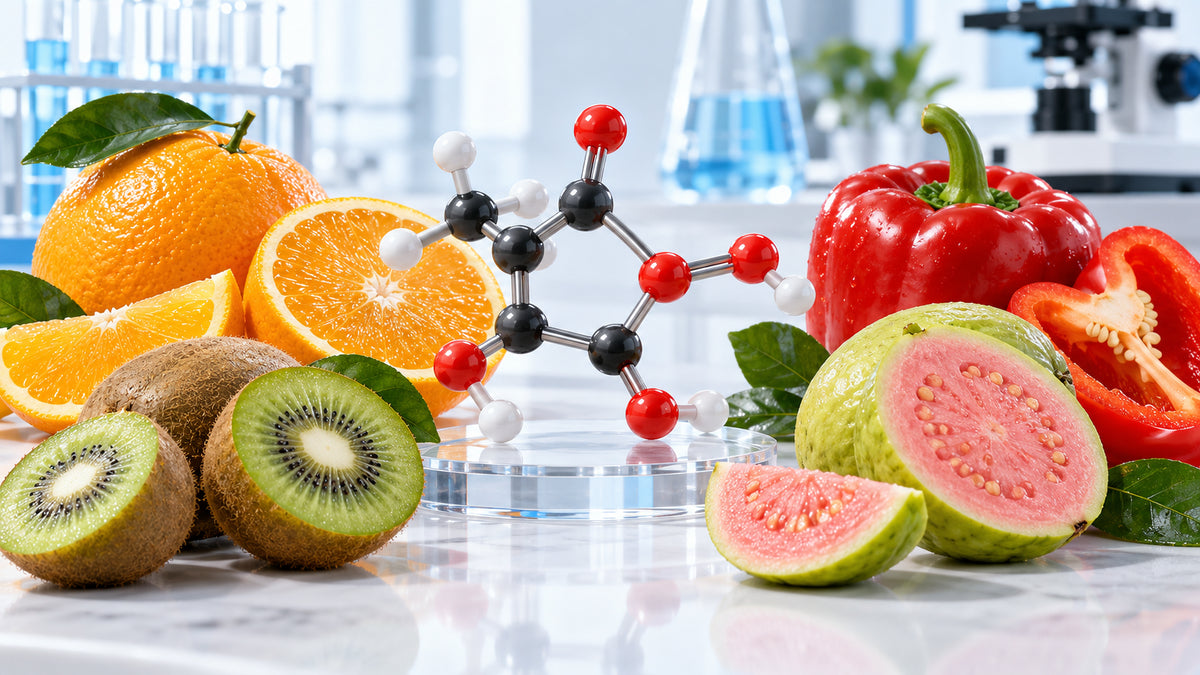
Vitamin C is an essential, water-soluble vitamin that humans must get from food or supplements because the body cannot make it. Chemically it is ascorbic acid, a small antioxidant molecule that also acts as a helper in enzymes that build collagen, make certain neurotransmitters and support immune cells. Citrus fruit, peppers, kiwi and broccoli are rich sources [1].
2. Vitamin C Key Facts
|
Fact |
Detail |
|---|---|
|
Chemical name |
L-ascorbic acid (reduced form) |
|
Formula and molar mass |
C6H8O6; about 176.12 g/mol |
|
CAS number |
50-81-7 |
|
Solubility |
Water-soluble; not meaningfully stored in fat |
|
Essential for humans? |
Yes; humans lack a working gene for its synthesis [7] |
|
US RDA, adults |
90 mg/day for men, 75 mg/day for women; add 35 mg for smokers [2] |
|
Pregnancy / lactation |
85 mg / 120 mg per day for adults [2] |
|
Tolerable upper intake |
2,000 mg/day for adults [2] |
|
Daily Value on US labels |
90 mg [1] |
|
Food additive code |
E300 (ascorbic acid) |
|
Classic deficiency disease |
Scurvy |
3. Scientific and Common Names: Ascorbic Acid and Related Terms
Several names describe the same nutrient, which can confuse shoppers.
- Vitamin C: the general nutritional name, used on most consumer labels.
- L-ascorbic acid: the chemical name of the active form. The L prefix refers to its three-dimensional shape; the D-form has almost no vitamin activity.
- Ascorbate: the negatively charged ion formed when ascorbic acid loses a hydrogen ion. Salts such as sodium ascorbate and calcium ascorbate contain it.
- Dehydroascorbic acid (DHA): the oxidized form that the body can convert back to ascorbic acid. Do not confuse it with the fish-oil fatty acid DHA.
- Antiscorbutic factor: an older term from the era when researchers searched for the substance that prevents scurvy.
- E300, E301, E302: European food-additive codes for ascorbic acid, sodium ascorbate and calcium ascorbate, used as preservatives and antioxidants in foods.
The history helps explain the name. In 1747, Scottish naval surgeon James Lind compared remedies for scurvy among sailors and found that oranges and lemons worked best [12]. Albert Szent-Györgyi isolated the compound in the early 1930s, and in 1933 it was named ascorbic acid, meaning anti-scurvy acid. He received the 1937 Nobel Prize in Physiology or Medicine for related discoveries.
4. Ingredient Category
In nutrition science, the compound belongs to several overlapping groups:
- Vitamin: an organic micronutrient required in small amounts for normal function.
- Water-soluble vitamin: it dissolves in water, circulates in blood, and excess is largely excreted in urine. The body holds only a limited pool, roughly 1.5 to 3 grams at most [1].
- Antioxidant: it donates electrons to neutralize reactive oxygen species and helps regenerate vitamin E [6].
- Enzyme cofactor: it is required by enzymes that hydroxylate proline and lysine in collagen, synthesize carnitine and norepinephrine, and regulate certain oxygen-sensing pathways.
In regulatory terms, it is a dietary ingredient and food additive, not a drug.
5. Natural Source, Plant Part and Nutrient Form
In food, the nutrient occurs mainly as L-ascorbic acid, with a small share as dehydroascorbic acid. It is concentrated in fruits and the fleshy parts of vegetables, and found in smaller amounts in leaves.
Typical food amounts (approximate, from NIH data) [1]
|
Food |
Serving |
Approx. amount |
|---|---|---|
|
Red bell pepper, raw |
half cup |
about 95 mg |
|
Orange |
one medium |
about 70 mg |
|
Kiwi |
one medium |
about 64 mg |
|
Broccoli, cooked |
half cup |
about 51 mg |
|
Strawberries |
half cup |
about 49 mg |
Some lesser-known plant sources are far richer by weight. Acerola cherry, camu camu, rose hips and amla (Indian gooseberry) are used in natural-source powders and traditional foods. Amla is a staple in Ayurvedic preparations and Indian households, often eaten raw, pickled or in chyawanprash.
Because the vitamin is sensitive to heat, light, air and water, prolonged cooking and long storage reduce food content. Steaming or eating raw produce preserves more.
6. Where It Comes From: Plants, Animals and Industry
Plants. They make ascorbic acid from sugars, mainly through a pathway that converts glucose into L-galactose and then into the vitamin. Plants use it for photosynthesis protection and stress defense [8].
Animals. Most animals manufacture it in the liver or kidney using an enzyme called L-gulonolactone oxidase. Humans, other primates, guinea pigs and fruit bats lost a functional copy of that gene during evolution, which is why we depend on diet [7].
Industry. Almost all supplement-grade material is produced commercially. The classic Reichstein process, developed in 1933, converts glucose through sorbitol and sorbose to the final acid. Modern plants often use fermentation steps with bacteria to shorten the chemistry [11]. China is the largest producer.
A common worry is whether synthetic and natural forms differ. The molecule is chemically identical: L-ascorbic acid made from corn glucose is the same compound as that in an orange. Natural-source products may add accompanying plant compounds, but the vitamin itself is not different. Research has not shown a consistent advantage for natural over synthetic forms in healthy adults [1].
7. How a Vitamin C Supplement Is Used
Ascorbic acid appears in supplements and foods in several ways:
- Daily dietary supplementation to cover gaps, typically 100 to 1,000 mg per serving.
- Multivitamin and immune formulas, often paired with zinc, vitamin D or elderberry.
- Fortification of juices, cereals and powdered drinks.
- Cold and flu season use, often as a higher dose taken at the first sign of illness.
- Iron support, since taking it with iron-rich meals or iron tablets improves absorption of non-heme (plant-based) iron [1].
- Food preservation, where it prevents browning and oxidation.
- Clinical use, including treatment of scurvy and intravenous therapy under medical supervision, which is separate from over-the-counter products.
Absorption depends on dose. Intestinal transporters (SVCT1) take up ascorbic acid, and they saturate. At intakes of 30 to 180 mg, about 70% to 90% is absorbed, but at doses above 1 gram absorption falls to under 50% [1]. Blood levels plateau at around 200 to 400 mg daily in healthy people [5], so very large single doses add little and raise the chance of stomach upset. Splitting doses across the day can improve uptake [10].
8. Main Active Constituents
In a basic supplement, the only active constituent is L-ascorbic acid or one of its salts. In the body, three related forms matter:
- Ascorbate, the main form at body pH, which donates electrons.
- Ascorbyl radical, a short-lived intermediate after one electron is donated.
- Dehydroascorbic acid, formed after two electrons are lost, which can be recycled back to ascorbate.
Whole-food and plant-extract products add other compounds, such as flavonoids, carotenoids and polyphenols. Labels sometimes list them as bioflavonoids or a vitamin C complex. These compounds have their own biology, but they are not the vitamin, and evidence that they improve its absorption or effect in humans is limited [1].
9. Why People Research Vitamin C
People search for it for several reasons, and the evidence differs for each.
- Colds and immunity. A Cochrane review found that regular supplementation does not reduce how often most people catch colds, but it modestly shortens duration, by about 8% in adults and 14% in children [4]. In people under heavy physical stress, such as marathon runners and soldiers in cold environments, it roughly halved cold risk. Starting a supplement after symptoms begin showed no consistent benefit. Broader immune roles are real, but they do not translate into a cure [3].
- Collagen, skin and wound healing. The vitamin is essential for collagen formation, which is why deficiency causes bleeding gums, bruising and poor healing.
- Iron absorption. It improves absorption of plant-based iron, useful for vegetarians.
- Antioxidant protection. Blood levels track with fruit and vegetable intake, but trials of high-dose supplements have not shown clear protection against heart disease or cancer [6].
- Eye health. It is a component of the AREDS formula for people at risk of advanced macular degeneration.
- Preventing deficiency. Scurvy is rare in wealthy countries but can occur with very restricted diets, alcohol dependence or smoking.
10. Common Vitamin C Supplement Forms
|
Form |
Description |
Notes |
|---|---|---|
|
Ascorbic acid |
The standard, inexpensive form |
Slightly acidic; may upset sensitive stomachs |
|
Sodium ascorbate |
Buffered mineral salt |
Gentler; contributes sodium |
|
Calcium ascorbate |
Buffered with calcium |
Often marketed as non-acidic |
|
Magnesium, potassium ascorbate |
Other mineral salts |
Niche use |
|
Ester-C and similar |
Calcium ascorbate with metabolites |
Claims of better retention have limited independent support |
|
Liposomal |
Encapsulated in phospholipid spheres |
Small studies suggest higher blood levels, but data are limited |
|
Ascorbyl palmitate |
Fat-soluble ester |
Mainly food and cosmetic antioxidant, not a primary oral source |
|
Formats |
Tablets, capsules, powders, effervescent tablets, chewables, gummies, liquids |
Gummies often contain less than the label suggests; check testing |
For most people, plain ascorbic acid is effective and economical. Buffered forms are reasonable for those who feel stomach discomfort.
11. What It Is Not: Common Confusion
- It is not a cold cure. Evidence supports a small reduction in duration with regular use, not rapid recovery [4].
- It is not the same as citric acid. Citrus fruits contain both, but citric acid is a different compound with no vitamin activity.
- It is not the same as bioflavonoids. These accompany it in plants but are separate substances.
- It is not stored in large amounts. Excess is excreted, so mega-doses do not build a reserve.
- It is not a substitute for fruit and vegetables. Whole foods bring fiber, potassium and other nutrients.
- Natural does not mean stronger. The molecule is identical in food, extract and synthetic form [1].
- Intravenous therapy is not a supplement. It is a medical treatment with different risks and uses.
-
It is not vitamin D or zinc. People often combine them in immune blends, but each has its own role and limits.

12. Safety Note
At dietary intakes, the vitamin is very safe. Supplements are generally well tolerated, with a tolerable upper intake of 2,000 mg per day for adults [2]. Points to know:
- Digestive upset. Doses above 2 grams commonly cause diarrhea, nausea and cramps.
- Kidney stones. In a large Swedish study, men taking supplements had about twice the risk of kidney stones, likely linked to oxalate formed from ascorbic acid [9]. Anyone with a history of oxalate stones should talk to a clinician.
- Iron overload. People with hemochromatosis should avoid high doses, because the vitamin boosts iron absorption.
- G6PD deficiency. Very high intravenous doses can trigger hemolysis in this inherited condition.
- Lab test interference. High doses can distort some glucose meter and stool blood test results.
- Medicines and treatments. Ask your oncologist before using antioxidant supplements during chemotherapy or radiotherapy, and check with a pharmacist if you take blood thinners or aluminum-containing antacids.
- Pregnancy and children. Keep within age-specific upper limits unless a clinician directs otherwise.
Your next step: check the elemental amount on your label, add it to what you eat, and stay well below 2,000 mg unless a clinician recommends more.
13. FAQ
Is vitamin C the same as ascorbic acid?
In practice, yes. Ascorbic acid is the chemical name of the active form, while vitamin C is the nutritional name for it and its closely related forms [1].
Can the body make it?
No. Humans carry a nonfunctional version of the gene needed to make it, so intake from food or supplements is essential [7].
How much do I need per day?
Adult men need 90 mg and adult women 75 mg, with 35 mg more for smokers. Many people reach this from two servings of fruit and a serving of vegetables [2].
Is natural better than synthetic?
Not in terms of the vitamin itself. The molecule is the same, so choose based on tolerance, price and quality testing [1].
Does it prevent colds?
Regular use does not prevent colds in most people, but may slightly shorten them, with a bigger benefit in people under intense physical stress [4].
Can I take too much?
Yes. Above 2,000 mg per day, side effects such as diarrhea become common, and long-term high intake may raise kidney stone risk in susceptible people [2][9].
14. References
- National Institutes of Health, Office of Dietary Supplements. Vitamin C: Fact Sheet for Health Professionals.
- Institute of Medicine. Dietary Reference Intakes for Vitamin C, Vitamin E, Selenium, and Carotenoids. Washington, DC: National Academies Press; 2000.
- Carr AC, Maggini S. Vitamin C and immune function. Nutrients. 2017;9(11):1211.
- Hemilä H, Chalker E. Vitamin C for preventing and treating the common cold. Cochrane Database Syst Rev. 2013;(1):CD000980.
- Levine M, Conry-Cantilena C, Wang Y, et al. Vitamin C pharmacokinetics in healthy volunteers: evidence for a recommended dietary allowance. Proc Natl Acad Sci USA. 1996;93(8):3704-3709.
- Padayatty SJ, Katz A, Wang Y, et al. Vitamin C as an antioxidant: evaluation of its role in disease prevention. J Am Coll Nutr. 2003;22(1):18-35.
- Nishikimi M, Fukuyama R, Minoshima S, Shimizu N, Yagi K. Cloning and chromosomal mapping of the human nonfunctional gene for L-gulono-gamma-lactone oxidase, the enzyme for L-ascorbic acid biosynthesis missing in man. J Biol Chem. 1994;269(18):13685-13688.
- Smirnoff N, Wheeler GL. Ascorbic acid in plants: biosynthesis and function. Crit Rev Biochem Mol Biol. 2000;35(4):291-314.
- Thomas LD, Elinder CG, Tiselius HG, Wolk A, Åkesson A. Ascorbic acid supplements and kidney stone incidence among men: a prospective study. JAMA Intern Med. 2013;173(5):386-388.
- Lykkesfeldt J, Tveden-Nyborg P. The pharmacokinetics of vitamin C. Nutrients. 2019;11(10):2412.
- Pappenberger G, Hohmann HP. Industrial production of L-ascorbic acid (vitamin C) and D-isoascorbic acid. Adv Biochem Eng Biotechnol. 2014;143:143-188.
- Lind J. A Treatise of the Scurvy. Edinburgh: Sands, Murray and Cochran; 1753.
For general information only. Talk to your doctor before starting any supplement.